Abstract art

Description

The chart is an interactive lineage map. Abstract art sits at the center, on a timeline that runs from older movements at the top to newer ones at the bottom. The movements that influenced it appear above it, any parallel movements it developed alongside sit on its own row, and the movements it later influenced appear below. Every line is a real, cited connection between two movements: a solid line is an influence historians broadly agree on, and a dashed line is an indirect, parallel, or contested link.

For Abstract art (c. 1910 – Present), it traces four movements that shaped it, all well-established links: Cubism, Expressionism, Impressionism and Romanticism; it fans out to seven movements it went on to influence, all well-established links: Abstract expressionism, Abstract illusionism, Art Informel, Geometric abstract art, Hurufiyya, Objective abstraction and Suprematism.

Abstract art uses visual language of shape, form, color, and line to create a composition which may exist with a degree of independence from visual references in the world. Abstract art, non-figurative art, non-objective art, and non-representational art are all closely related terms. They have similar, but perhaps not identical, meanings.

Western art had been, from the Renaissance up to the middle of the 19th century, underpinned by the logic of perspective and an attempt to reproduce an illusion of visible reality. By the end of the 19th century, many artists felt a need to create a new kind of art that would encompass the fundamental changes taking place in technology, science, and philosophy. The sources from which individual artists drew their theoretical arguments were diverse and reflected the social and intellectual preoccupations in all areas of Western culture at that time. Read more ↗

Key Artists

Wassily Kandinsky
Pioneer of non-objective painting who authored 'Concerning the Spiritual in Art' (1911), theorizing that abstract colors and forms operate directly upon the human soul like symphonic music.
Hilma af Klint
Visionary Swedish mystic and early proto-abstract master who created monumental, biomorphic, and spiritually guided non-representational paintings years before her male contemporaries.
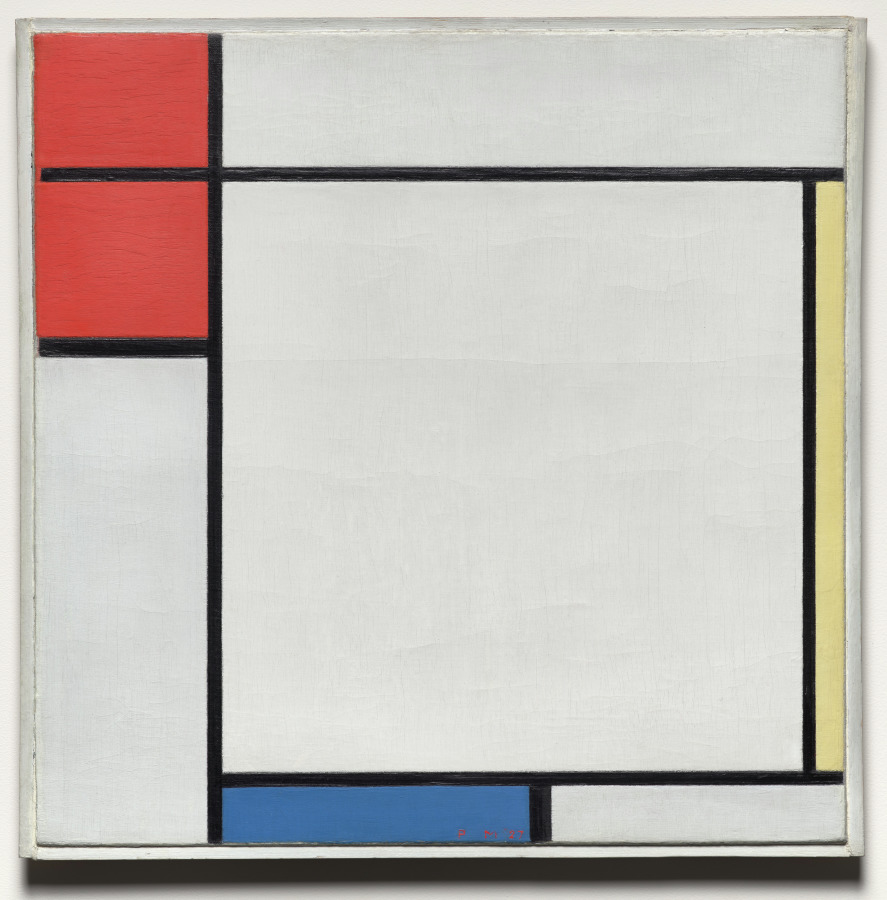
Piet Mondrian
Co-founder of De Stijl who evolved from landscape painting into Neo-plasticism, reducing universal reality to an austere grid of black vertical-horizontal lines and primary colors.
Kazimir Malevich
Founder of Suprematism in 1913 who abandoned natural appearance entirely for pure geometric feeling, creating iconic milestones like the Black Square.
Robert Delaunay
Pioneer of Orphism (Orphic Cubism) alongside Sonia Delaunay, utilizing vibrant, circular concentric discs of pure contrasting colors to create optical light and rhythm.
František Kupka
Czech-born pioneer of pure abstraction in Paris who explored Newton's color discs and musical fugues, transforming vertical planes and cosmic circles into non-objective painting.

Famous Artworks

The Ten Largest, No. 7, Adulthood
Hilma af Klint · 1907
Moderna Museet, Stockholm - Tempera and paper on canvas
Credit: Hilma af Klint (Wikimedia Commons)
Simultaneous Windows (2nd Motif, 1st Part)
Robert Delaunay · 1912
Solomon R. Guggenheim Museum, New York - Oil on canvas
Credit: Robert Delaunay (Wikimedia Commons)
Discs of Newton (Study for 'Fugue in Two Colors')
František Kupka · 1912
Philadelphia Museum of Art - Oil on canvas
Black Square
Black Square
Kazimir Malevich · 1915
State Tretyakov Gallery, Moscow - Oil on linen
Credit: Kazimir Malevich (Wikimedia Commons)
Composition VIII
Composition VIII
Wassily Kandinsky · 1923
Solomon R. Guggenheim Museum, New York - Oil on canvas
Credit: Xyxyzyz (Wikimedia Commons)
Composition with Red, Blue, and Yellow
Piet Mondrian · 1930
Kunsthaus Zürich - Oil on canvas
Credit: Cleveland Museum of Art - Piet Mondrian

Fun Facts

Although Wassily Kandinsky long claimed to have painted the world's very first purely abstract watercolor in 1910, Swedish artist and mystic Hilma af Klint had already secretly completed her monumental abstract series 'Paintings for the Temple' between 1906 and 1908, stipulating in her will that her works should not be publicly exhibited until at least twenty years after her death.
↗ Source: tate.org.uk
When Kazimir Malevich first exhibited his revolutionary 'Black Square' at the '0,10 Last Futurist Exhibition of Paintings' in Petrograd in December 1915, he hung the canvas across the upper top corner of the room - the exact sacred location traditionally reserved for religious Orthodox icons in Russian peasant homes.
↗ Source: tate.org.uk

Shop Abstract art wall art

Explore more