Early Netherlandish painting

Description

Early Netherlandish painting is the body of work by artists active in the Burgundian and Habsburg Netherlands during the 15th- and 16th-century Northern Renaissance period, once known as the Flemish Primitives. It flourished especially in the cities of Bruges, Ghent, Mechelen, Leuven, Tournai and Brussels, all in present-day Belgium. The period begins approximately with Robert Campin and Jan van Eyck in the 1420s and lasts at least until the death of Gerard David in 1523, although many scholars extend it to the beginning of the Dutch Revolt in 1566 or 1568 – Max J. Friedländer's acclaimed surveys run through Pieter Bruegel the Elder. Early Netherlandish painting coincides with the Early and High Italian Renaissance, but the early period (until about 1500) is seen as an independent artistic evolution, separate from the Renaissance humanism that characterised developments in Italy. Read more ↗

Key Artists

Jan van Eyck
Supreme master of Early Netherlandish painting who perfected the oil medium, achieving unprecedented optical precision, luminous glazing, and disguised symbolism.
Rogier van der Weyden
Influential Brussels city painter whose intense emotional pathos, sculptural relief compositions, and gentle linearity moved viewers across all of Europe.
Robert Campin (Master of Flémalle)
Founding father of the Flemish school in Tournai who broke from International Gothic gold backgrounds to set religious scenes inside realistic bourgeois Flemish homes.
Hans Memling
Leading master of late 15th-century Bruges who harmonized Van der Weyden's piety with Van Eyck's detail into serene altarpieces and refined domestic portraits.
Hieronymus Bosch
Visionary master of s-Hertogenbosch who utilized Netherlandish oil technique to create complex moralizing triptychs filled with fantastic, surrealistic imagery.
Hugo van der Goes
Ghent master of psychological realism and dramatic scale whose monumental Portinari Altarpiece stunned Florentine painters when shipped to Italy in 1483.

Famous Artworks

The Ghent Altarpiece (The Adoration of the Mystic Lamb)
Hubert and Jan van Eyck · 1432
St. Bavo's Cathedral, Ghent, Belgium - Oil on oak polyptych
Credit: Jan van Eyck / Presumably Hubert van Eyck (Wikimedia Commons)
The Arnolfini Portrait
Jan van Eyck · 1434
National Gallery, London - Oil on oak panel
Credit: Jan van Eyck (Wikimedia Commons)
The Descent from the Cross (The Deposition)
Rogier van der Weyden · 1435
Museo del Prado, Madrid - Oil on oak panel
Credit: Rogier van der Weyden (Wikimedia Commons)
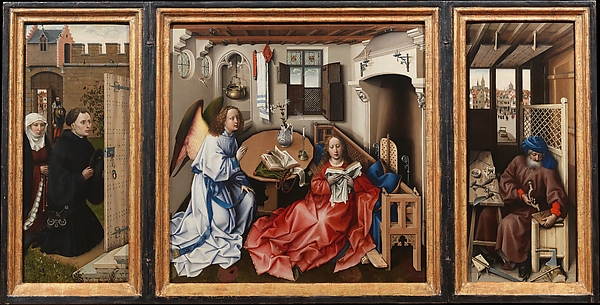
The Mérode Altarpiece (Annunciation Triptych)
Robert Campin (Workshop) · 1428
Metropolitan Museum of Art (The Cloisters), New York - Oil on oak triptych
Credit: Metropolitan Museum of Art, New York, NY - Robert Campin
The Garden of Earthly Delights
Hieronymus Bosch · 1505
Museo del Prado, Madrid - Oil on oak triptych
Credit: Hieronymus Bosch (Wikimedia Commons)
The Portinari Altarpiece
Hugo van der Goes · 1476
Uffizi Gallery, Florence - Oil on wood triptych

Fun Facts

While 16th-century Italian artist Giorgio Vasari erroneously credited Jan van Eyck with literally 'inventing' oil paint from scratch, Van Eyck actually perfected existing oil binder formulas with fast-drying driers to achieve unprecedented translucent glazes.
↗ Source: britannica.com
In Jan van Eyck's Arnolfini Portrait, the artist painted a microscopic convex mirror on the back wall that reflects not only the backs of the couple but also two tiny figures stepping into the room, one of whom is believed to be Van Eyck himself.
↗ Source: britannica.com

Shop