Plein Air

Description

En plein air (pronounced [ɑ̃ plɛ.n‿ɛʁ]; French for 'outdoors'), or plein-air painting, is the act of painting outdoors.

This method contrasts with studio painting or academic rules that might create a predetermined look. The theory of 'En plein air' painting is credited to Pierre-Henri de Valenciennes (1750–1819), first expounded in a treatise titled Reflections and Advice to a Student on Painting, Particularly on Landscape (1800), where he developed the concept of landscape portraiture by which the artist paints directly onto canvas in situ within the landscape. Read more ↗
Key Artists

Pierre-Henri de Valenciennes
Pioneering French theorist and landscape painter whose influential 1800 treatise advocated painting oil sketches directly outdoors in nature to capture transient light.
Charles-François Daubigny
Leading figure of the Barbizon school who famously converted a studio boat ('Le Botin') to paint river landscapes en plein air directly from the water.
Claude Monet
The most dedicated champion of en plein air painting, spending decades outdoors painting series of haystacks, poplars, and water lilies across shifting atmospheric conditions.
Camille Pissarro
Core Impressionist master who painted rustic French landscapes and village fields en plein air, teaching younger artists like Cézanne to paint directly from nature.
John Singer Sargent
American expatriate virtuoso who practiced brilliant en plein air painting alongside Monet in Giverny and created dazzling outdoor watercolors across Europe and the Middle East.
Théodore Rousseau
Central founder of the Barbizon school who rejected academic studio formulas to live and paint inside the Forest of Fontainebleau directly observing ancient oak trees and weather.

Famous Artworks

Claude Monet Painting by the Edge of a Wood
John Singer Sargent · 1885
Tate Britain, London - Oil on canvas
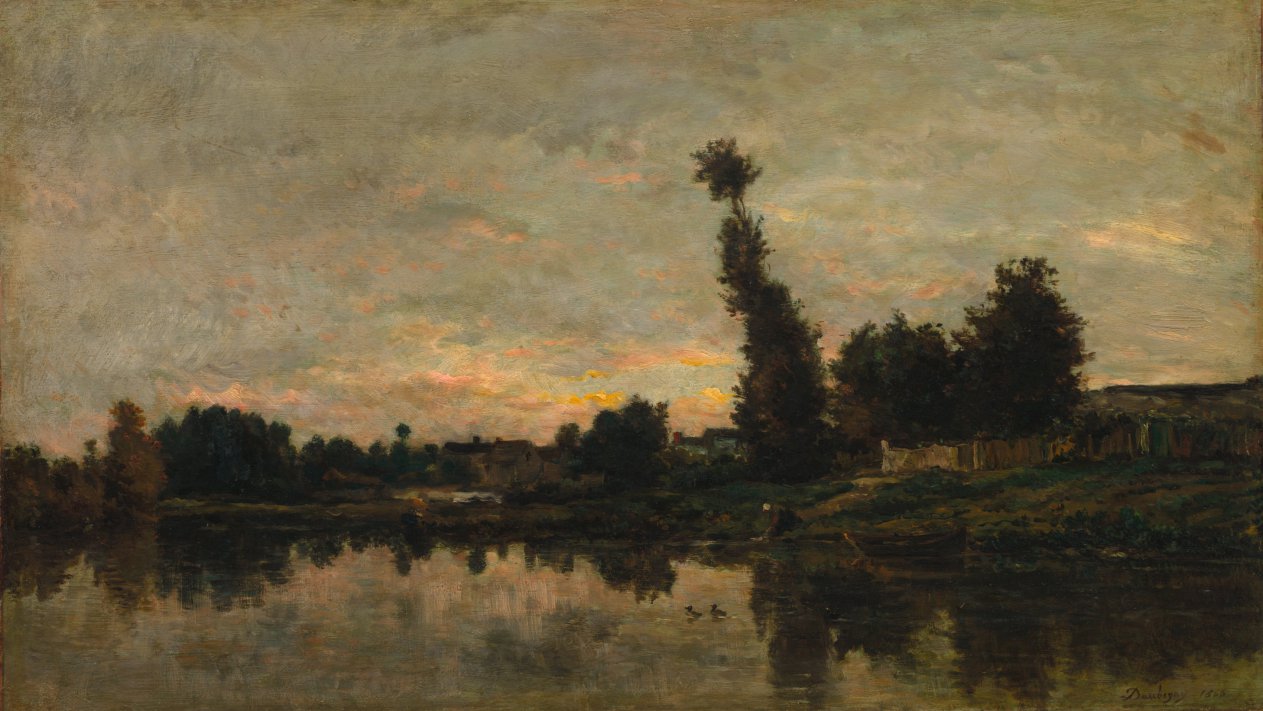
Sunset on the Oise
Sunset on the Oise
Charles-François Daubigny · 1865
Musée du Louvre, Paris - Oil on wood panel
Credit: Cleveland Museum of Art - Charles François Daubigny
The Forest of Fontainebleau: Morning
Théodore Rousseau · 1850
Wallace Collection, London - Oil on canvas
Credit: Théodore Rousseau (Wikimedia Commons)
Haystacks (Effect of Snow and Sun)
Claude Monet · 1891
Metropolitan Museum of Art, New York - Oil on canvas
Credit: Claude Monet (Wikimedia Commons)
The Hoar Frost
The Hoar Frost
Camille Pissarro · 1873
Musée d'Orsay, Paris - Oil on canvas
Credit: Camille Pissarro (Wikimedia Commons)

Fun Facts

The widespread rise of en plein air painting in the mid-nineteenth century was directly enabled by the invention of the collapsible tin paint tube in 1841 by American portraitist John G. Rand, which allowed artists to easily carry premixed oil colors into the wilderness without them drying out.
↗ Source: en.wikipedia.org
To capture landscape perspectives that were impossible from riverbanks, Barbizon painter Charles-François Daubigny built a floating studio boat nicknamed 'Le Botin' (The Little Box), rowing down the Seine and Oise rivers to paint right on the water.
↗ Source: en.wikipedia.org

Shop