Description
The chart is an interactive lineage map. Pointillism sits at the center, on a timeline that runs from older movements at the top to newer ones at the bottom. The movements that influenced it appear above it, any parallel movements it developed alongside sit on its own row, and the movements it later influenced appear below. Every line is a real, cited connection between two movements: a solid line is an influence historians broadly agree on, and a dashed line is an indirect, parallel, or contested link.
For Pointillism (c. 1886 – 1900), it traces one movement that shaped it, a well-established link: Impressionism; it runs alongside one parallel movement, a well-established link: Post-Impressionism; it fans out to two movements it went on to influence, all well-established links: Fauvism and Kinetic Pointillism.
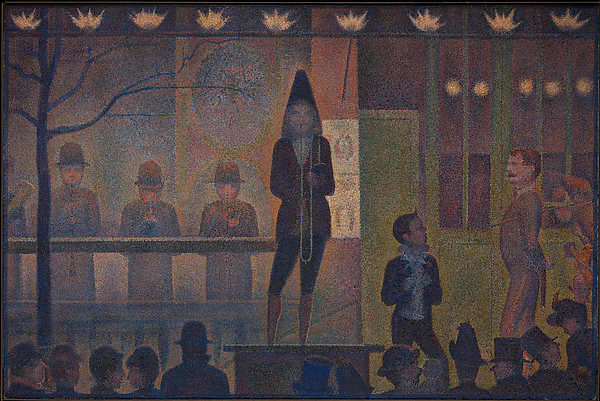
Pointillism (/ˈpwæ̃tɪlɪzəm/, also US: /ˈpwɑːn-ˌ ˈpɔɪn-/) is a technique of painting in which small, distinct dots of color are applied in patterns to form an image.
Georges Seurat and Paul Signac developed the technique in 1886, branching from Impressionism. The term "Pointillism" was coined by art critics in the late 1880s to ridicule the works of these artists, but is now used without its earlier pejorative connotation. The movement Seurat began with this technique is known as Neo-impressionism. The Divisionists used a similar technique of patterns to form images, though with larger cube-like brushstrokes. Read more ↗
Key Artists
Famous Artworks

_-_BF811_-_Barnes_Foundation.jpg)