Ukiyo-e

Description

Ukiyo-e (浮世絵) is a genre of Japanese art that flourished from the 17th through 19th centuries. Its artists produced woodblock prints and paintings of such subjects as female beauties; kabuki actors and sumo wrestlers; scenes from history and folk tales; travel scenes and landscapes; flora and fauna; and erotica. The term ukiyo-e (浮世絵) translates as "picture[s] of the floating world". Read more ↗

Key Artists

Hishikawa Moronobu
Accredited as the first great master of ukiyo-e who consolidated the genre in the late 17th century with single-sheet monochrome woodblock prints of beautiful women and Edo street scenes.
Suzuki Harunobu
Pioneered nishiki-e (full-color 'brocade prints') in 1765 using multiple woodblocks, revolutionizing ukiyo-e with delicate, lyrical portrayals of youthful beauties.
Torii Kiyonaga
Leading master of the Torii school during the 1780s peak, celebrated for tall, statuesque courtesan figures and multi-sheet diptychs and triptychs of outdoor gatherings.
Kitagawa Utamaro
Master of bijin-ga (pictures of beautiful women) who popularized okubi-e (large-headed portraits) capturing subtle psychological nuances and sensual expressions.
Tōshūsai Sharaku
Enigmatic master active only for ten months in 1794–1795, producing striking, intensely psychological kabuki actor portraits that broke with conventional idealization.
Katsushika Hokusai
Globally celebrated master whose monumental series 'Thirty-Six Views of Mount Fuji' elevated landscape from a background element to the primary subject of ukiyo-e.
Utagawa Hiroshige
Celebrated poet of landscape ukiyo-e whose series 'The Fifty-Three Stations of the Tōkaidō' captured atmospheric changes of rain, mist, and snow across travel routes.
Utagawa Kuniyoshi
Late Edo master known for dramatic, dynamic warrior prints (musha-e), mythical sea monsters, spectral skeletons, and subversive political satire.

Famous Artworks

Beauty Looking Back (Mikaeri Bijin-zu)
Hishikawa Moronobu · 1690
Tokyo National Museum - Hanging scroll, color on silk (Important Cultural Property)
Young Lovers Walking Together under an Umbrella in a Snowstorm (Crow and Heron)
Suzuki Harunobu · 1767
Metropolitan Museum of Art, New York / Museum of Fine Arts, Boston - Polychrome woodblock print (nishiki-e)
Three Beauties of the Present Day (Kansei Sanbijin)
Kitagawa Utamaro · 1793
Tokyo National Museum / Museum of Fine Arts, Boston - Polychrome woodblock print
Credit: Kitagawa Utamaro (Wikimedia Commons)
The Actor Ōtani Oniji III as Edogawa Shirōshi (Yakko Edobei)
Tōshūsai Sharaku · 1794
Metropolitan Museum of Art, New York / Tokyo National Museum - Polychrome woodblock print with dark mica background
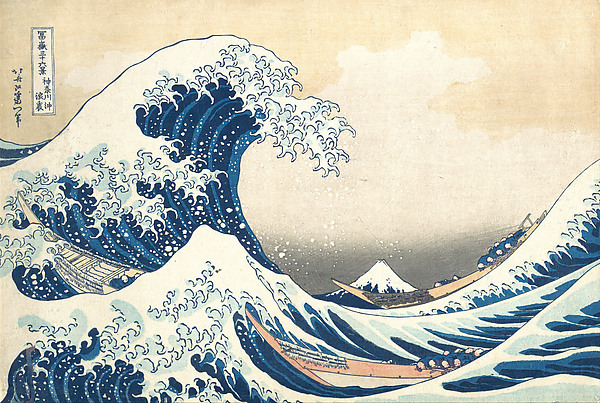
Under the Wave off Kanagawa (The Great Wave)
Katsushika Hokusai · 1831
Metropolitan Museum of Art, New York / Tokyo National Museum - Polychrome woodblock print
Credit: Metropolitan Museum of Art, New York, NY - Katsushika Hokusai
Morning View of Nihonbashi
Utagawa Hiroshige · 1833
Art Institute of Chicago / Met Collection - Polychrome woodblock print
Takiyasha the Witch and the Skeleton Spectre
Utagawa Kuniyoshi · 1844
Victoria and Albert Museum, London / Various - Woodblock print triptych
Credit: Wikimedia Commons

Fun Facts

The term 'ukiyo-e' literally translates to 'pictures of the floating world'; originally, in Buddhist terminology, 'ukiyo' referred to the sorrowful, ephemeral earthly world, but during Edo's economic boom, commoners homophonically adapted the kanji to mean a joyful, floating world of urban pleasure.
↗ Source: en.wikipedia.org
Traditional ukiyo-e prints were never produced by a single artist working alone; instead, they required a strict four-party collaborative quartet (the 'ukiyo-e quartet') consisting of the publisher who financed and directed the project, the artist who drew the design, the master carver who cut the cherry woodblocks, and the printer who inked and pressed the paper.
↗ Source: en.wikipedia.org

Shop