

Rococo wanted to invite you to a garden party; Romanticism wanted to drown you in a storm.
If you have ever stood in front of a painting and felt a sudden, terrifying sense of your own insignificance against the crushing weight of the natural world, you were looking at Romanticism. It is a movement defined not by a single technique, but by a specific, intense emotional frequency. The artists who drove it didn't just want to show you a landscape. They wanted to show you the terrifying, beautiful truth of what it feels like to be alive and helpless inside it.
To truly understand how to identify the Romanticism art style, you have to look at what it was running away from.
The Powdered Wig and the Storm: Romanticism vs. Rococo
Imagine the mid-18th century. The French aristocracy is commissioning paintings of themselves swinging on velvet ropes, dressed in pastel silks, surrounded by manicured, impossibly perfectly trimmed gardens. This was Rococo. It was light, flirtatious, artificial, and safe. The colors were soft pinks, mint greens, and powdery blues. The brushwork was delicate, rendering silks and feathers with painstaking precision. It was art designed for palace walls, meant to compliment the wallpaper and offend no one.
Take Jean-Honoré Fragonard's The Swing (1767). It is the absolute peak of Rococo. A young woman kicks off her shoe playfully into the soft, glowing foliage while her lover watches from the bushes. The light is soft, the trees act as a stage curtain, and the entire scene is drenched in theatrical, frivolous luxury.

The Swing by Jean-Honoré Fragonard (Public Domain, Wikimedia Commons)
By the turn of the 19th century, the world had changed. The French Revolution had spilled blood in the streets, and the Industrial Revolution was choking the skies with black smoke. A group of artists looked at the powdered wigs and pastel gardens of Rococo and decided they were fundamentally dishonest. They didn't want the manicured garden anymore. They wanted the wild, untamable forest. They wanted the sublime.
This is your first rule for identifying Romanticism: if the nature in the painting looks like it could kill you, it's probably Romanticism.
How to Read the Canvas: The Signatures of Romanticism
When you are looking at a piece of wall art for your own home, knowing the visual language of Romanticism helps you understand the mood it will project into the room. Here is what you are actually looking for.
1. The Tyranny of the Sky and the Sublime Nature
In a Romantic painting, the sky is rarely a calm backdrop. It is an active participant in the violence of the scene. You will see churning, muscular clouds, violent storms, and dramatic, unnatural sunsets. The landscape is not a stage for human actors; the landscape is the main character.
This concept is called the "sublime": a mixture of awe and terror experienced when confronting something infinitely larger and more powerful than yourself. Where Rococo gave us pleasant parks, Romanticism gives us avalanches, shipwrecks, and bottomless chasms.
Look at J.M.W. Turner. He is the master of the atmospheric storm. In The Fighting Temeraire (1839), the sky is a blazing, violent furnace of oranges and crimsons, swallowing the old warship as it is towed to its death by a small, dirty, modern steam tug. The paint is thick (impasto), the colors are aggressive, and the emotion is pure, unfiltered nostalgia and awe. This makes pieces inspired by him incredible additions to any sea and ocean wall art collection.

The Fighting Temeraire by J.M.W. Turner (Public Domain, Wikimedia Commons)
2. The Lone, Insignificant Figure
Rococo was about the social group. The party, the lovers, the aristocracy. Romanticism is profoundly lonely.
If there is a human figure in a Romantic landscape, they are almost always small, solitary, and turned away from the viewer. This technique, called the Rückenfigur (figure from the back), was perfected by the German artist Caspar David Friedrich. By placing a lone figure with their back to us, Friedrich forces us to look at what they are looking at. We adopt their isolation and their awe.
You can see this most famously in Friedrich's Wanderer above the Sea of Fog (1818). The man stands on a rocky precipice, gazing out over a terrifying, impenetrable expanse of thick fog and jagged peaks. We know nothing about him. We only know the vast, chilling scale of the world he is confronting.
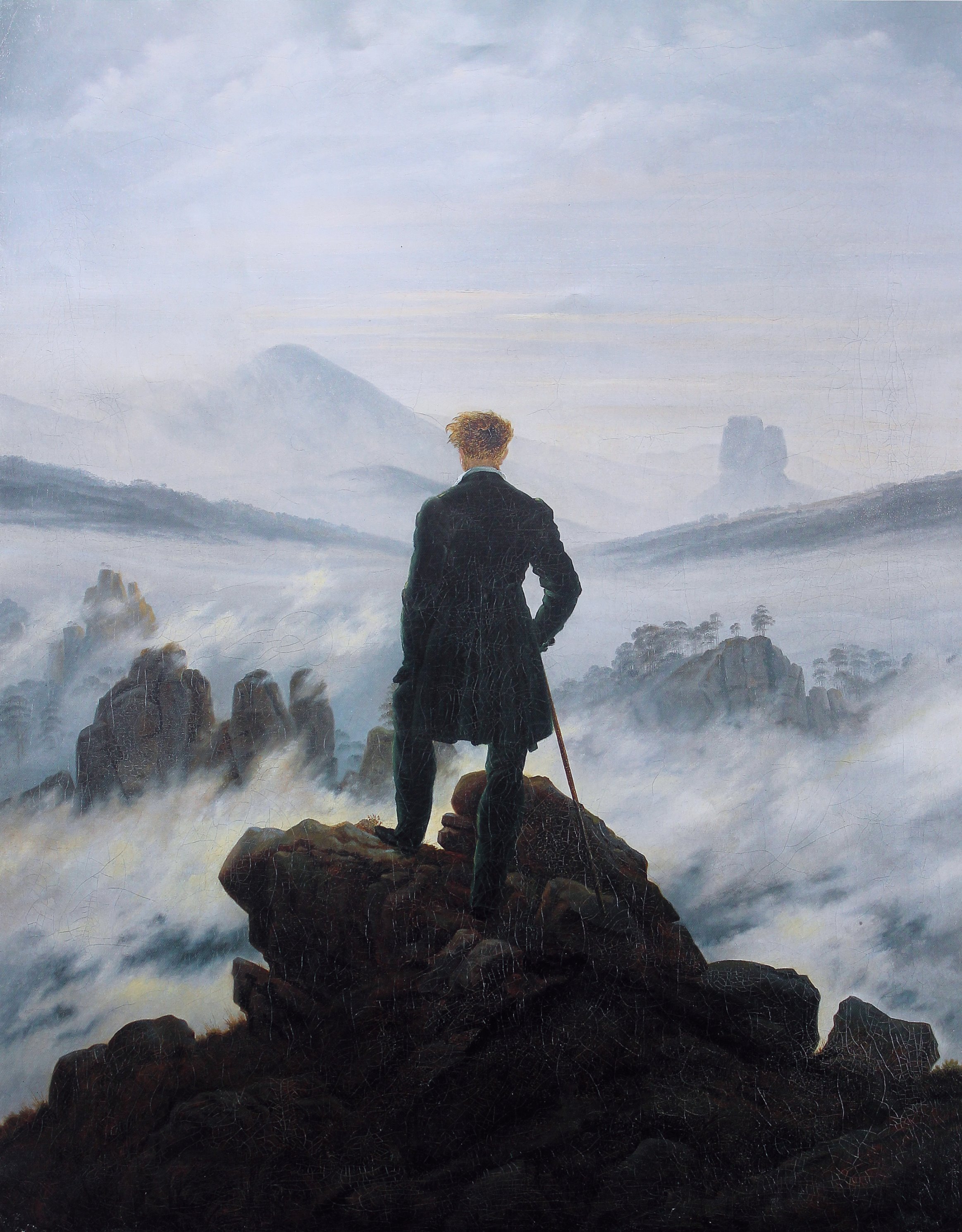
Wanderer above the Sea of Fog by Caspar David Friedrich (Public Domain, Wikimedia Commons)
3. The Deep Shadow and the Chiaroscuro
Romanticism thrives in the dark. While Rococo artists sought even, flattering lighting, Romantic artists leaned heavily into heavy shadow and sharp contrast, a technique known as chiaroscuro. This intense interplay of light and dark heightens the drama, making the scene feel unstable and deeply emotional.
Spanish artist Francisco Goya utilized this to devastating effect. Goya's Romanticism wasn't just about landscapes; it was about the dark, terrifying depths of the human psyche. His later works are drenched in shadow, using light only to illuminate violence, fear, or madness, completely stripping away the polite veneer of society to show the monsters underneath.
Bringing the Storm Inside
So why do we still hang these turbulent, moody pieces on our walls today? Because sometimes, you do not want your home to just be a polite, pastel garden. You want a room that has gravity. A large abstract wall art piece that channels these Romantic principles (deep shadows, thick brushwork, an undeniable sense of scale) can anchor a room instantly.
If you have a north-facing room with limited light, leaning into the moody drama of a Romantic-inspired piece with dark frames and rich, saturated colors can make the space feel intentionally cozy and theatrical, rather than just dim.
Romanticism asked us to stop pretending everything was fine, and to instead acknowledge the terrifying beauty of the storm. The next time you look at a painting, check the sky. If it looks like it's about to break open and swallow you whole, you have found the Romantics.


