

Pablo Picasso created over 50,000 artworks during his 80-year career. He didn't just paint one way; he constantly reinvented his style, moving from somber blue portraits to fragmented geometry and eventually to incredibly simple continuous line sketches.
Because he worked in so many distinct styles, there is a piece of his art that fits almost any interior space. The trick is matching the era of his work to the atmosphere you want to build in a room.
If you're considering adding some of his genius to your walls, start by understanding his three most home-friendly eras: the line drawings, Cubism, and the Blue and Rose periods. Each brings a completely different energy to a space.
The Minimalist Line Drawings
Some of Picasso's most popular works today are the animal sketches he did late in his life, using a single, continuous line.
He drew dogs, camels, and flamingos with just a flick of the wrist. These sketches strip away all the complexity of his earlier work, leaving only the pure essence of the subject. They are brilliant studies in restraint.
Because they are so visually quiet, these simple sketches are incredibly versatile. They work beautifully in Scandinavian or Japandi interiors where negative space is celebrated, making them a staple of minimalism wall art. A small framed print of his famous Dachshund ("Lump") adds a touch of sophistication to a modern nursery or a narrow hallway. If you want art that feels intelligent but doesn't dominate the room, start here.
- Perfect for: Hallways, bathrooms, minimal bedrooms
- Frame style: Thin black metal or light ash wood
- Vibe: Understated, clever, calm
Cubism: Adding Geometric Energy
If the line drawings are quiet, Cubism is loud. Co-founded by Picasso around 1907, this movement shattered the rules of perspective.
Instead of painting a subject from one angle, he painted it from multiple angles at once, breaking faces and objects into sharp, geometric planes that serve as the foundation for modern geometric abstract art. Works like The Weeping Woman or Girl before a Mirror use intense, contrasting colors to heighten the drama.

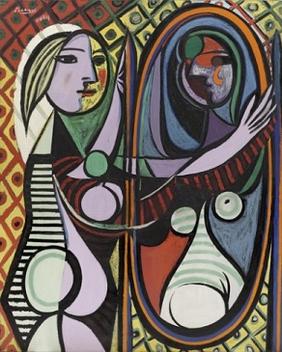
In a home, cubism art prints are high-energy statement pieces. They demand attention. If you have a living room with mid-century modern furniture and solid colors, a large Cubist print will instantly anchor the space. The sharp angles and bright hues of his mid-career portraits provide exactly the kind of visual tension that brings a plain white wall to life. To learn more about his incredible legacy, you can read about Pablo Picasso on Wikipedia.
- Perfect for: Living rooms, dining rooms, home offices
- Frame style: Bold black or ornate vintage frames for contrast
- Vibe: Energetic, bold, intellectual
The Blue and Rose Periods: Decorating with Mood
Before he broke forms apart in Cubism, Picasso went through distinct color phases. The Blue Period (1901-1904) was defined by somber, cool tones: indigo, cerulean, and icy greys. The Rose Period (1904-1906) shifted to warm terracotta, pink, and ochre.
These periods are masterclasses in color psychology. The Blue Period works are contemplative and melancholic. They fit perfectly in spaces where you want quiet reflection, like a reading nook or a private study. The cooler tones pair naturally with deep navy walls or cool grey upholstery.
The Rose Period works, featuring circus performers and acrobats, bring a softer, warmer energy. The earthy pinks and oranges work beautifully in rooms with warm wood tones, leather furniture, and brass accents. When you hang a piece from these eras, you are hanging a concentrated dose of color.
How to Mix Picasso with Other Art
You don't need to dedicate an entire wall to just one artist. His work plays exceptionally well with others.
If you're building a gallery wall, a Picasso line drawing acts as a great palate cleanser next to heavy, colorful abstract art. The white space gives the eye a place to rest. Conversely, a bold Cubist print should be treated as the anchor of a wall, so build your other, quieter pieces around it so they don't compete for attention.
The beauty of his catalog is its sheer variety. You can hang a somber blue portrait in the study and a playful line drawing in the kitchen, and both will feel completely intentional.
Find the era that speaks to your space. A brilliant piece of art should make your room feel more like you.
Join our newsletter for weekly design inspiration and early access to new releases.
Frequently Asked Questions
What makes Pablo Picasso's line drawings so special?
His line drawings capture the complete essence of an animal or subject using a single, unbroken stroke. This technique requires incredible mastery of form, resulting in art that feels both simple and brilliant.
Where is the best place to hang a Cubist art print?
Cubist prints are energetic statement pieces, making them ideal for high-traffic areas like living rooms or dining spaces. They work best on a large, open wall where their bold colors and geometric shapes can serve as the room's focal point.
Can I mix Picasso's different styles in one room?
Yes, but it requires balance. A bold Cubist painting pairs surprisingly well with his minimalist line drawings, as the negative space in the sketch gives the eye a break from the intense colors of the Cubist work.
What frame works best for a Picasso print?
For his continuous line drawings, use thin, minimalist frames in black or natural wood to let the art breathe. For his colorful Cubist or Blue Period works, you can use thicker, bolder frames to contain the intense visual energy.
Why are the Blue and Rose periods important for interior design?
These periods are defined by dominant, monochromatic color palettes. The cool indigo tones of the Blue Period create a calm, reflective mood, while the terracotta and pink hues of the Rose Period add warmth and soft energy to a space.


0 comments