Realism

Description

In art, realism is generally the attempt to represent subject-matter truthfully, without artificiality, exaggeration, or speculative or supernatural elements. The term is often used interchangeably with naturalism, although these terms are not necessarily synonymous. Naturalism, as an idea relating to visual representation in Western art, seeks to depict objects with the least possible amount of distortion and is tied to the development of linear perspective and illusionism in Renaissance Europe. Realism, while predicated upon naturalistic representation and a departure from the idealization of earlier academic art, often refers to a specific art historical movement that originated in France in the aftermath of the French Revolution of 1848. Read more ↗

Key Artists

Gustave Courbet
The fearless, self-proclaimed founder and radical champion of French Realism who declared he could not paint an angel because he had never seen one.
Honoré Daumier
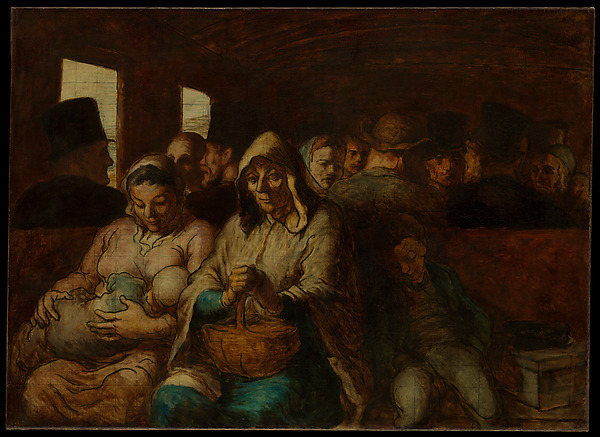
Master painter and satirical printmaker whose biting caricatures and empathetic oil paintings exposed the grim struggles of the working class and hypocrisy of the bourgeois elites.
Jean-François Millet
Key figure of rural realism whose solemn peasant paintings bridged the forest naturalism of Barbizon and the gritty socio-political focus of Realism.
Rosa Bonheur
The most celebrated female painter of the nineteenth century whose rigorous anatomical observation and monumental animal compositions earned international glory.
Édouard Manet
Pioneering modernist whose unflinching 1860s realist depictions of urban Parisian life, prostitutes, and street singers stripped away academic mythology and launched avant-garde painting.
Adolf von Menzel
Foremost German Realist master noted for sharp observation of modern industrial factories, royal court ceremonies, and urban life with unprecedented technical virtuosity.

Famous Artworks

The Stone Breakers
The Stone Breakers
Gustave Courbet · 1849
Formerly Gemäldegalerie, Dresden (Destroyed in WWII) - Oil on canvas
Credit: Gustave Courbet (Wikimedia Commons)
A Burial at Ornans
A Burial at Ornans
Gustave Courbet · 1850
Musée d'Orsay, Paris - Oil on canvas
Credit: Gustave Courbet (Wikimedia Commons)
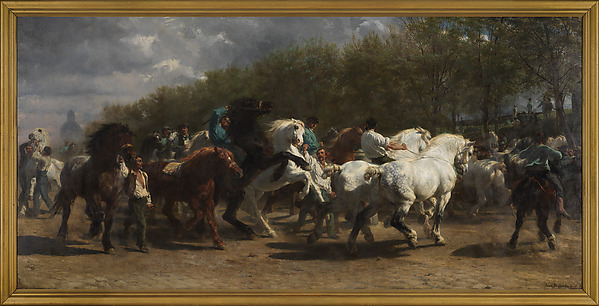
The Horse Fair
The Horse Fair
Rosa Bonheur · 1853
Metropolitan Museum of Art, New York - Oil on canvas
Credit: Metropolitan Museum of Art, New York, NY - Rosa Bonheur
The Angelus
The Angelus
Jean-François Millet · 1859
Musée d'Orsay, Paris - Oil on canvas
Credit: Jean-François Millet (Wikimedia Commons)
The Third-Class Carriage
Honoré Daumier · 1863
Metropolitan Museum of Art, New York - Oil on canvas
Credit: Metropolitan Museum of Art, New York, NY - Honoré Daumier
The Iron Rolling Mill (Modern Cyclops)
Adolf von Menzel · 1875
Alte Nationalgalerie, Berlin - Oil on canvas

Fun Facts

When the Universal Exposition of 1855 rejected his major masterpieces, Gustave Courbet erected his own private temporary building nearby named 'The Pavilion of Realism', staging the first independent artist solo exhibition in history.
↗ Source: metmuseum.org
To make sketches undisturbed among rowdy male horse traders and slaughterhouse workers for 'The Horse Fair', Rosa Bonheur had to obtain official police permission ('permission de travestissement') from the Paris Prefecture to wear men's trousers.
↗ Source: metmuseum.org

Shop Realism wall art

Explore more