On the morning of Monday, 12 October 1654, around 10:15, Cornelis Soetens unlocked the subterranean vault of the former Poor Clares convent in the Doelenkwartier district of Delft. The facility, known officially as 't Secreet van Hollandt, held roughly ninety thousand Amsterdam pounds (about forty tonnes) of black gunpowder packed into wooden casks. Soetens had walked down the steps with a lantern to collect a small sample of powder for a prospective buyer. A stray spark touched an open grain.
The shockwave from forty tonnes of exploding black powder shattered every church window across the city; it sheared the roofs off five hundred brick townhouses, uprooted entire roadside orchards, flattened a quarter of Delft into a smoking crater, and hurled pulverized masonry directly through the Doelenstraat studio where thirty-two-year-old Carel Fabritius stood before his easel.
The sound travelled across the province of Holland and was recorded on the island of Texel, one hundred and fifty kilometres to the north. In Delft, a quarter of the city ceased to exist within seconds. Between one and two hundred townspeople were killed on the spot, and several thousand were pulled wounded from collapsed cellars and smoking rubble.
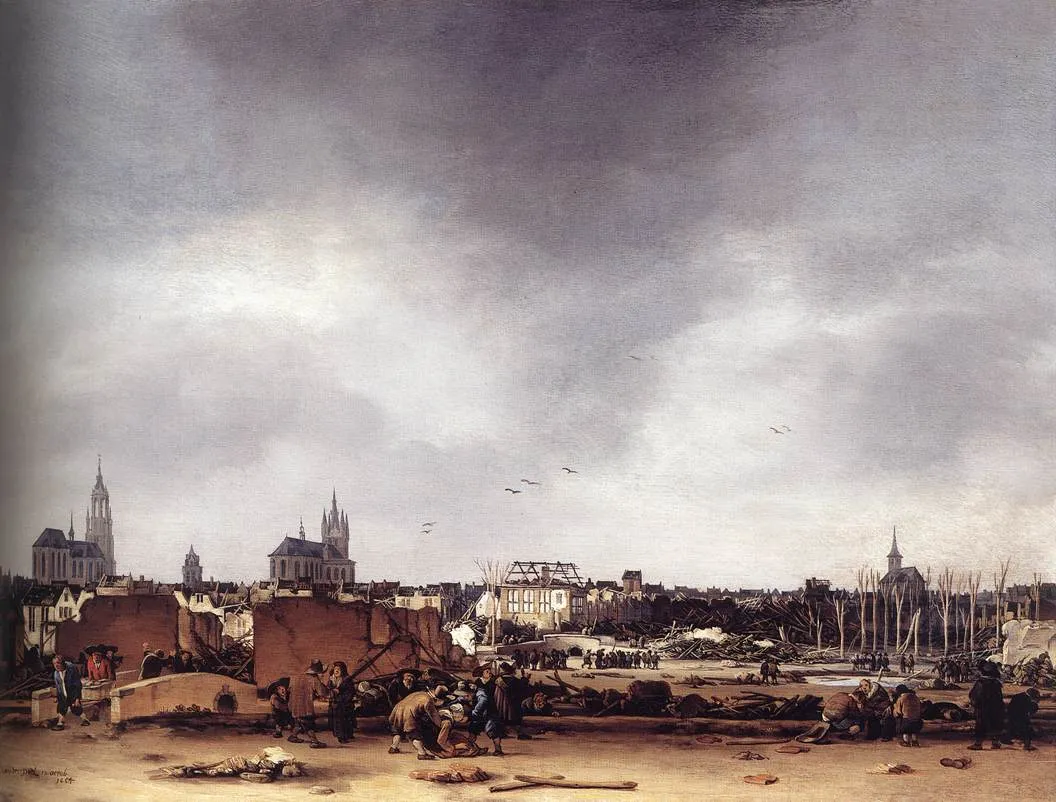
Fabritius worked on the Doelenstraat, direct in the blast path. According to the biographer Arnold Houbraken in De groote schouburgh (1718), Fabritius was in the middle of painting a commissioned portrait of Simon Decker, the former deacon of the Oude Kerk, with his pupil Mattias Spoors standing nearby. When the shockwave arrived, the house fell inward on all three men. Rescuers dug Fabritius out alive after several hours under the beams, but he died shortly after arrival at the city hospital, the Oude Gasthuis. Decker and Spoors were dead under the bricks.
The disaster erased nearly every canvas Fabritius had produced since leaving Rembrandt's studio in Amsterdam, where he had trained around the completion of Rembrandt's Night Watch before establishing his independent practice. Within the history of Dutch Golden Age art, few accidents were as artistically devastating. Fellow Delft painter Egbert van der Poel, who buried his own daughter in the days following the blast, left the town and painted more than twenty separate views of the smoking crater where the Doelenkwartier had stood.
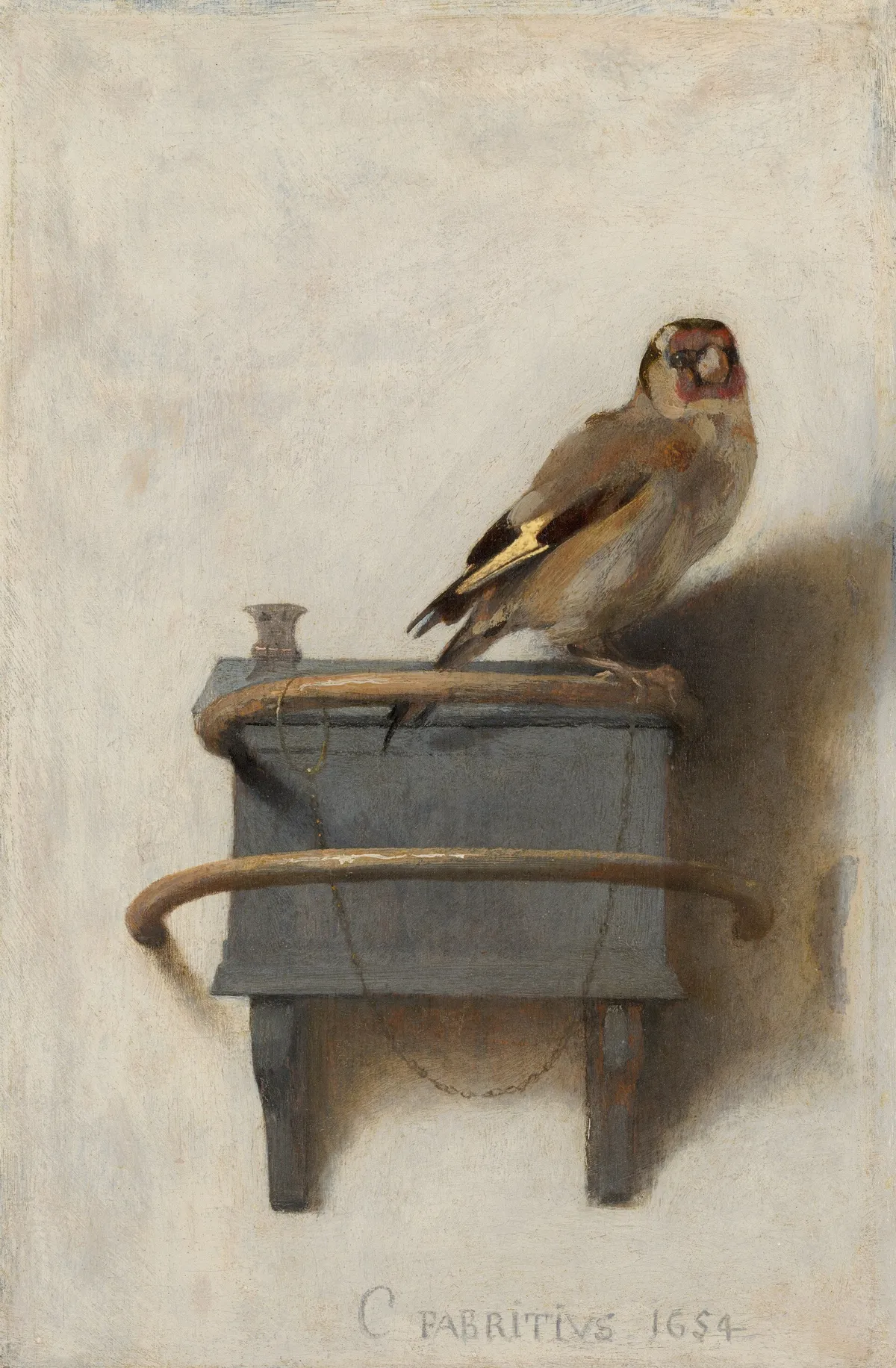
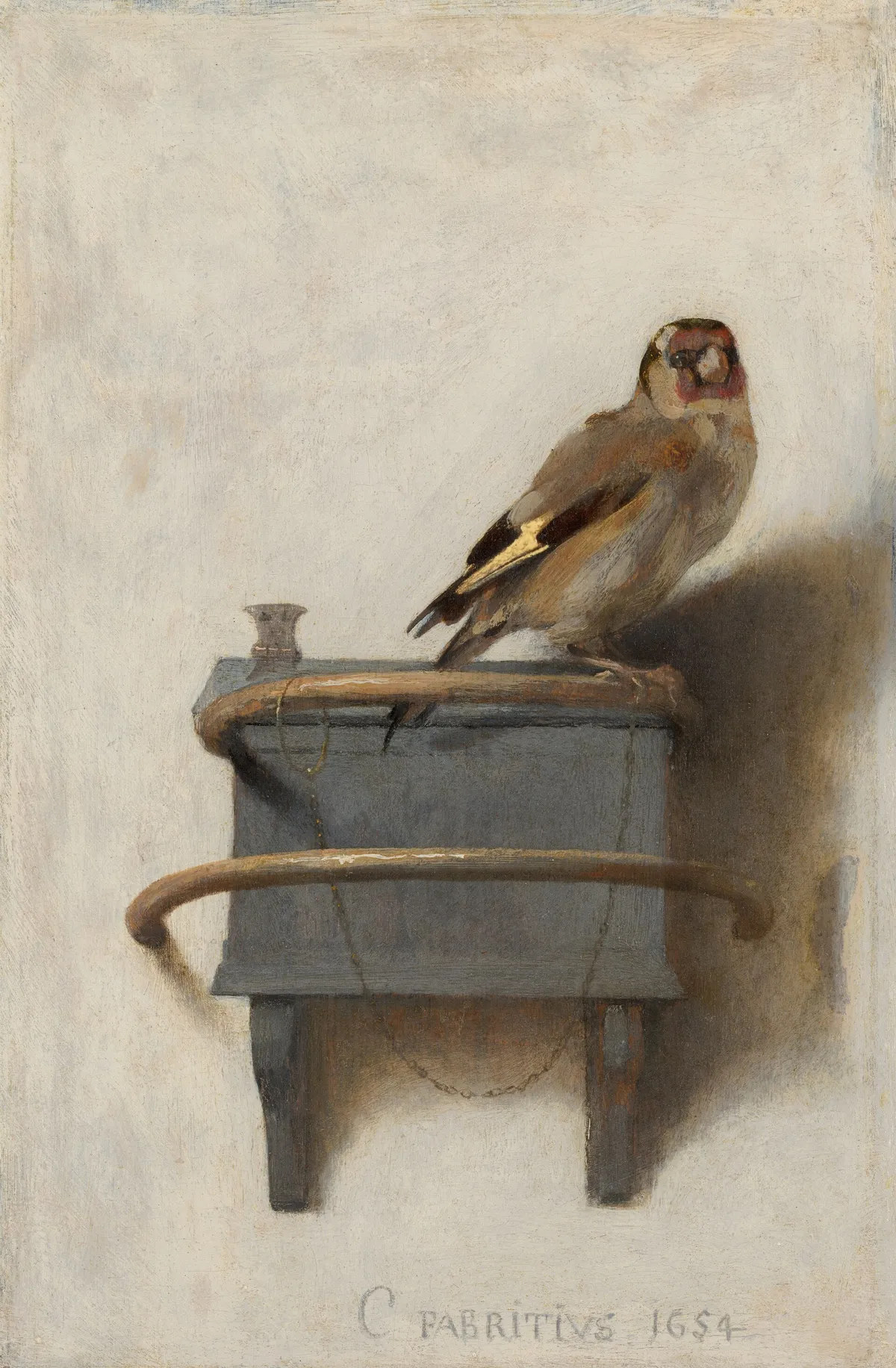
Among the few objects retrieved from the ruins was a small oak board, measuring 33.5 by 22.8 centimetres, inscribed in brown oil paint at the bottom: C FABRITIVS 1654.
The Autopsy of a Utilitarian Panel
Modern museum visitors treat The Goldfinch (Het puttertje) as a delicate jewel of seventeenth-century oil painting. Its physical construction tells a different story. The oak board is between eight and ten millimetres thick, an unusually heavy depth for a picture barely larger than a notebook sheet. Embedded within the edge grain are the remains of an internal wooden dowel pin, confirming the panel was sawn down from a larger piece of joined architectural joinery.
Before Fabritius reworked the composition, the panel possessed a two-centimetre black border. Ten iron nails were driven through a gilded molding directly into this painted rim, spaced at regular intervals around the perimeter. Because the nails never punctured the rear surface, the frame was mounted straight onto the face of the board rather than holding it from behind. Fabritius subsequently ripped this frame off, leaving a faint greenish perimeter line where copper compounds from the gold leaf had oxidized into the paint.
He then revised the composition himself: he dragged fresh cream paint across the right border to cover the nail marks, signed his name lower down, and painted a secondary curved wooden ring beneath the feeder bracket. The reverse shows four nail holes and six secondary suspension holes near the top edge. Art historian Linda Stone-Ferrier has argued that the panel was conceived as an architectural fixture: either fixed into the jamb of an interior window to trick visitors into seeing a live bird on the sill, or hinged as a protective swinging door over a more fragile cabinet painting.
The subject itself was an everyday sight in seventeenth-century Holland. The European goldfinch (Carduelis carduelis) was nicknamed puttertje ("little water-drawer") because it could be trained to hoist a thimble-sized metal bucket on a chain out of a drinking bowl. Within the wider tradition of bird art, Fabritius stripped away all conventional allegorical clutter, painting the creature perched on its semicircular feeder against a pale, whitewashed plaster wall. To render the yellow wing bar, he applied thick lead-tin yellow over dark pigment and then scratched through the wet paint using the wooden butt of his brush (a sgraffito technique learned in Rembrandt's workshop) to let the dark underlayer delineate the feathers.
The Phoenix and the Delft Sunlight
Thirteen years after the disaster, Delft publisher Arnold Bon included a memorial poem in Dirck van Bleyswijck's town history, Beschryving der Stadt Delft (1667). Bon mourned the loss of the city's greatest painter before naming an heir:
"Soo doov' dan desen Phenix t'onzer schade,
In 't midden en in 't beste van zyn swier,
Maar weer gelukkig rees' er uyt zyn vier
VERMEER, die meesterlyck betrad zyn pade."
Nineteenth-century art historians translated Bon's verse literally, arguing that Johannes Vermeer must have been Fabritius's pupil. Delft archival records contain no record of any such apprenticeship. Fabritius had registered with the Delft Guild of Saint Luke in 1652; Vermeer registered in December 1653. While Vermeer's estate inventory later listed several small head studies by Fabritius, their connection was optical rather than academic. Rembrandt had taught Fabritius to emerge figures out of deep shadow; Fabritius turned Rembrandt's method inside out, placing dark figures against luminous, sun-bleached walls. Vermeer inherited that washed Delft daylight, not a master's studio ledger.
The Pocks in the Wet Paint
For two centuries after the explosion, the little panel disappeared from written history. It resurfaced in Brussels in the collection of Chevalier Joseph-Guillaume-Jean Camberlyn, where French critic Théophile Thoré-Bürger saw it in 1859. Thoré-Bürger, who was then single-handedly recovering Vermeer from obscurity, was struck by the "deadly pale wall" (mur blême) and "luminous colour" (lumineuse couleur). He called the work "a mere little nothing" (un petit rien) and acquired it from Camberlyn's heirs in 1865.
Following Thoré-Bürger's death, the panel was sold at Hôtel Drouot in Paris on 5 December 1892 to dealer Étienne-François Haro for 5,500 francs. Four years later, on 27 February 1896, Abraham Bredius, the director of the Mauritshuis, purchased it at the Émile Martinet sale for 6,200 francs, securing it for the permanent collection in The Hague.
The decisive forensic revelation arrived in 2003, during a comprehensive restoration directed by Mauritshuis chief conservator Jørgen Wadum. Because heavy lead pigments blocked standard X-ray examination, Wadum used computed tomography (CT scanning) alongside microscopic surface analysis. Conservators observed dozens of minuscule indentations and shallow craters peppering the paint film.
Crucially, the paint around these micro-craters showed no brittle fractures or concentric drying cracks. The high-velocity particles and airborne grit that pitted the surface struck while the oil film was still soft and drying. The Goldfinch was sitting on an easel or work table in the Doelenstraat studio at 10:15 on the morning of 12 October 1654, absorbing the flying debris of ninety thousand pounds of gunpowder before the ceiling came down.
When American author Donna Tartt published her novel The Goldfinch in 2013, her plot followed a young boy named Theodore "Theo" Decker who survives a museum explosion and escapes with the panel. Tartt later recalled that she had selected the surname Decker years before researching the Delft Thunderclap: "When coincidences like that start happening you know the muses are at your side." The church deacon who died beside Fabritius under the falling beams had waited three and a half centuries for his surname to rejoin the bird.
On the reverse of the panel, tucked near the suspension holes, sits a small stencil stamped in red ink in 1938: an equilateral triangle applied by the Dutch government to designate the objects that had to be evacuated underground before the first bombs fell.