On November 25, 2026, the 61st Venice Biennale handed its top art prizes to winners picked by an email survey. Three days after the seven-month show closed, Chicago sculptor Nick Cave and the national pavilion of India won the first-ever Visitors' Lions. The public vote replaced the usual Golden Lions when the official international jury walked out in April over Russia and Israel.
More than 100 artists and 39 national delegations boycotted the new prize. Organizers kept their names on the ballot anyway. La Biennale promised to discard votes for withdrawn entries, while refusing to publish vote counts or say whether a boycotting participant finished first.
Why the Jury Walked and 39 Countries Refused the Vote
The split started on April 22. The five-member jury, led by Brazilian curator Solange Oliveira Farkas, announced it would not award prizes to countries whose leaders faced International Criminal Court arrest warrants for crimes against humanity. That targeted Russian president Vladimir Putin and Israeli prime minister Benjamin Netanyahu.
All five jurors resigned eight days later after clashes with Biennale management and Italian officials. Italy's culture minister boycotted opening week, Israel's Foreign Ministry accused the jury of politicizing culture, and the European Union pulled funding over Russia's return.
France, Britain, Austria, the Netherlands, and Ukraine withdrew from prize contention through open letters on the art platform e-flux. Dozens of artists in the central show, In Minor Keys, conceived by curator Koyo Kouoh before she died ahead of the opening, joined them.
"The jury acted like any conscionable people would have done," Indian photographer Sohrab Hura told The Art Newspaper from the show's lineup. "I'd rather support them than hope for some award."
What Visitors Picked at the Venice Biennale
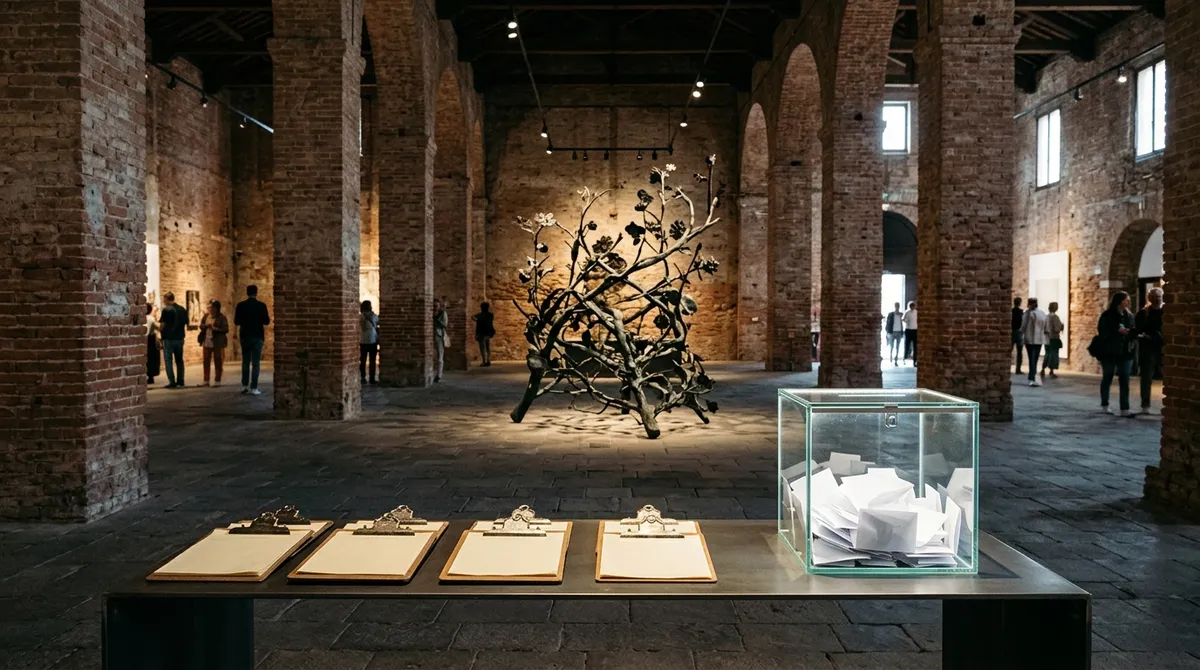
Of 714,015 visitors between May 9 and November 22, ticket-holders who toured both main exhibition grounds received a one-time email ballot. As The New York Times reported, the public voted for two quiet installations built around grief and lost homes.
Nick Cave, known for beaded wearable Soundsuits, went quiet for Two Points in Time - At Once, a seven-part procession through the stages of grief. Outside by the water stood Amalgam (Origin) (2024), a 26-foot bronze cast of his own body with branches, flowers, and birds rising from its head.
Inside, painted vintage metal serving trays framed needlepoint self-portraits, putting Cave's own face into his work for the first time, Artnet News noted. Thanking his late friend Kouoh, Cave said the suite "recognises the history of violence and oppression that Black people have endured and continue to endure in the United States."
India won Best National Participation for Geographies of Distance: Remembering Home, its first Venice pavilion in seven years. Sumakshi Singh rebuilt her demolished New Delhi family house in white thread, while Asim Waqif constructed a sprawling bamboo structure. Curated by Amin Jaffer, the show also featured works in earth, clay, and papier-mache by Alwar Balasubramaniam, Ranjani Shettar, and Skarma Sonam Tashi.
The Organizers' Defense
Biennale leadership defended the Visitors' Lions as a way to protect 109 invited artists and a record 100 national pavilions from political shutdowns. President Pietrangelo Buttafuoco called Venice "a place of truce" and quoted Pablo Picasso: "a painting only comes to life through the person who looks at it."
Asked about the hidden numbers, a Biennale spokesperson told The Art Newspaper that regulations bar releasing rankings or detailed results: "This applies to the Visitors' Lions, just as it has always applied to the decisions of the international juries."