In May 1992, a Los Angeles Times writer who lived where "the helicopters don't come" confessed she was "nurturing my first illusion" that the city was finally facing its inequalities. Thirty-four years later, the illusion is what stuck.
Free at The Broad in Downtown Los Angeles from November 21, 2026 through April 4, 2027, Has the myth been shattered opens by questioning its own title. Curated by Jen Vanegas Rocha, the show pulls over 40 works by 14 artists from the museum's permanent collection.
Inside Guadalupe Rosales's Has the myth been shattered
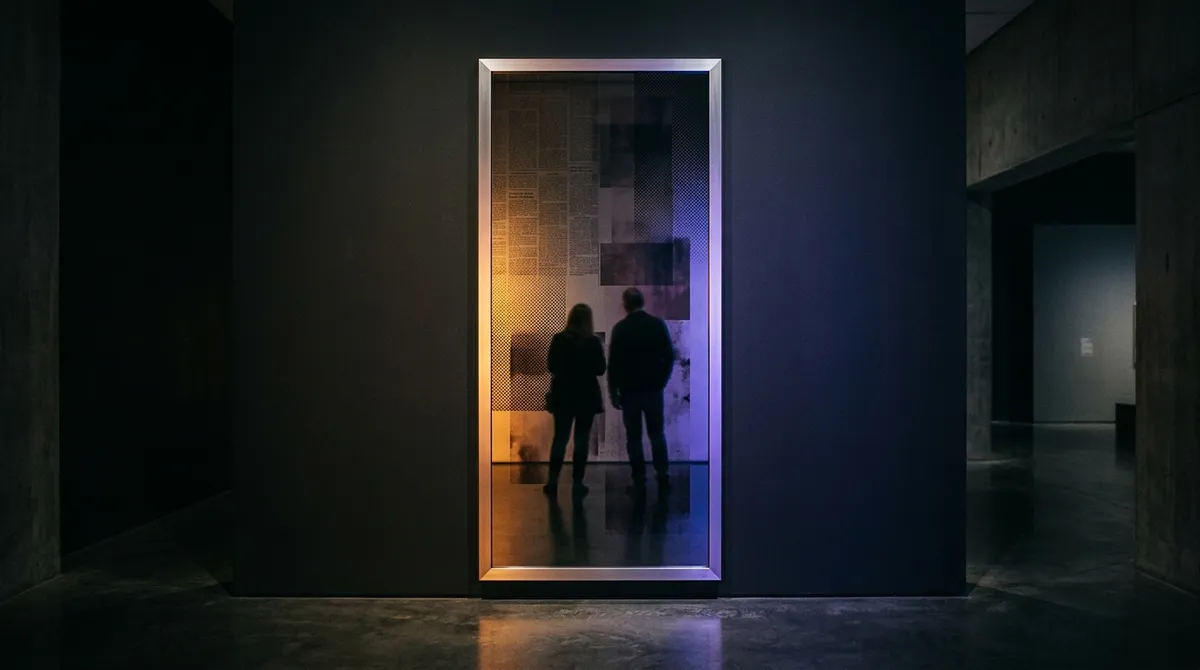
Visitors enter past East L.A. artist Guadalupe Rosales's 2024 sculpture Has the myth been shattered. Inside a six-foot aluminum frame engraved with "East," "lost," and "angels" in Old English lettering, color-shifting LEDs light up a two-way mirror and a plastic toy figurine. Behind the glass sits a replica of Janny Scott's May 14, 1992 Los Angeles Times front page.
Rosales bought an original copy of that paper on eBay decades after rushing home from school at age 11 under smoke-stained skies. As the LEDs shift behind the glass, the headlines "Seeing Ourselves" and "Has the Myth Been Shattered?" float directly across your own face.
Rosales told the Los Angeles Times she also built the work for her cousin, killed in 1996. A local paper reduced his entire life to his name, his age, and five words: "gang member was stabbed to death."
Hank Willis Thomas's flash-only archive
In a darkened gallery nearby, the walls look almost blank at first. Hank Willis Thomas's 2018 series Black Survival Guide, or How to Live Through a Police Riot, acquired in late 2025 and shown here for the first time, prints a 13-page 1968 survival manual onto retroreflective vinyl. It is the exact same material used on highway signs.
In normal gallery light, you see faint typewritten advice written for Black residents of Wilmington, Delaware during a nine-month National Guard occupation after Martin Luther King Jr.'s assassination. Aim a phone camera and fire the flash, and hidden News Journal photos of armed soldiers flare straight through instructions on staunching bleeding and surviving power outages.
Warhol, Mickalene Thomas, and Ligon across the galleries
Elsewhere in the galleries, three pieces work directly from newsprint, wartime art history, and 19th-century type:
- Andy Warhol, Race Riot (circa 1963): The oldest work in the show lifts Charles Moore's Life magazine photos of police dogs attacking Birmingham civil rights marchers. Printed as a stark pop art screenprint, the piece keeps the period's hostile framing intact by naming a peaceful protest a riot.
- Mickalene Thomas, The Charnel House (Resist #5) (2021): Hanging across from Warhol, this 11-foot-wide canvas layers rhinestones, acrylic, and oil over Picasso's 1944–45 wartime composition. A Black Panther free breakfast poster sits beside Angela Davis and the names of Freddie Gray and Alton Sterling.
- Glenn Ligon, Narratives (1993): Nine quiet, sepia-toned etchings mimic the ornate title pages of 19th-century slave narratives. Ligon swaps historic escape stories for his predominantly white private school, his queer desire, and his career as an artist.
A broadsheet on the way out
On February 4, 2027, The Broad's free The 1992 Room evening will hand visitors a paper broadsheet with two blanks: "In 1992, people believed ___. In 2027, we know ___." Guests will pin their answers onto a growing lobby wall.
Back at the threshold mirror, Rosales told ARTnews what keeps her searching old newsprint: "I'm not looking for answers. But for some kind of physical proof that things really happened, that they're not just in our memories."