

In December 1915, in a cold gallery in Petrograd, two men almost came to blows over where to hang their artwork. Kazimir Malevich had spent weeks secretly painting geometric shapes on white canvases, culminating in a plain black square painted on linen. Vladimir Tatlin had spent the same months cutting sheet metal, wire, and wood into sharp three-dimensional structures suspended across walls. When they met at the 0.10 Exhibition (The Last Futurist Exhibition of Paintings), Tatlin looked at Malevich's paintings and snapped that they were useless, mystical nonsense. Malevich countered that Tatlin's metal constructions were nothing more than glorified carpentry.
That backstage shouting match marked the birth of modern art's fiercest philosophical war. Within two years, as the Russian Revolution upended the empire, these two radical movements—Suprematism and Constructivism—split the avant-garde down the middle. Both rejected traditional portraiture and landscape painting. Both abandoned realistic depiction. But they held completely opposite views on what abstract art was actually for.
Malevich's Suprematism chased the cosmic zero-point
Malevich called his movement Suprematism because he believed pure feeling in art was supreme over any practical use, narrative, or social goal. Before 1915, he had experimented with Cubo-Futurism and designed backdrops for the radical 1913 opera Victory Over the Sun. But he wanted to go further—to strip away every single reference to the visible world.
His breakthrough was Black Square (1915). To make its point unmissable, Malevich hung the canvas high up in the top corner of the gallery room—the exact spot where traditional Russian Orthodox homes placed their sacred religious icons. It was a deliberate provocation. By replacing an image of a saint with a solid black square on a white background, he signaled that representational art was dead. In its place stood the zero-point of painting: pure form, pure color, and infinite space.
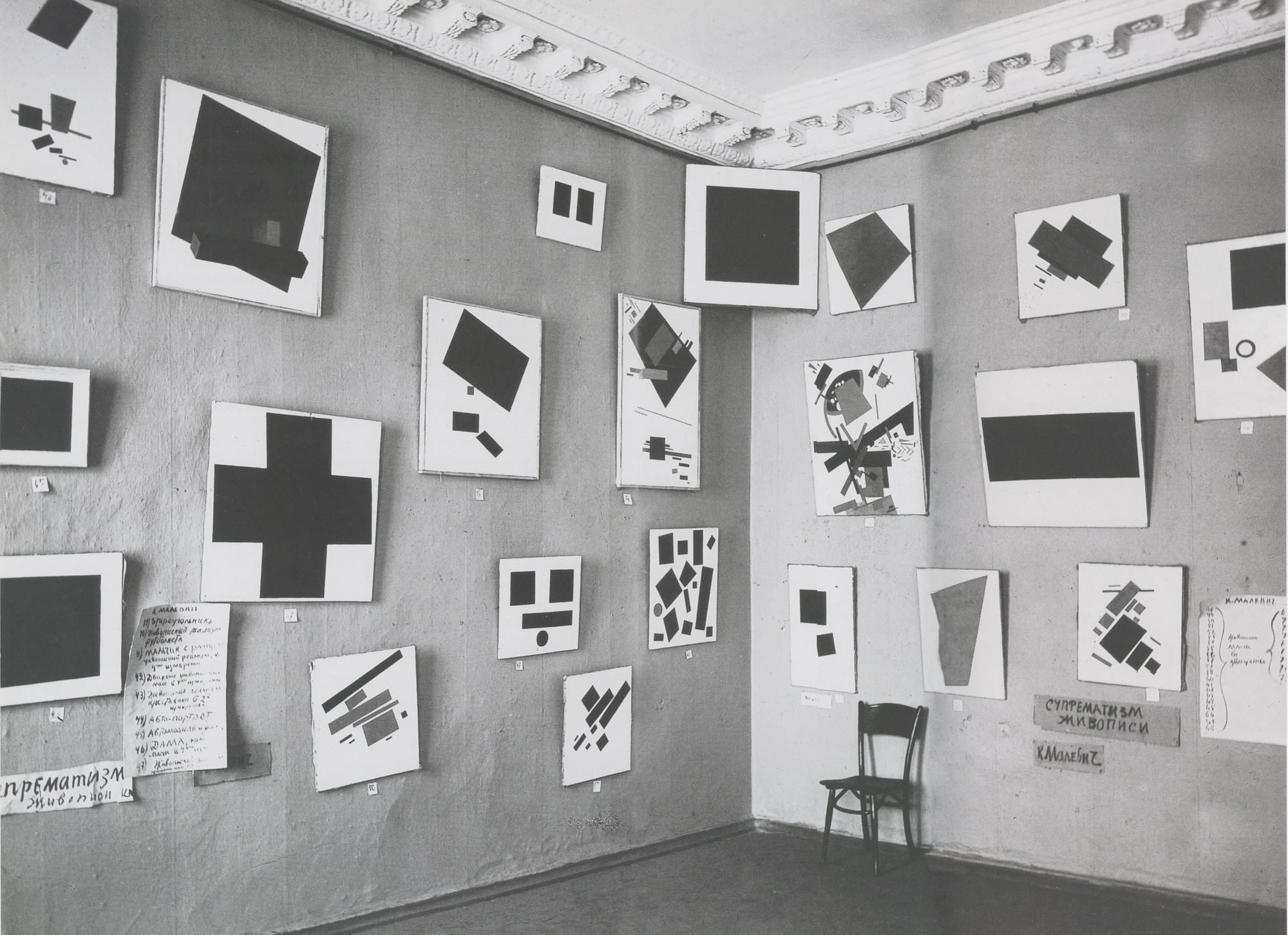
The 0.10 Exhibition, Petrograd (December 1915). Malevich hung Black Square in the top "red corner" traditionally reserved for religious icons. Public domain via Wikimedia Commons
For Malevich, abstraction wasn't a pattern or a decorative motif. It was a spiritual window. He believed that squares, circles, and floating rectangles freed the viewer's mind from physical objects, letting them experience pure sensation. Suprematist paintings deliberately avoided real-world references: no chairs, no faces, no revolutionary slogans. Just geometry floating in white ether.
Tatlin's Constructivism demanded art serve the factory floor
Vladimir Tatlin looked at Malevich's floating squares and saw bourgeois escapism. A former icon painter and sailor who had visited Picasso's studio in Paris in 1913, Tatlin believed that in a revolutionary society, artists had no right to retreat into private spiritual worlds.
Tatlin founded Constructivism on the concept of faktura—the raw, honest handling of materials. Instead of using paint to trick the eye into seeing depth on a flat canvas, artists should construct physical objects out of real industrial materials: iron, glass, wood, steel, and tin. Art shouldn't sit in a gallery for rich connoisseurs to admire; it should build the physical world.
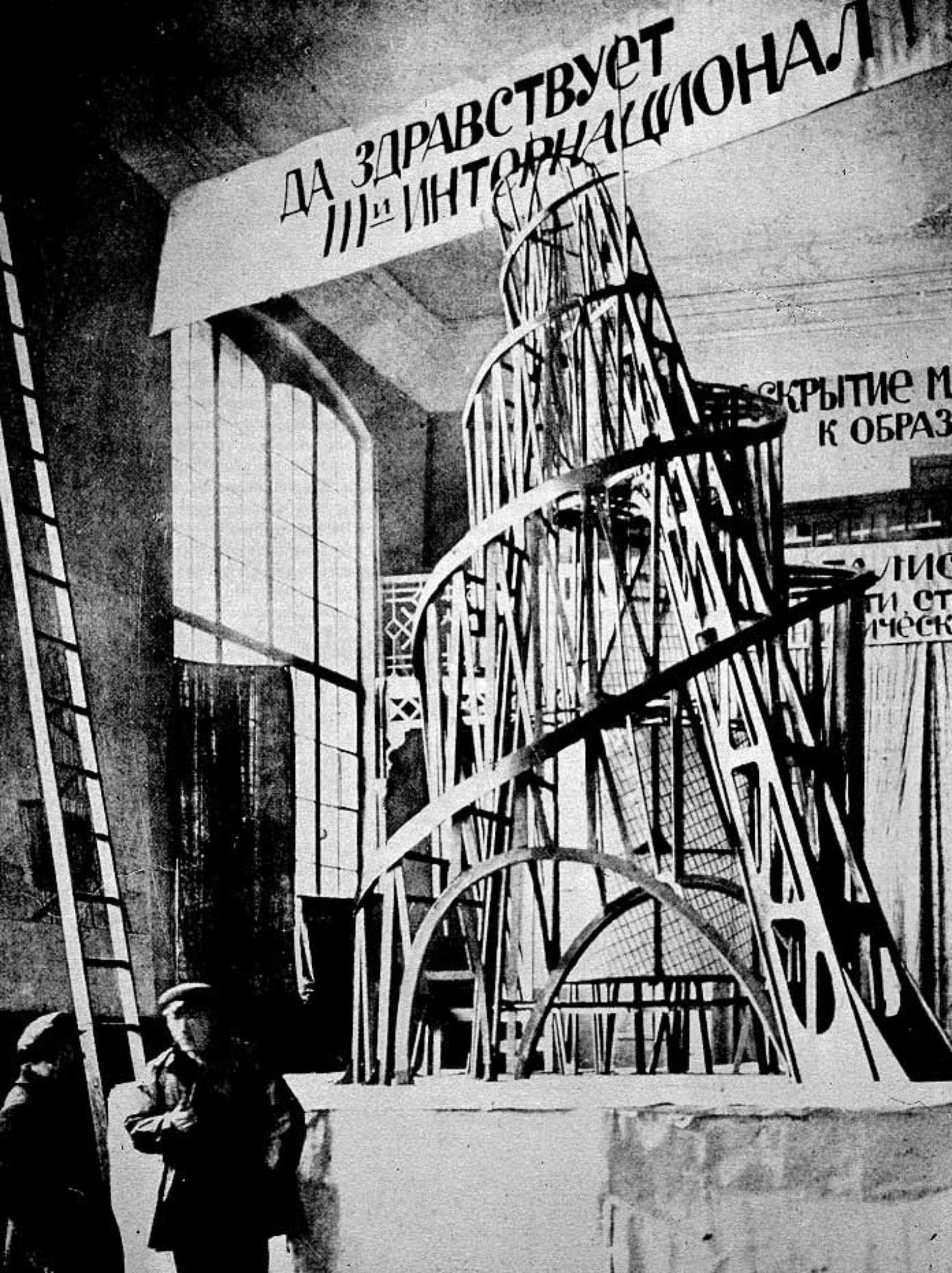
Vladimir Tatlin, model for Monument to the Third International (1919–1920). Designed as a 400-meter spiraling steel tower containing rotating geometric halls for legislative assemblies and news broadcasting. Public domain via Wikimedia Commons
The ultimate expression of Tatlin's philosophy was his 1919 proposal for the Monument to the Third International (commonly called Tatlin's Tower). Designed to stand 400 meters tall—taller than the Eiffel Tower—it was a giant spiraling twin-helix frame of iron and steel supporting three rotating glass structures: a cube, a pyramid, and a cylinder. Each volume would rotate at different speeds (once a year, once a month, once a day) while housing government halls, telegraph offices, and open-air projectors to broadcast news onto the clouds. It was never built due to civil war shortages, but it remains one of modern architecture's most famous symbols.
By 1921, Constructivists like Alexander Rodchenko and Varvara Stepanova officially declared "the death of easel painting." They abandoned gallery art entirely to design functional teapots, worker clothing, textile patterns, propaganda posters, and furniture. Their motto was simple: Art into life.
Spiritual mystery vs structural utility: how their tools differed
The gap between Suprematism and Constructivism comes down to three main choices:
- The Goal: Suprematism sought spiritual transformation through pure non-objective feeling. Constructivism sought social transformation through functional design and manufacturing.
- The Medium: Suprematism stayed on canvas using oil paint to explore weightlessness and color. Constructivism worked with raw industrial materials like sheet steel, timber, glass, wire, and photo-montage printmaking.
- The Role of the Artist: Malevich saw the artist as a philosopher and visionary priest of form. Tatlin and Rodchenko saw the artist as an engineer, constructor, and factory colleague.
This division spilled into Soviet art schools during the early 1920s. Malevich led the UNOVIS school in Vitebsk, where students wore black squares on their sleeves and painted Suprematist murals on trams and bakery walls. Tatlin and Rodchenko taught at VKhUTEMAS in Moscow, training students in metalworking, wood joinery, and mass-production graphic layout.
The Stalinist curtain and their lasting legacies
Despite their fierce debate, neither movement survived the political crackdown of the 1930s. In 1932, Joseph Stalin decreed Socialist Realism as the single approved artistic style for the Soviet Union. Abstract art was denounced as formalist and anti-Soviet. Malevich was interrogated, his work confiscated, and he returned to painting figurative portraits in his final years. Tatlin fell out of favor and spent his last decades designing a bird-like human glider (the Letatlin) that never took flight.
Yet their brief rivalry reshaped global visual culture. Constructivism traveled directly to Germany, where artists like László Moholy-Nagy brought its material logic to the Bauhaus, laying the foundation for modern graphic design, industrial furniture, and minimalist architecture. It also resonated with the Dutch De Stijl movement.
Suprematism, meanwhile, proved that a single shape could carry immense emotional weight. Its clean geometry echoes across our geometric abstract art collection and continues to influence modern poster design and contemporary abstraction.
To see how these Russian pioneers fit into the wider story of modern art, explore our interactive art movements timeline. Or browse our full abstract wall art collection to bring bold geometric balance into your own room.


0 comments