The Room on Al Bateen: Retiring the Western Trophy Playbook
Western auction houses spent two decades treating the Persian Gulf as a convenient dumping ground for secondary blue-chip leftovers. The playbook was predictable: fly a minor Warhol or a surplus Picasso into a hotel ballroom, court sovereign wealth, and hope regional buyers mistook import tariffs for cultural importance.
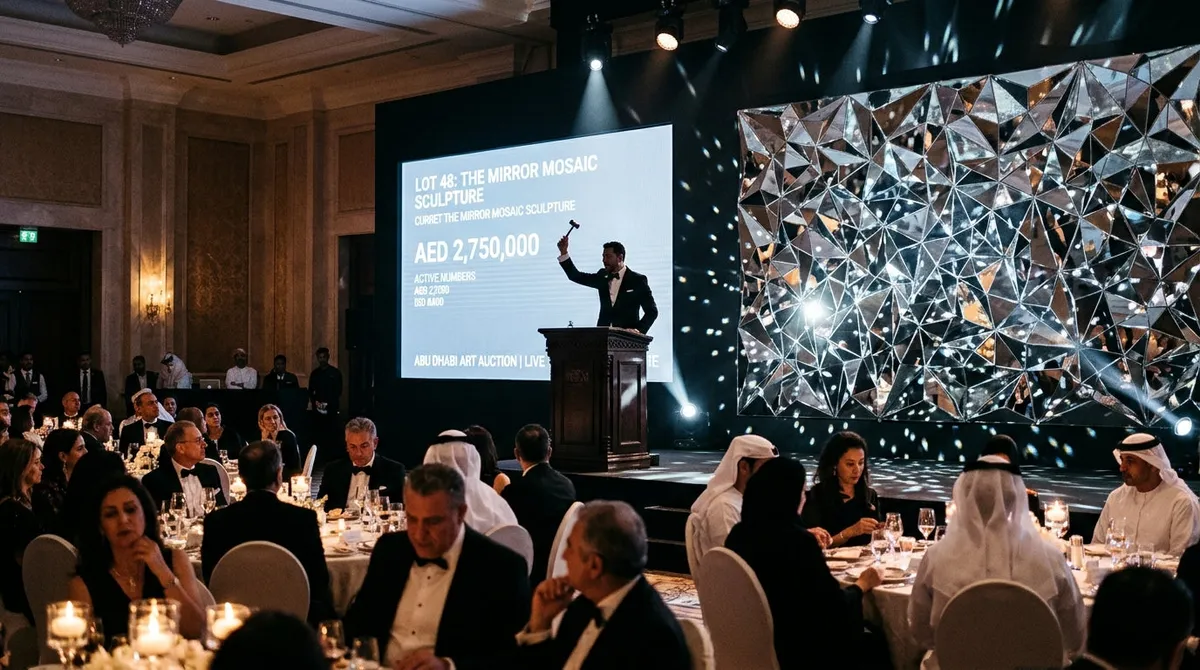
On the evening of November 1, 2026, inside the ballroom of The Abu Dhabi EDITION on Al Bateen marina, that patronizing routine died. Staging the inaugural Christie's Abu Dhabi auction of live fine art, the house wagered its reputation entirely on regional modern masters. The sale, titled "MAWASIM: 20 Years of Modern and Contemporary Middle Eastern Art," hammered down $8,940,800 without relying on a single imported Western canvas.
The receipts delivered the house's highest evening benchmark for Middle Eastern art at Christie's in over a decade. Spanning 70 museum-caliber lots by 58 artists across 13 countries, the catalog drew landmark consignments directly from foundational regional institutions, including Beirut's Dalloul Art Foundation and Sharjah's Barjeel Art Foundation. As reported by Artnet News, the room established nine distinct artist records before the night concluded.
Inside the Christie's Abu Dhabi Auction: The Seven-Minute Hexagon
The flashpoint arrived early with Lot 14: Variations on the Hexagon (2006) by the late Iranian master Monir Shahroudy Farmanfarmaian. Built from thousands of precision-cut glass mirror facets embedded in plaster on wood, the work synthesizes Sufi geometric cosmology with the hard-edge minimalism Farmanfarmaian absorbed alongside Frank Stella in 1960s Manhattan. Her signature technique adapted ayeneh-kari, the traditional Persian architectural practice of cutting mirrors into geometric vaulting, turning sacred architectural ornamentation into freestanding geometric abstract art.
The rostrum opened bidding around $150,000, well below the piece's conservative pre-sale estimate of $200,000 to $300,000; seven minutes of relentless telephone combat followed across three continents, escalating in disciplined $25,000 increments until the hammer finally fell at $844,800, more than tripling the high estimate and shattering the artist's previous auction record.
The momentum rippled through the catalog. Palestinian abstractionist Samia Halaby’s kinetic 1978 canvas Yesterday commanded $358,400 to establish an all-time medium record, while Lebanese-Armenian modernist Paul Guiragossian's dense figurative oil Noces (Wedding) brought $486,400. Turkish-Jordanian pioneer Fahrelnissa Zeid’s kaleidoscopic Composition reached $524,800, matched by contemporary masterworks from Ali Banisadr and Faisel Laibi Sahi at $512,000 apiece.
Yet the hammer prices alone did not tell the full story. According to sale records published by Arab News, over 30 percent of registered bidders were Millennials and Gen Z, and 37 percent of all buyers were transacting with the auction house for the very first time.
This was not the caricature of Gulf collecting: passive family trusts parking capital in safe decorative gold. It was a fiercely literate, younger cohort acquiring difficult, historically loaded abstraction to build their own regional canon.
Why Abu Dhabi Won the Institutional Long Game
For twenty years, Dubai served as the undisputed commercial retail heart of the UAE art trade, hosting Christie's regular sales at Jumeirah Emirates Towers since 2006. Dubai provided commercial velocity and international tax-free transactions, but it lacked curatorial weight.
Abu Dhabi offered a fundamentally different proposition. Over the past decade, the emirate invested billions of dollars constructing the Saadiyat Cultural District: an extraordinary cultural corridor anchored by Jean Nouvel’s Louvre Abu Dhabi, the forthcoming Guggenheim Abu Dhabi designed by Frank Gehry, and the Zayed National Museum.
The MAWASIM auction demonstrated how secondary market liquidity migrates toward museum density. As detailed by The National, staging this milestone sale on Al Bateen was a calculated acknowledgment that Abu Dhabi has become the intellectual spine of Arab and Persian modernism.
London and New York can no longer view the region as a peripheral outpost of wealthy check-signers. The Gulf is setting the prices, defending the scholarship, and writing the checks.