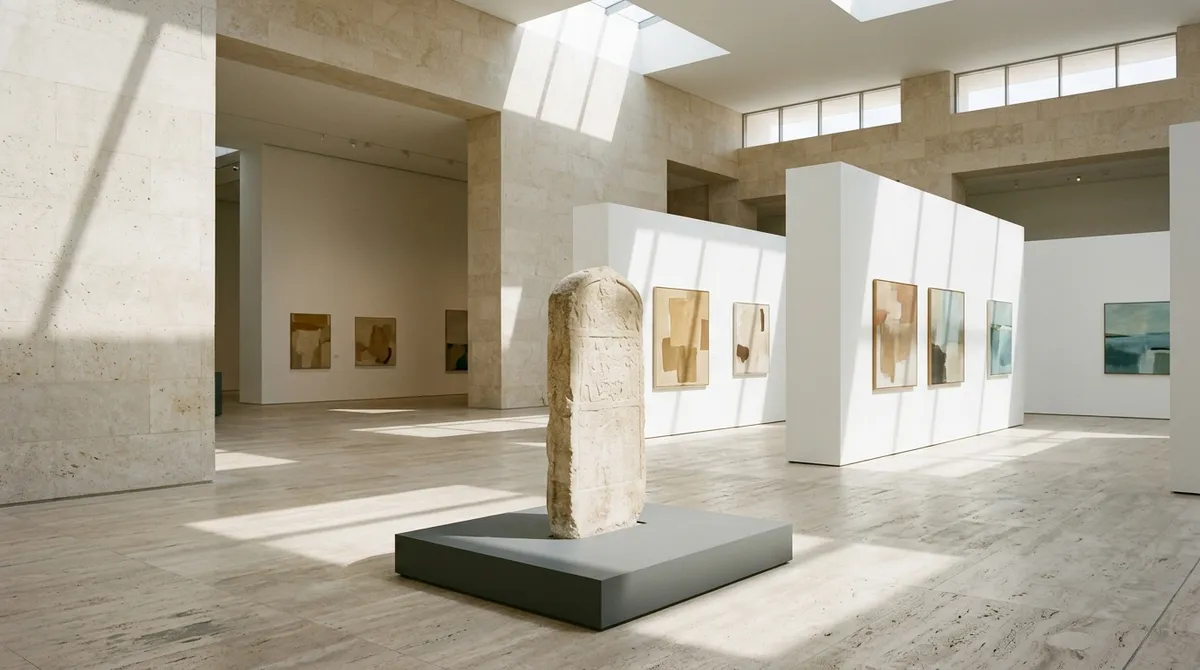
Within hours of opening, the first Frieze Abu Dhabi sold a 2,000-year-old gravestone. The funerary stele was carved for a woman named Fayšat from Qataban, in what is now Yemen. London's David Aaron gallery sold it for seven figures, and it is back on the Arabian Peninsula for the first time in 70 years.
Frieze arrived weeks after Christie's first Abu Dhabi auction, part of a fall rush of Western art brands into the emirate. The fair's opening days showed how buying works here. The decisive money moves early and in private, and the open floor takes its time.
The royal family had already shopped. In a walkthrough on Wednesday, before anyone else could get in, they bought every inlaid gemstone work by Pakistani artist Hamra Abbas at Dubai's Lawrie Shabibi gallery. Small marble and lapis still lifes went for $10,000, larger quartz-laden landscapes for $28,000 to $30,000.
Inside Frieze Abu Dhabi
The fair, at Manarat Al Saadiyat from November 19 to 22, 2026, replaces Abu Dhabi Art, the state-backed event founded in 2009. Artnet News counts 89 galleries, down from 142 last year, and judges the smaller fair the better one.
Gagosian, absent from the old fair since 2014, brought Pop art editions by Roy Lichtenstein at $20,000 to $300,000, and Frieze's owner, Ari Emanuel, haggled at his own fair with dealer Timothy Taylor over a Hilary Pecis canvas. The stele hung in the Masters section, which is built around the Indian Ocean as an ancient trade route, a theme Louvre Abu Dhabi shares this season.
Slower on the Open Floor
Dubai's Efie Gallery hung El Anatsui wall hangings priced from $525,000 to $1.8 million. By the end of opening day, it had holds (works reserved, not yet paid for) on three lower-priced pieces by other artists.
The U.S. war with Iran suspended or delayed flights for some regional visitors, and some VIPs from farther away canceled. Even so, Maryam Al Falasi of Abu Dhabi's Iris Projects says her gallery's sales this year are ahead of 2025.
"My family has been working with collectors here for generations, long before the recent expansion of the Gulf's cultural infrastructure," said Salomon Aaron, whose family runs the gallery that sold the stele. "It's important not to underestimate the depth of collecting knowledge and experience in the region."