Under ultraviolet luminescence, the battered surface of an ancient marble fragment in Frankfurt stops looking like bare stone. Microscopic crystals of Egyptian blue pigment (cuprorivaite) ignite with intense infrared luminescence, revealing painted borders that have survived in silence for twenty-four centuries. Alongside those pigments sit millimeter-wide drill holes cut by Athenian bow drills, the forgotten sockets where ancient metalworkers pinned bronze swords, bridles, and diadems directly into marble.
For Dr. Vinzenz Brinkmann, Head of Antiquities at the Liebieghaus Skulpturensammlung, these microscopic toolmarks provided the physical coordinates to solve an architectural riddle that has baffled classical archaeologists for three hundred years. By measuring chisel strike angles and the socket depth of ancient iron clamps, Brinkmann began tracing how thirty-nine colossal statues were once anchored onto the temple gable: the physical foundation of the Parthenon puzzle.
Rebuilding antiquity's most famous image: The Parthenon puzzle
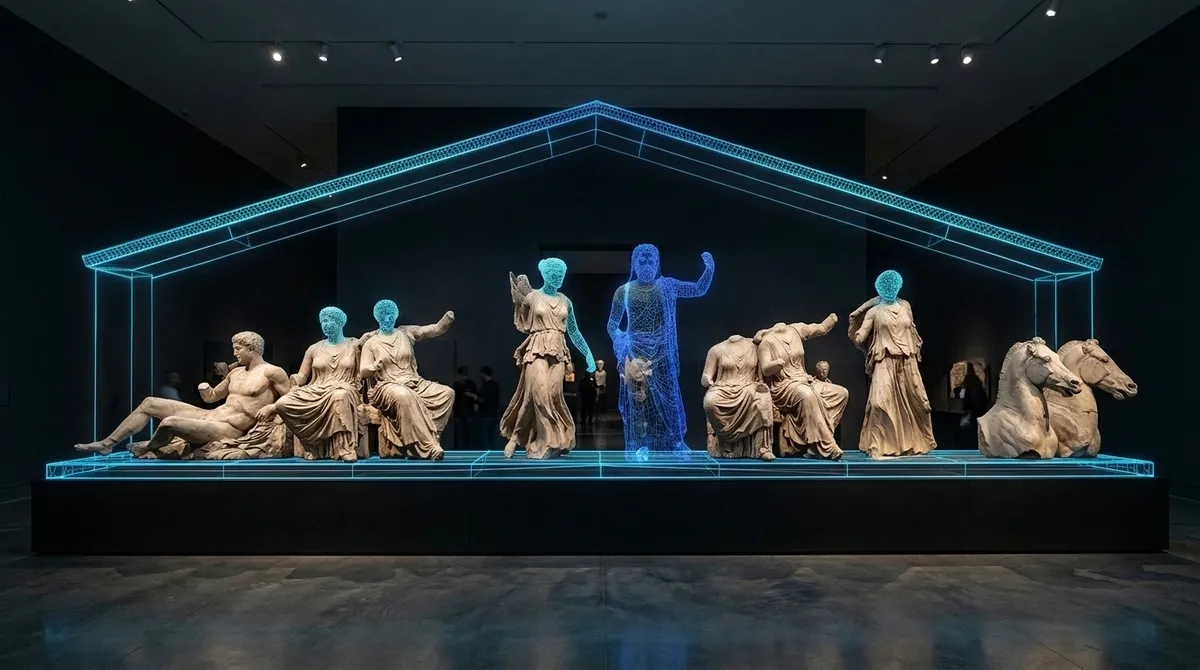
On November 18, 2026, the Liebieghaus opened its landmark exhibition, Athena, the Stage is Yours: The Parthenon Puzzle, scheduled to run through July 25, 2027. The project sets out to reconstruct the lost eastern pediment of the Parthenon, the architectural gable described by classical art historians as the most famous image of antiquity. Spanning thirty meters across the temple roofline, the original triangular composition staged the dramatic myth of Athena springing fully armed from the head of Zeus.
Catastrophe dismantled the scene long before modern archaeology existed. In 1687, during the Great Turkish War, a Venetian mortar shell struck an Ottoman ammunition depot housed within the temple, blowing out the sanctuary walls and shattering the pediment. Today, only roughly sixty fragmented sculptures survive from the original group, scattered in pieces across European institutions.
The Roman sarcophagi that unlocked the missing center
Rebuilding a lost thirty-meter marble tableau from sixty broken pieces required an entirely fresh investigative methodology. Brinkmann and his team generated high-resolution 3D surface scans of every accessible fragment, measuring the exact micro-contours left by classical Athenian stonemasons. The digital scans confirmed the physical posture and rotational tilt of surviving torsos, but the crucial central figures remained missing.
The breakthrough arrived not on the Acropolis, but inside a museum gallery in Russia. During a 2014 research visit to the State Hermitage Museum in St. Petersburg, Brinkmann recognized a carved relief on a Roman sarcophagus lid that mirrored the Parthenon pediment layout. Subsequent fieldwork identified nine Roman sarcophagi lids across Russia and Italy, including critical sculptural reliefs preserved at the Galleria Borghese and the Vatican Museums in Rome. Roman artisans had copied the Athenian pediment centuries after its creation, preserving the lost central group of Zeus, Athena, and surrounding deities in miniature relief.
"Our research makes it possible, for the first time, to re-imagine key fragments and to reconstruct the monumental composition of the east pediment on a sound scientific basis," Brinkmann explained in a museum briefing. His team demonstrated how the miniature Roman carvings gave researchers the precise compositional coordinates required to position surviving fragments with mathematical precision.
London agrees to lend, but Athens draws the line
As detailed by The Art Newspaper, the Liebieghaus aimed to gather surviving original marbles alongside its 3D reconstructions. The British Museum, which holds the extensive Parthenon Sculptures gallery removed by Lord Elgin in the early nineteenth century, agreed to loan two original Parthenon marble fragments to the Frankfurt show.
The British Museum confirmed the loan as part of its ongoing international loan program. A museum spokesperson affirmed that trustees consider loans whenever objects are physically fit to travel, can be safely preserved, and promote international study of classical culture. For Frankfurt, securing the two London fragments represented a major curatorial milestone.
The unanimous vote of the Central Archaeological Council
The project hit a political wall when the Liebieghaus requested nine complementary pediment fragments from the Acropolis Museum in Athens. Greece's Central Archaeological Council (KAS), the supreme advisory body on national antiquities, convened an extraordinary session and voted unanimously to reject the German museum's loan application.
Culture Minister Lina Mendoni confirmed the council's decision, cementing a national boycott of the exhibition. For Athens, allowing Greek-owned antiquities to share an exhibition space with artifacts removed by Lord Elgin under a standard loan framework was unacceptable.
"Displaying authentic Greek fragments alongside items seized by Elgin would validate an illegitimate division," a senior Greek cultural heritage representative stated following the council vote. Greek officials maintained that entering into reciprocal loans alongside London would treat severed components of a single architectural monument as separate, legitimately owned artworks, directly compromising Greece's decades-long campaign for full, permanent repatriation.
Digital resolution versus geopolitical reality
With Athens refusing to participate, the Liebieghaus had to alter its gallery installation. Rather than shelving the project, the museum proceeded with the two original fragments from London, incorporating additional classical loans from the Louvre and the Vatican Museums.
To bridge the void left by the withheld Athenian fragments, Brinkmann turned to digital fabrication. The exhibition paired the surviving marbles with life-size 3D optical laser projections, millimetric resin casts, and interactive wireframes. The resulting installation allows visitors to see how thirty-nine figures locked onto the roof timbers, presenting the pediment at its original architectural scale.
The Frankfurt exhibition highlights the stark contrast between technological progress and unresolved cultural diplomacy. While 3D laser mapping and forensic toolmark analysis can reconstruct antiquity's greatest pediment with millimeter precision, digital models cannot mend the political fractures dividing European museums.
For audiences fascinated by classical Greek sculpture, the enduring geometric harmony preserved in ancient architectural reliefs explains why classical form remains central to fine art traditions today. The Parthenon pediment can now be seen complete in digital light, but its original stones remain divided by modern national borders.