What if the severe, fur-trimmed man standing beside his bride in Room 28 was never the Italian merchant Giovanni Arnolfini, but Jan van Eyck looking out at his own face?
That question electrifies the Ground Floor Galleries of London's National Gallery as staff complete final lighting adjustments for Van Eyck: The Portraits (opening November 21, 2026). At the center of the layout sits an unprecedented Arnolfini Reunion: a side-by-side hanging designed to test six centuries of art-historical attribution.
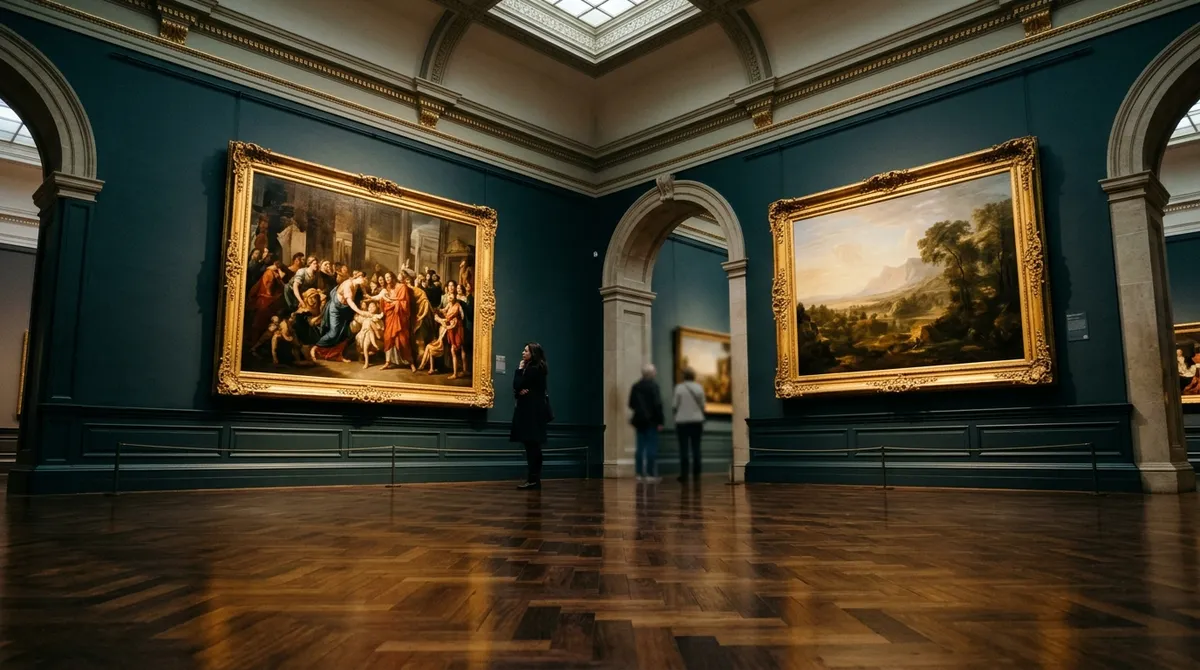
Step through the entry threshold into the climate-controlled dimness. The overhead lamps are dialled down to fifty lux, the strict international threshold required to protect fifteenth-century Baltic oak panels from photochemical fading.
Room 1: The Nine Fragile Panels That Survived Six Centuries
Jan van Eyck produced dozens of private likenesses during his tenure as court painter to Philip the Good, Duke of Burgundy. Today, only nine authenticated painted panel portraits survive across global collections.
Because shifting relative humidity can warp aged oak boards and crack their chalk-and-glue gesso grounds, these fragile panels almost never leave their home institutions. As highlighted in The Art Newspaper Van Eyck coverage, uniting all nine works brings together roughly half of the master's total surviving worldwide oeuvre under a single roof.
Co-curator Susan Foister and the gallery team have hung the panels strictly at eye level. Stripped of distracting decorative barriers, the display focuses the eye on Van Eyck's microscopic control of oil painting glazes: the moist film along a lower eyelid, the blue veins tracing a temple, and the optical sheen of polished velvet.
Room 2: The Arnolfini Reunion and the 1447 Archive
Entering Room 2, the sightline opens directly onto the central controversy of the exhibition. On the left hangs London's permanent masterwork, The Arnolfini Portrait, dated 1434. Mounted immediately to its right is Berlin's loan, Portrait of a Man (Giovanni? Arnolfini), painted between 1435 and 1438.
Seen side by side, the physical resemblance is undeniable. Both figures share an identical aquiline nose, heavy hooded eyelids, high cheekbones, and thin, downturned lips. For over a century, scholars assumed Berlin's solitary panel depicted the same Lucchese merchant who commissioned the London double wedding portrait. In the exhibition catalogue, however, Berlin Gemäldegalerie curator Stephan Kemperdick challenges that assumption with a compelling archival discovery.
Archival records uncovered in Paris prove that the merchant Giovanni di Arrigo Arnolfini did not marry his bride, Giovanna Cenami, until 1447. That date falls thirteen years after the London painting was inscribed, and six years after Jan van Eyck died in 1441.
Kemperdick points to visual clues within the London interior to support his self-portrait theory. On the back wall above the mirror, the formal calligraphic signature reads: Johannes de eyck fuit hic 1434 ("Jan van Eyck was here 1434"). While traditional art history interpreted this as a notary's legal witness formula, the lettering sits immediately beside the man's head, functioning visual-first as an identifying title.
Behind the woman, the carved wooden finial on the bedpost depicts Saint Margaret trampling a dragon. While Saint Margaret was revered as the patron saint of pregnancy, Kemperdick reads the carving as a direct name pun for the painter's wife, Margaret van Eyck. In the convex mirror between the standing couple, an optical device explored in detail in The Arnolfini Portrait hidden mirror, two small figures appear in the doorway, underscoring how carefully Van Eyck staged observer perspectives.
Curators remain divided on the identification. Skeptics note that the bride in the 1434 double portrait has warm brown eyes, whereas Margaret van Eyck's documented portrait in Bruges shows distinct grey-blue irises. Yet comparing the two men face to face in Room 2, the shared bone structure makes the traditional merchant label feel far less secure.
Room 3: The Domestic Mirror and the Vermilion Chaperone
Move past the partition into Room 3, where the exhibition pairs two deeply intimate likenesses. On one side hangs London's newly conserved Portrait of a Man (Self-Portrait?) from 1433, known as the Man in a Red Turban. Facing him across the gallery is the loan from Bruges: the Portrait of Margaret van Eyck, completed in 1439 and lent by the Groeningemuseum Bruges.
The visual dialogue between husband and wife is electric. The male sitter wears a voluminous chaperone folded into sharp ripples of fiery vermilion, his direct gaze studying the viewer with forensic intensity. Across the space, Margaret gazes back with calm poise, her horned linen headdress crimped into rows of starched folds that catch the light at age thirty-three.
Around her portrait's original wooden frame runs Van Eyck's Latin inscription: "My husband Johannes completed me in the year 1439 on 17 June." For anyone accustomed to studying Northern Renaissance masters through reproductions or modern fine art prints, seeing the original oak panels together reveals a domestic frankness that high-resolution digital scans fail to replicate.
The Back Corner: Silverpoint Color Notes from Dresden
In a quiet alcove near the exit sits the exhibition's most fragile treasure: Jan van Eyck's only surviving preparatory drawing on paper, Portrait of an Older Man (c. 1431), on loan from the Kupferstich-Kabinett in Dresden.
Executed in silverpoint and goldpoint on white-prepared paper, the sheet records the weathered features of an aging cleric, traditionally identified as Cardinal Niccolò Albergati. Along the margins, Van Eyck jotted rapid Middle Dutch color notes in his own hand: "gelwachtich" (yellowish) for the hollows beneath the eyes, and "rootachtich" (reddish) across the bridge of the nose and cheek.
Hanging directly beside the drawing is the finished oil portrait from Vienna's Kunsthistorisches Museum, reuniting drawing and painting for only the second time in modern history. The pairing allows viewers to follow Van Eyck's mental translation from monochrome silverpoint lines to luminous oil glazes.
Exit Reflection: The Birth of Psychological Realism
Stepping out of the galleries into Trafalgar Square, the lasting impression of the exhibition is clarity. Uniting these nine oak panels removes the romantic patina of legend and reveals Van Eyck as an exacting observer of human psychology.
Whether the London double portrait depicts an Italian merchant or Jan van Eyck himself, the achievement remains unchanged. Six hundred years after the wet paint dried on Baltic oak, Van Eyck's sitters still command the room with the quiet gravity of living people.