Under the glare of angled museum track lighting, the creature glints with clinical precision. Six thousand precision-cut Swarovski crystals cover the curve of its cast-brass skull, framing two jet-black ocular voids and an articulated jawline that splits along a hidden mechanical seam. Resting on a dark plinth, it looks like a preserved specimen from a Tokyo subculture museum or a hyper-finished resin casting fresh from Takashi Murakami's Miyoshi studio.
It is neither. The object is Lot 1 in Christie's single-owner auction Scarcity & Infinity, an 88-lot sale running online from November 25 through December 10, 2026. This creature is an Artycapucines Crystal Panda evening clutch, carrying an estimate of $20,000 to $30,000, and it introduces a catalog that treats commercial leather goods with the forensic gravity of blue-chip sculpture.
The auction forms the centerpiece of Christie’s Luxury Week in New York, presenting more than 100 artist-commissioned handbags assembled by a single European collector over three decades. With total pre-sale estimates exceeding $1 million, the catalog reads less like a retail retrospective and more like a physical index of late-twentieth-century art movements. As documented in the ARTnews sale announcement, the sale traces how luxury fashion houses abandoned traditional luggage design to become private patrons, turning calfskin, taurillon leather, and brass into alternative canvas portfolios.
For contemporary collectors registered through Christie’s Luxury Week, these objects occupy a strange intermediate ground between tabletop bronzes and industrial prototypes. Four dominant aesthetic movements define the catalog: Neo-Pop Superflat, Obsessional Biomorphism, Deconstructivist Architecture, and Postmodern Appropriation.
Spotlight 1: Takashi Murakami’s Superflat Kitsch (The Artycapucines Crystal Panda)
Murakami has spent four decades dismantling the boundary between commercial otaku merchandise and high museum art. His 2000 Superflat manifesto argued that postwar Japanese visual culture erased historical hierarchies between fine painting and graphic design, a philosophy executed at scale through his Kaikai Kiki production factory. The Artycapucines Crystal Panda clutch stands as the purest physical embodiment of that theory: an anime mascot rendered as an armored jewelry box.
Murakami juxtaposes the cold sparkle of Austrian strass against a subversive neon-pink lambskin interior, engineering a push-button release that divides the panda's skull in two along its sagittal axis. The interior cavity measures barely three inches deep, effectively sabotaging utilitarian carry in favor of sculptural display. Produced in an edition of 130 pieces, the clutch behaves like a portable reliquary for contemporary manga tropes.
Christie's catalog also features nine additional lots from Murakami's 2025 Artycapucines VII Collection, marking his formal reunion with the Parisian house after a decade-long hiatus. Among them, the Pink and White Artycapucines Mini Tentacles (edition of 95) replaces classical leather handles with cast silicone octopus limbs, while a White Crocodile Cerises Mini Capucines layers his iconic cartoon smiling cherries over wild exotic hide. The tension between centuries-old French saddlecraft and candy-colored Japanese pop consumerism remains Murakami's most potent critical intervention.
Spotlight 2: Yayoi Kusama’s Obsessional Biomorphism (The Yellow & Black Pumpkin Bag)
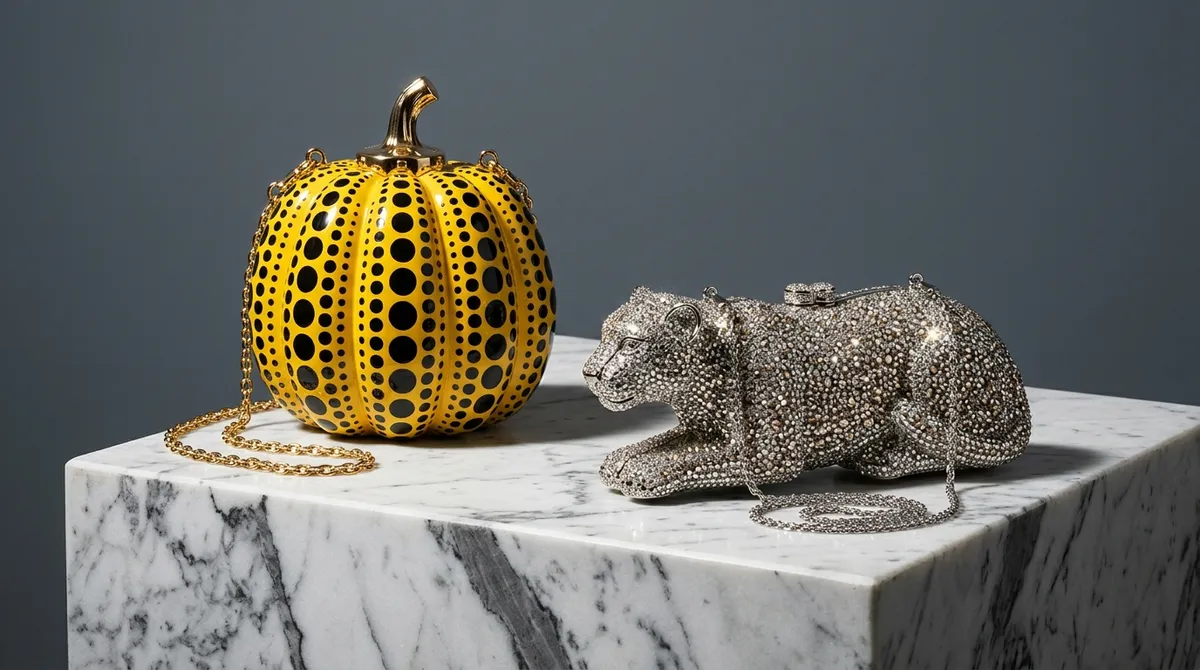
Where Murakami weaponizes commercial irony, Yayoi Kusama channels psychological compulsion. Lot 14 in the Christie's sale is her sculptural Yellow and Black Pumpkin Bag (estimate $8,000 to $10,000), created for the 2023 Creating Infinity collaboration. The object is not a bag with a motif printed onto it; it is a rigid, three-dimensional leather gourd formed through thermo-molded cowhide panels that curve inward toward an articulated black leather stem.
The pumpkin has served as Kusama's primary psychic surrogate since her childhood in Matsumoto, Nagano Prefecture. Her family operated a commercial plant nursery and seed farm, and during the food shortages of World War II, pumpkins became both a daily dietary staple and an anchor of sanity against her recurring hallucinations of enveloping dots. As detailed in Yayoi Kusama's official archive, she formally exhibited yellow-and-black polka-dot pumpkins at the 1993 Venice Biennale, expanding the motif into mirrored rooms and seaside public monuments.
On this edition, the hypnotic black dot gradients decrease in diameter as they ascend each bulbous rib, replicating the exact optical perspective of her celebrated 1994 seaside bronze pier pumpkin on Naoshima island. Holding the piece reveals an uncompromising sculptural rigidity; the stiffened leather ribs allow zero compression, demanding that the owner handle it with the care usually reserved for a fragile ceramic vessel.
Spotlight 3: Frank Gehry’s Deconstructivist Architecture (The Crocodile Fish & "Bear with Us" Clutch)
Lot 27 presents Frank Gehry's rarest leather design: the White Crocodile Drawn Fish Mini Capucines, produced in a strict edition of only 20 pieces worldwide with a pre-sale estimate of $10,000 to $15,000. Rather than applying architectural panels directly to the bag, Gehry translated his lifelong obsession with marine kinetics into embroidered line work. Since crafting his experimental ColorCore fish lamps in the 1980s and suspending a monumental timber fish inside the Fondation Louis Vuitton in Paris, Gehry has treated the aquatic vertebrate as nature's non-Euclidean sculpture.
On the Drawn Fish, his hand-sketched ink line drawing is rendered in fine black embroidery against white porosus crocodile hide. The bag's centerpiece is a solid cast-brass handle, sculpted into an undulating dorsal fin that echoes the curvilinear titanium cladding of his Guggenheim Museum Bilbao.
Alongside the aquatic Capucines sits Gehry’s metallic Bear with Us clutch, a wearable translation of his monumental 2014 sculpture. The original work, constructed from crumpled 316L stainless steel and preserved in the Besthoff Sculpture Garden at the New Orleans Museum of Art, explored how industrial sheet metal could simulate soft origami folds. The miniature clutch replicates those fractured, mirrored facets in cast aluminum, transforming an evening accessory into an architectural scale model engineered by Gehry Partners.
Spotlight 4: Postmodern Irony & Industrial Ready-Mades (Jeff Koons & Tom Sachs)
The final section of Scarcity & Infinity documents how postmodern appropriation entered the luxury canon. Lot 42 brings forward Jeff Koons' 2017 Masters Collection, in which the American artist transposed canonical Renaissance and Rococo paintings by Fragonard, Rubens, Da Vinci, and Titian across coated monogram canvas. Koons applied reflective metallic block lettering naming the historical painters across the front, making history's greatest oil canvases look like mass-market retail billboards.
Koons also made commercial history during this collaboration. He became the first contemporary artist permitted to alter Louis Vuitton's sacred monogram, replacing the intertwined initials with his own stylized 'JK' monogram. The gesture mirrored Marcel Duchamp painting a mustache on the Mona Lisa; it was an act of high-low institutional vandalism produced with the full blessing of the corporate patron.
In stark contrast to Koons' mirror-finish irony, the sale highlights the workshop bricolage of sculptor Tom Sachs. Known for his handmade space-program assemblages and plywood carpentry, Sachs approached the luxury house through deliberate functional brutalism. His custom pieces strip away polished brass in favor of industrial nylon webbing, heavy-duty parachute clasps, thermal heat-shrink tubing, and raw shop-floor rivets. Sachs exposes the hardware mechanisms that luxury houses typically conceal, treating the handbag as a field tool built for lunar exploration.
The Vitrine Economy: When Limited Editions Replace the Gallery Plinth
Walking through the preview vitrines at Christie's New York clarifies why this sale marks a turning point in the secondary art market. The collector who assembled these 88 lots did not acquire them for red carpets; the lots arrive in pristine condition because they lived in custom acrylic display vitrines alongside editioned bronzes and framed graphics. In contemporary auction cycles, limited-run artist leather goods now frequently command higher price density per square inch than paper lithographs by the same creators.
This shift mirrors the mid-century evolution of Pop Art, when artists broke down the boundary between mass manufacturing and museum walls. Works found in contemporary collections and Meron's pop art collection trace their lineage to this exact creative friction, where industrial methods, commercial iconography, and artistic intention collide. When an auction house catalogs a handbag with the provenance and condition reports once reserved for bronzes, the luxury vitrine has officially become an extension of the gallery plinth.