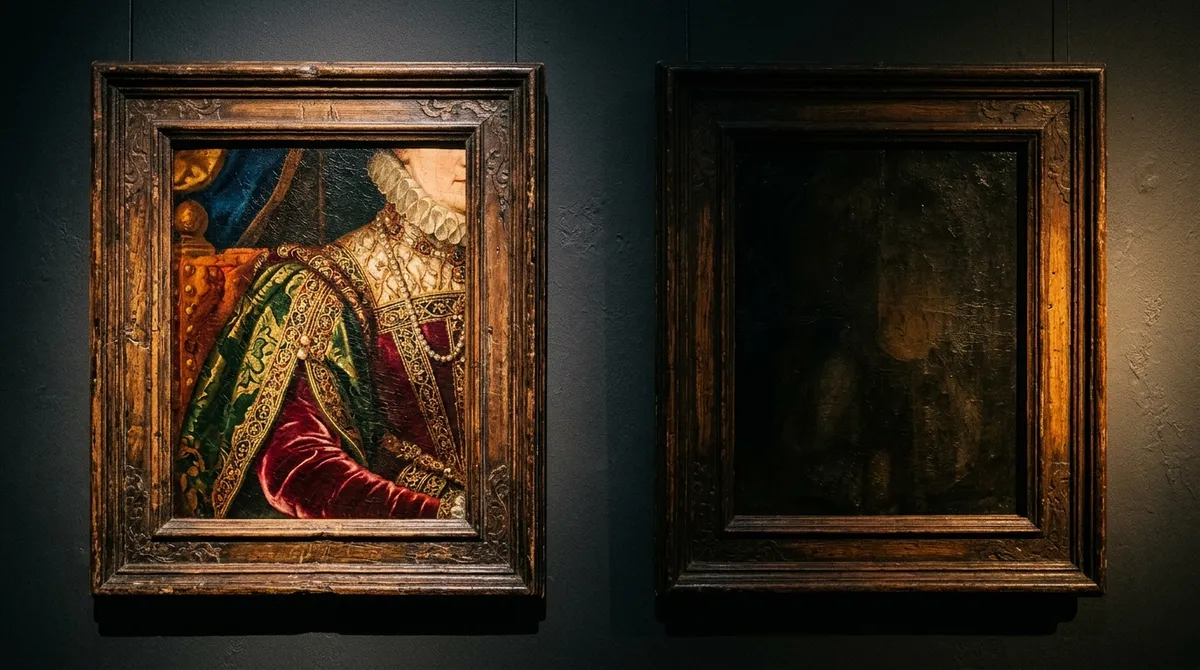
She was never a duchess. She wasn't supposed to hang alone, either. For more than three centuries, one of the most famous faces in London's National Gallery, nicknamed The Ugly Duchess, has been missing the other half of her own joke.
On December 8, 2026, her partner finally comes back into view. Christie's London is offering Quentin Metsys's An Old Man as Lot 6 in its Old Masters Evening Sale. As Art History News noted when the lot surfaced in November, the panel carries a £6 million to £8 million estimate, roughly $10.5 million at the top end.
What the £8M companion looks like
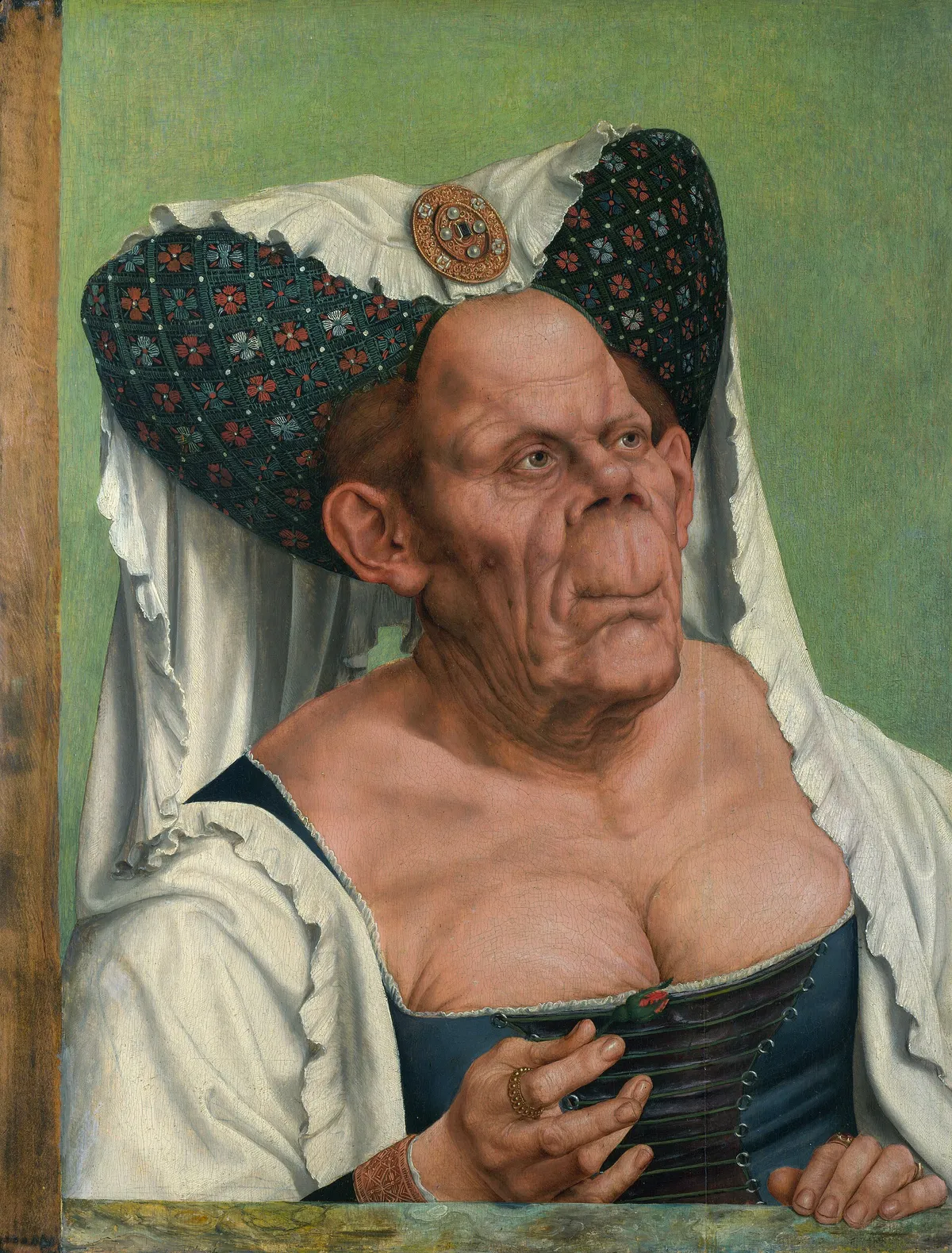
In London, An Old Woman leans over a marble ledge in a tightly laced bodice and a flaring horned headdress. Between thumb and forefinger, she pinches a drooping red rosebud, the classic Renaissance token of youth and courtship.
An Old Man is the target sitting just out of frame. Painted in strict profile in a deep purple-red velvet bonnet and brown fur collar, he sports a prodigious hooked nose, a jutting lower lip, dark cheek stubble, and stray white hairs tucked inside his ear.
In 16th-century Netherlandish marriage diptychs, the husband always claimed the prestigious viewer's-left spot. Metsys put the old woman in his seat instead, dressed her in fashions sixty years out of date, and painted the old man raising an open palm with a gold thumb-ring.
In all of Metsys's surviving paintings, the only other character wearing a thumb-ring is Pontius Pilate in his Madrid Ecce Homo. Scholars still cannot agree whether the old man's raised hand greets his admirer or waves her away.
1513: Leonardo's drawings and the Antwerp lab trail
For centuries, scholars assumed these two portraits were simply copied from lost drawings by Leonardo da Vinci. During the 1490s in Milan, Leonardo filled paper sheets with visi mostruosi, extreme studies of sunken mouths, bulbous noses, and jutting chins.
Yet Leonardo never allowed those grotesque faces into a finished oil painting. He kept them small and confined to sketchbooks. Around 1513 in Antwerp, Quentin Metsys (also spelled Quinten Massys) broke that unspoken rule, blowing those marginal types up to life size in Northern figurative art before almost anyone else dared.
While nobody can trace the exact courier route that brought Leonardo's sketches north, conservation scans show Metsys built an original double act from scratch:
- The 1513 Paris pattern: A dated oil-on-paper study in Paris matches the man's head to the millimeter, and 2022 infrared scans at the Metropolitan Museum of Art show Metsys transferred that face onto the panel while sketching the hands freehand.
- The green-glaze fix: X-rays show Metsys painted over the woman's light-green background with a white layer and a second dark glaze so her panel would match the man's translucent green.
- Matched timber: Both panels use two oak boards whose angled joins align into one continuous seam when stacked, pointing to the same pair of workshop planks.
1645 to 1865: King of Tunis, fake Duchess, Wonderland star
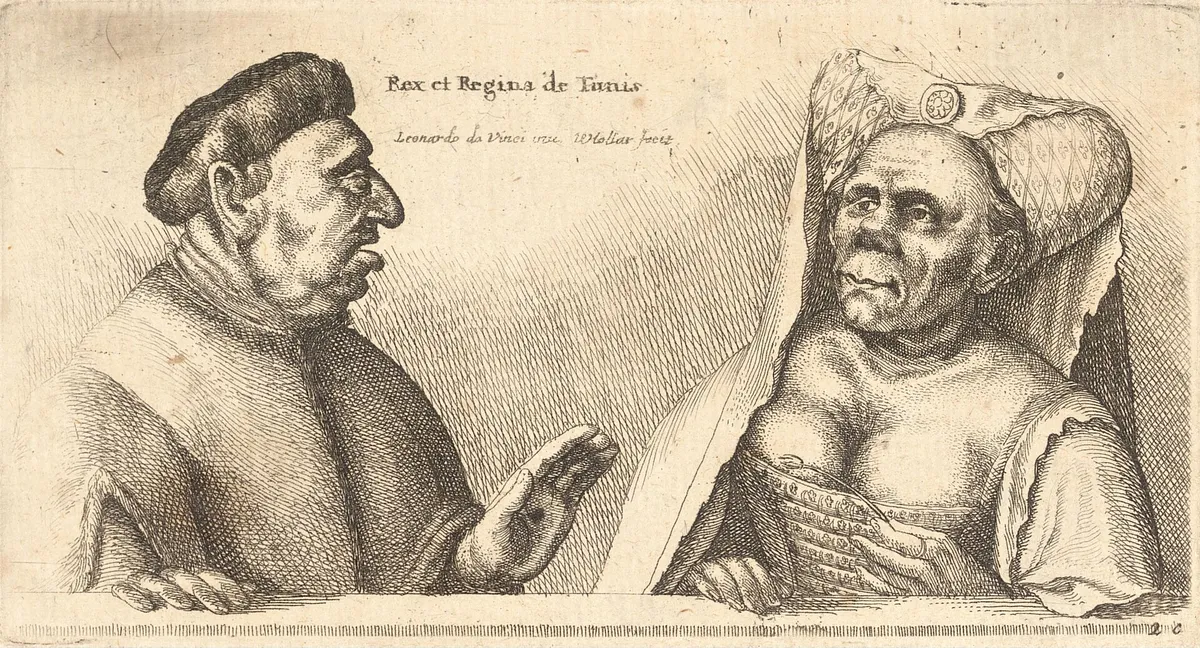
The pair stayed together long enough to be etched side by side in Antwerp around 1645. Bohemian printmaker Wenceslaus Hollar engraved both heads leaning over their shared parapet, credited Leonardo with the invention, and gave the sheet a baffled title: Rex et Regina de Tunis (the King and Queen of Tunis).
Soon after, both paintings travelled to Normandy and separated before 1700. By then, rumors had pinned An Old Woman onto Margaret Maultasch, a 14th-century Duchess of Carinthia and Countess of Tyrol whom political rivals had smeared as the ugliest woman in history.
That false royal label stuck, and British pop culture welded it shut. In 1865, illustrator Sir John Tenniel borrowed her flared horned headdress, sunken cheeks, and scowl to draw the Duchess in Lewis Carroll's Alice's Adventures in Wonderland. Almost overnight, a 16th-century Antwerp satire became The Ugly Duchess forever.
1920 to 2023: Museum rejections, a medical debate, and rare reunions
London's art establishment took decades to warm up to the joke. When An Old Woman sold at Christie's in January 1920 for £880, painter and dealer Hugh Blaker bought her and offered to lend her to the National Gallery. Trustees turned the loan down in 1920, 1922, and again in 1938 when Blaker's sister Jenny offered it, dismissing the panel as an unsettling "curiosity."
Jenny Blaker finally settled the matter by bequeathing the painting to Trafalgar Square in 1947. Meanwhile, An Old Man remained in French private hands until surfacing on the Paris market in April 1954. He later moved into a New York private collection and reunited publicly with London's panel only twice: in 2008 and for the 2023 exhibition The Ugly Duchess: Beauty and Satire in the Renaissance.
Medical researchers and curators still argue over what Metsys was actually painting. In October 2008, University College London surgery professor Michael Baum and medical student Christopher Cook argued that the woman's enlarged jaw, pushed-up nose, and bulging forehead record advanced Paget's disease of bone (osteitis deformans).
National Gallery curator Emma Capron and other art historians reject reading a 1513 satire as a hospital chart. They point out that richly dressed, scowling crones were already stock figures in Northern carnival plays and humanist satire like Desiderius Erasmus's Praise of Folly (1511), where elderly suitors clinging to outmoded clothes stood in for universal vanity.
Why The Ugly Duchess still divides the room
Whether December 8 sends An Old Man to another private wall or closer to London, the pair proves Northern Renaissance portraiture was never limited to solemn flattery. Metsys put altarpiece-grade oil craft behind dark comedy, turning an unidealized couple into a 500-year double act.
Hugh Blaker summed up the painting's pull back in September 1921, when he wrote a friend about the panel the museum trustees kept refusing: "Rejoices in the title of the ugliest portrait in the world. But what a masterpiece. I simply love her."