On a hot August afternoon in 1928, two ambitious young painters from London, Ben Nicholson and Christopher Wood, took a day trip from Carbis Bay to the fishing port of St Ives. Wandering through the cobbled back alleys behind Porthmeor Beach, down Back Road West, they glanced through an open cottage door and stopped in their tracks. Nailed directly into the peeling whitewashed walls were dozens of small, irregular pictures of sailing ships, lighthouses, and granite harbors, rendered in glossy marine enamel paint on torn scraps of cardboard boxes.
Sitting inside was Alfred Wallis, a 73-year-old retired deep-sea sailor and rag-and-bone dealer who had only picked up a paintbrush three years earlier, following the death of his wife Susan in 1922, simply "for company." Nicholson and Wood bought several pictures on the spot for a few shillings, astonished by what they had stumbled upon. They had spent years studying post-impressionist theory in Paris and London, yet here was an untrained mariner who solved the riddles of spatial composition without reading a single manifesto.
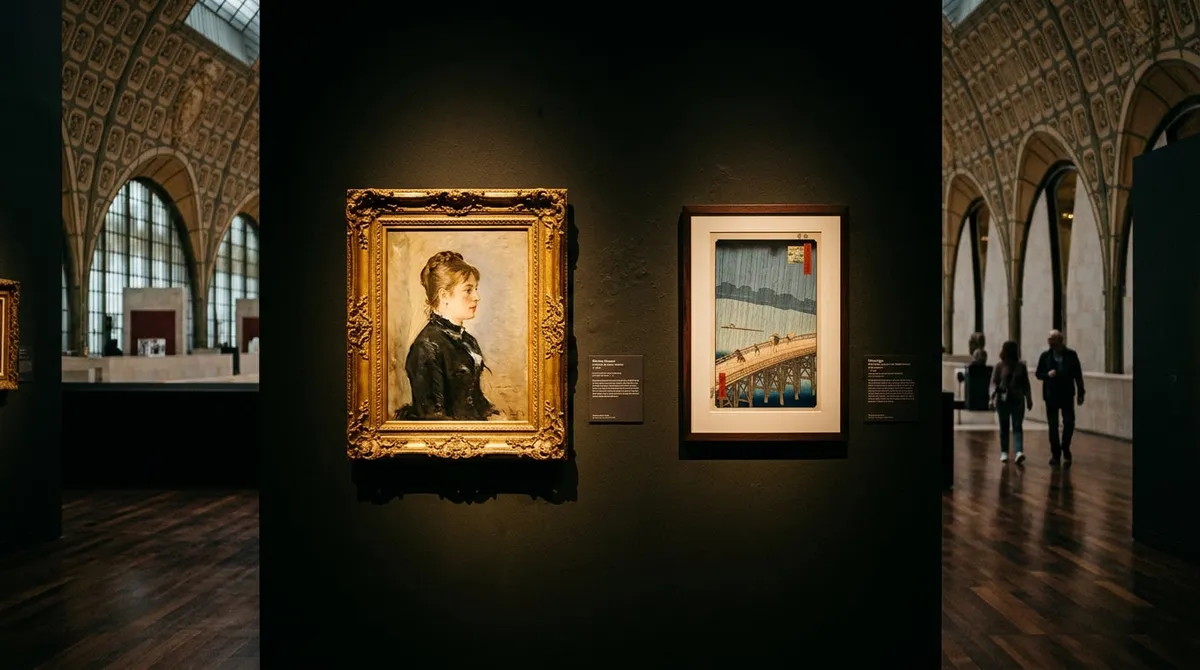
That accidental encounter forms the historic hinge of Alfred Wallis: An Artists' Artist, an exhibition curated by James Scott at Pallant House Gallery in Chichester, running from November 21, 2026, through May 2, 2027. As reported by The Art Newspaper, this exhibition pairs Wallis's cardboard landscapes with works by the avant-garde circle he inspired, proving that British modernism was not born in metropolitan salons, but in a salty front room smelling of ship chandler lacquer.
The Naive Mark That Unlocked Modernism
In 1928, British modernism was stuck. London painters wrestled with Cubist fragmentation and Paul Cézanne's structural planes, producing polite academic exercises that felt bloodless. Wallis never touched that debate because he had never encountered the Renaissance rules of single-point perspective.
Having spent his youth on sailing schooners voyaging between Penzance and Newfoundland, Wallis painted maritime reality from muscle memory and physical experience rather than optical sight. Scale in his compositions was dictated entirely by emotional gravity: a ship battling a gale was painted massive because it was a sailor's only refuge, while the shoreline became a protective curved bowl holding off the ocean. He worked exclusively with materials at hand, cutting cardboard boxes salvaged from St Ives grocers and applying cheap boat paint in a utilitarian palette of Prussian blue, copper boat red, black, lead white, and raw umber.
That blunt directness hit Nicholson and Wood like a cold wave. It is the same unpolished pull people find today in genuine folk art: an image created not to demonstrate pedigree or technique, but to anchor an urgent memory before it slips away.
Spotlight 1: Alfred Wallis, Schooner Passing the Harbour Lights
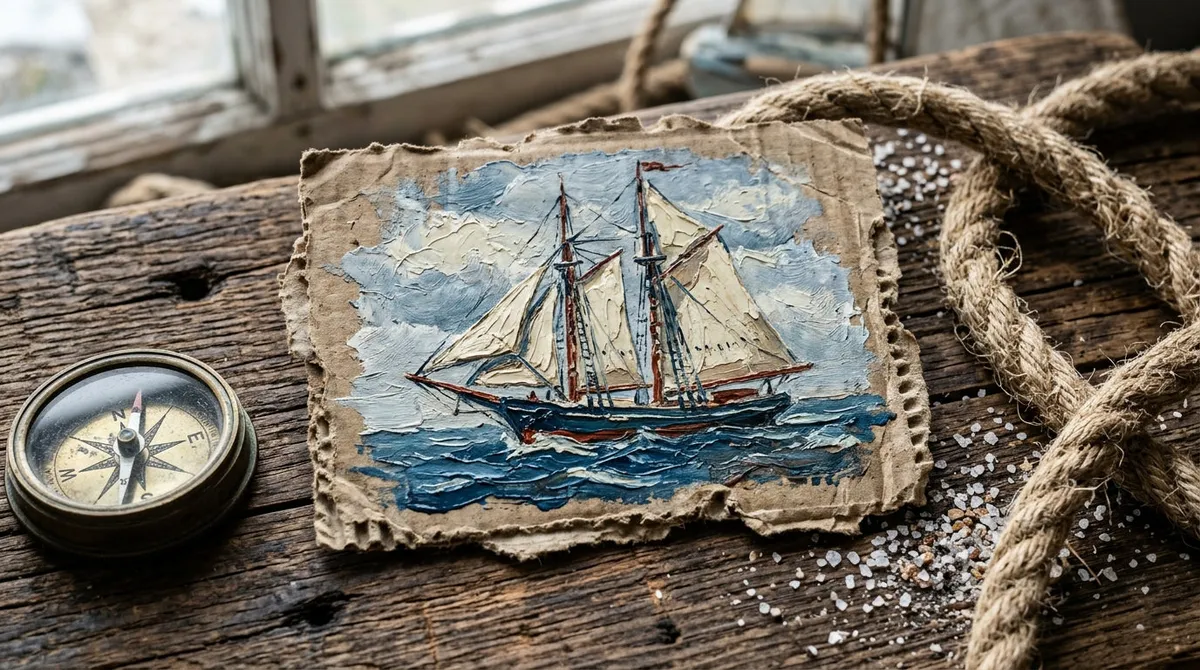
Painted on an irregular scrap of packing cardboard, Schooner Passing the Harbour Lights demonstrates how Wallis turned material poverty into visual daring. Rather than cutting his salvaged support into a conventional rectangle, Wallis let the torn, jagged corner of the cardboard dictate the diagonal angle of the vessel as it cuts through heavy swells. The glossy oil enamel sits on the rough grey cardboard surface, alternating between opaque impasto in the sea spray and thin, scrubbed washes where the cardboard grain shows through like wet sand.
The vessel itself breaks every rule of the academy: Wallis painted the hull in sharp profile to show its cutting entry through the tide, but tilted the deck upward into a bird's-eye view so the viewer could see the companionways, masts, and rigging all at once. Modernist painters recognized the move immediately. As documented in the Tate collection, Wallis intuitively arrived at the multi-perspective planes that Cubists in Paris spent decades debating over absinthe.
Spotlight 2: The Christopher Wood & Alfred Wallis Collaboration
The centerpiece discovery of the Pallant House survey is a rare collaborative canvas that puts this collision into physical paint. In 1929, Wood handed Wallis an unfinished oil of a Brittany quayside, filled with delicate French architecture and muted European tones. Wallis did not treat the canvas as precious. He took his brush and drove a charging sailing vessel straight through Wood's tidy French port.
The physical surface of this canvas is an astonishing battleground of styles. Wood's delicate, Parisian brushstrokes depicting stone buildings and tidy docks are sliced through by Wallis's blunt, heavy marine paint, which inserts a charging sailing vessel right into the center of the French harbor. Wallis ignored Wood's delicate light fall, anchoring the scene with his signature heavy black rigging and thick white crests.
This hybrid object captures the poignant creative contrast between the two men. Wood spent his short career chasing an elusive primitive innocence, hoping that unlearning academic polish would heal his creative anxiety, a struggle that tragically ended with his suicide in 1930. Wallis possessed that primitive innocence without trying, creating art with the casual certainty of a sailor mending a net.
Spotlight 3: Ben Nicholson, 1928 (Porthmeor Beach, St Ives)
For Ben Nicholson, the encounter was an aesthetic demolition. Painted only months after their 1928 meeting, Nicholson's 1928 (Porthmeor Beach, St Ives) discarded the polished Victorian finish he had inherited from his father, Sir William Nicholson, overnight.
Nicholson adopted Wallis's restricted palette, replacing rich salon hues with chalky whites, weathered slate greys, raw earth umbers, and faded marine blues. More importantly, Nicholson began physically distressing his painting surfaces, scouring oil paint with razor blades and sandpaper to mimic the weathered, salt-scoured texture of Wallis's discarded packing boards. Wallis taught Nicholson that a painting is not a window looking onto a scene, but a physical object that carries its own tactile history.
Nicholson championed Wallis relentlessly, sending his cardboard panels to London collectors and introducing his work to collector Jim Ede. Ede was so taken by the sailor's direct vision that he gathered over one hundred Wallis paintings, which today anchor the permanent collection at Kettle's Yard at the University of Cambridge.
Spotlight 4: Barbara Hepworth & Peter Lanyon: From Naive Sea to High Modernist Sculpture
Wallis's mark reverberated straight through the St Ives group across the 1930s and 1940s. When Barbara Hepworth arrived in Cornwall in 1939, she saw Wallis's harbor walls, curved like hollowed granite bowls against Atlantic gales, as an elemental lesson in spatial volume. The scooped recesses and pierced holes of Hepworth's stone and bronze sculptures carry that exact protective curvature, turning the sea-battered geography of St Ives into high modernist abstraction.
For Peter Lanyon, born and raised in St Ives, Wallis was neither an outsider nor a charming primitive. He was a local elder who knew the physical weight of coastal storms. Lanyon took Wallis's multi-angle perspective into the air, piloting gliders across the Cornish cliffs to paint swirling, aerial abstractions that mapped land, tide, and wind simultaneously.
Why Modernism Needed a Cornish Fisherman
Alfred Wallis died in 1942 in the Madron workhouse near Penzance, penniless and convinced that his paintings were simply company for an old man left alone in the dark. Today, his grave in St Ives cemetery looks out across Porthmeor Beach toward the Atlantic horizon, marked by a ceramic tombstone crafted by potter Bernard Leach that shows a tiny sailor entering a lighthouse harbor.
Pallant House Gallery's survey accomplishes something vital: it dismantles the myth that modern art was solely an elite intellectual movement passed down from Paris, Berlin, and Bloomsbury. British modernism found its bedrock because two educated painters had the humility to stop at an open cottage door in St Ives, recognize the genius of a 73-year-old mariner holding a tin of ship enamel, and rebuild their visual world from his weathered cardboard marks.