In the spring of 1879, visitors climbing the stairs of 28 Avenue de l'Opéra in Paris encountered eleven canvases that defied every rule of salon etiquette. The brushstrokes were broad, the pigments unvarnished, and the domestic figures carried a startling physical weight. Edgar Degas lingered longest before those canvases, studying an unfamiliar draughtsmanship that cut through the polite conventions of French society.
The painter was an American expatriate who had lived in France since 1866: Mary Cassatt. While her male peers were celebrated as pioneers of modern vision, Cassatt spent the century following her death in 1926 marginalized by French national museums. Art history textbooks cataloged her as an affluent socialite, an obedient disciple of Degas, or a provincial foreigner who drifted into Parisian studios by good fortune.
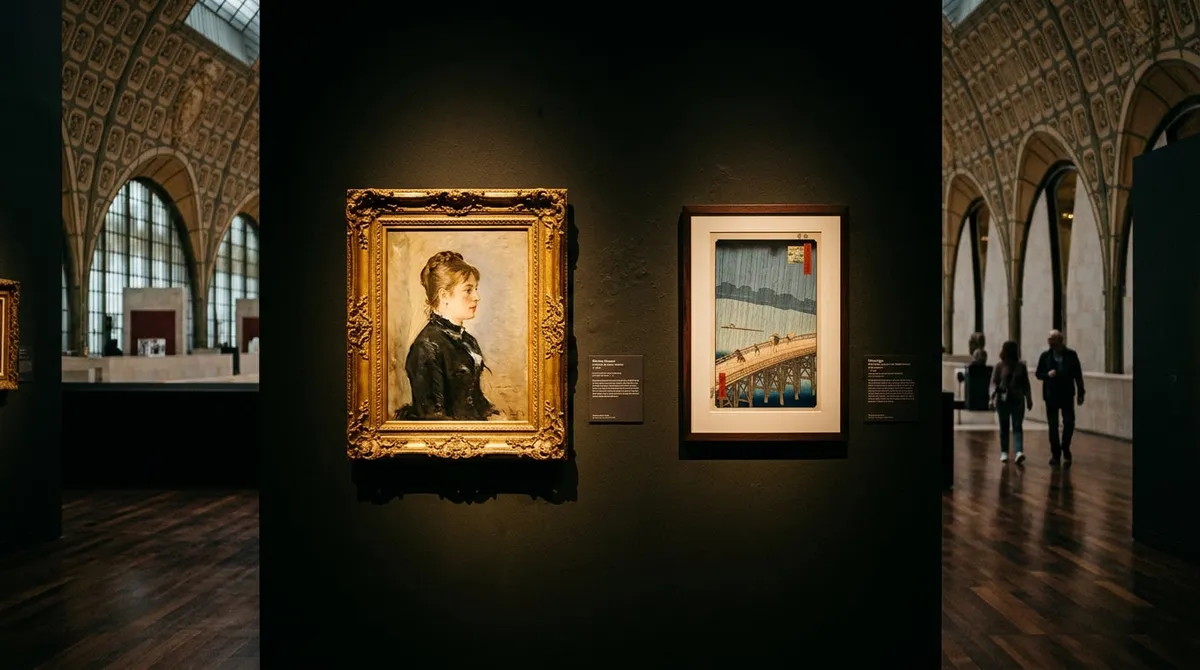
On October 6, 2026, that century-long omission ended. Under the towering barrel-vaulted ceiling of Paris's Musée d'Orsay, Mary Cassatt: Being Independent opened to the public, running through January 31, 2027. Curated by Sylvie Patry in collaboration with London's National Portrait Gallery and Boston's Museum of Fine Arts, the centenary retrospective unites eighty masterworks, conservation analyses, and private correspondence. As detailed in The Guardian, the exhibition restores an artist who altered the course of French modernism through sheer technical audacity.
The Expatriate in the Lion's Den (1866–1879)
The opening galleries of the Musée d'Orsay document an artist forged through open rebellion. When twenty-two-year-old Mary Stevenson Cassatt announced in 1866 that she was sailing from Pennsylvania to Paris to become a professional painter, her father Robert Simpson Cassatt resisted with fury. "I would almost rather see you dead in your grave than an artist," he declared, convinced that independent artistic ambition was scandalous for a woman of their standing.
Because the École des Beaux-Arts prohibited female students from enrolling, Cassatt pieced together a rigorous independent curriculum across Europe. Vitrines in the exhibition's first room display her 1868 Louvre copyist permits alongside travel sketchbooks from Parma, Seville, and Rome, where she studied Correggio, Velázquez, and Rubens. She submitted works to the official Paris Salon, earning acceptance for select portraits while chafing against academic demands for polished mythological sentiment.
By 1877, the Salon jury rejected both of her submissions, bringing her career to a standstill. That same spring, Edgar Degas arrived at her studio at 19 Rue Laval with an unexpected invitation. He had been struck by her 1874 Salon portrait of an Italian girl titled Ida, remarking to his colleagues: "Je n'admets pas qu'une femme dessine comme ça" (I will not admit that a woman can draw like that). He proposed that she abandon the state-sponsored Salon entirely to exhibit alongside the *Indépendants*.
Cassatt accepted without hesitation. Reflecting on that decisive partnership years later, she wrote: "At last, I could work with complete independence without considering the opinion of a jury. I had already recognized who were my true masters. I admired Manet, Courbet, and Degas. I hated conventional art."
The retrospective places Cassatt directly inside the core Impressionist timeline. She exhibited in four of the group's eight historic exhibitions: 1879, 1880, 1881, and the final 1886 show. Archival receipts displayed at the Orsay demonstrate that her sales from the 1879 presentation were substantial enough to purchase major paintings by Degas and Claude Monet, injecting liquidity into a bohemian circle frequently on the verge of eviction.
The Printmaker's Crucible and the Japanese Epiphany (1890–1895)
The middle rooms of the exhibition pivot around a transformative aesthetic shock: the spring 1890 Japanese print retrospective at the École des Beaux-Arts. The survey presented 725 Japanese ukiyo-e woodblock prints by masters such as Kitagawa Utamaro, Katsushika Hokusai, and Utagawa Hiroshige. Cassatt visited the exhibition repeatedly alongside Degas, writing to Berthe Morisot: "You couldn't dream of anything more practical or more beautiful... we must see it again."
While contemporary Parisian painters adopted Japanese art as decorative bric-a-brac, scattering silk fans and kimonos across academic backgrounds, Cassatt examined the underlying mechanics. She recognized that Utamaro and Hiroshige achieved psychological resonance through flat planes of pure pigment, cropped silhouettes, and steep diagonal viewpoints. She determined to adapt those visual principles to European printmaking.
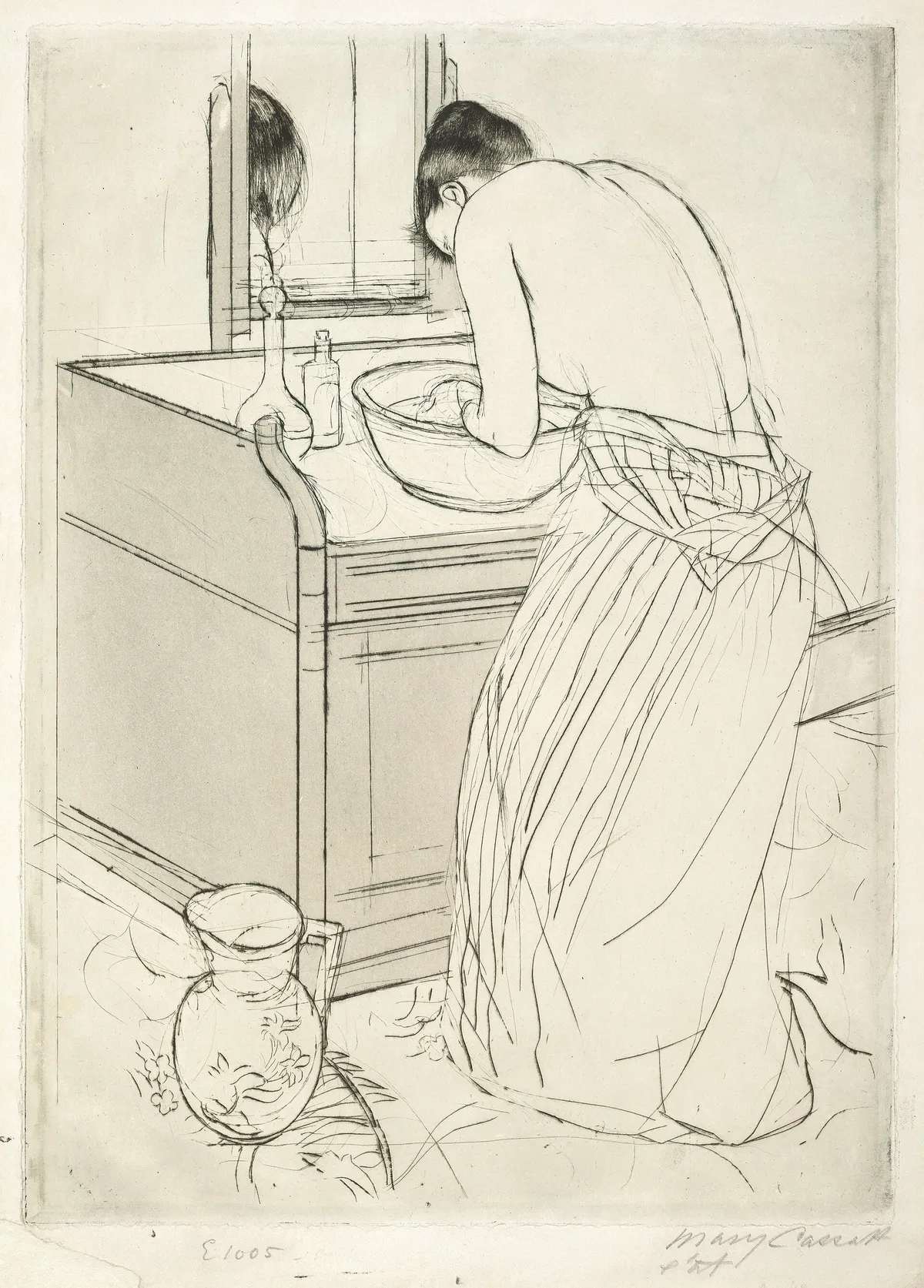
Between 1890 and 1891, working in her studio with the Parisian master printer M. Leroy, Cassatt produced her legendary suite of ten color prints, featuring works like The Letter, The Fitting, and Woman Bathing. Rather than carving soft woodblocks, she insisted on etching the compositions into Western metal intaglio plates.
The process demanded grueling labor and delicate chemical control. For each print, Cassatt prepared two or three separate copper plates, dusting the metal with powdered rosin before immersing it in nitric acid to create porous tonal grounds. She scratched sharp contours directly into the copper using a steel drypoint stylus, then hand-inked the plates using small leather pads (the *à la poupée* method). Running the damp paper sheets through a manual press required micro-precision; an alignment error of half a millimeter ruined the entire print.
When Durand-Ruel presented the completed suite in April 1891, the Impressionist circle was awestruck. Camille Pissarro wrote to his son Lucien in excitement: "The result is admirable, as beautiful as Japanese work... and she has produced them with printer's ink on copper!" The prints, represented in the Orsay retrospective through loans from the National Gallery of Art, proved that intaglio copper printmaking could achieve the flat, expressive color planes of Japanese woodcuts without sacrificing structural weight.
The Subversive Interior: Reframing Mothers and Children
In the third gallery of the retrospective, curator Sylvie Patry tackles the critical misconception that reduced Cassatt to a painter of nursery sentiment. Because her compositions frequently feature women bathing toddlers, reading letters, or serving tea, late nineteenth-century commentators treated her work as safe domestic ornamentation. That reading ignores both the social conditions of her daily life and the aggressive formal construction of her canvases.
Cassatt never married and never had children, dedicating herself entirely to her studio practice. Unaccompanied bourgeois women in nineteenth-century Paris were strictly barred from the public sphere; walking into a Montmartre cabaret or entering the backstage dance foyers frequented by Degas and Manet invited immediate social disgrace. Barred from the street, Cassatt turned the domestic interior into an arena of formal experimentation.
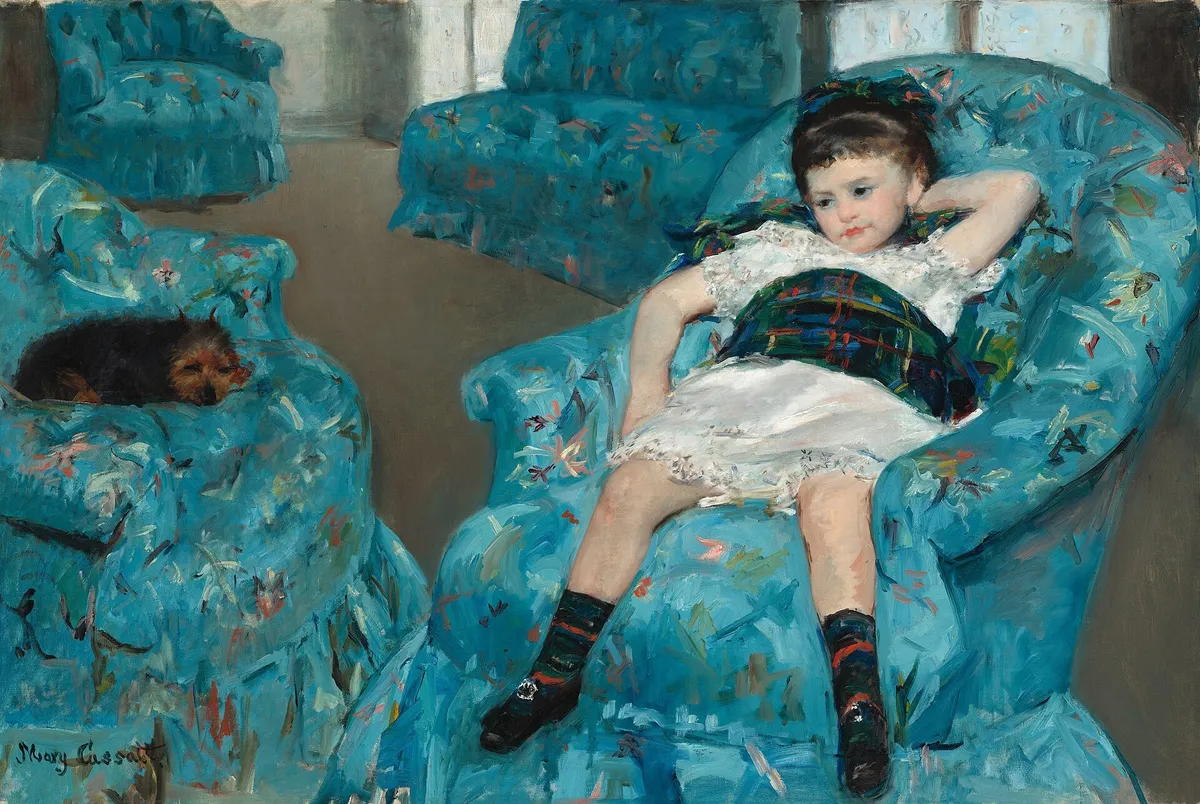
In Little Girl in a Blue Armchair (1878), on loan from Washington, Cassatt dismantled academic portraiture. A six-year-old child sprawls across giant turquoise armchairs, limbs askew and petticoats rumpled in unvarnished boredom while a lapdog naps nearby. Multispectral infrared reflectography conducted for the exhibition reveals that Degas added brushstrokes to adjust the corner perspective, yet the psychological honesty of the bored child belongs entirely to Cassatt.
Her 1878 canvas In the Loge, loaned by the Museum of Fine Arts Boston, turned spectatorship on its head. A woman dressed in austere black daytime clothes leans out of an opera box, training her field glasses onto the performance hall. Across the theater, an older man in a private balcony box leans forward with binoculars aimed directly at her. Cassatt exposed the predatory male gaze while her protagonist completely ignored it, asserting herself as an active viewer.
In masterworks like The Child's Bath (1893), Cassatt applied Japanese spatial compression to intimate physical care. The viewer looks down from an elevated vantage point onto a mother holding a child over a painted washbasin. The bold vertical stripes of the mother's gown cut across floral rugs, demonstrating how Impressionist art could ground radical color theory in the tangible labor of domestic life. Cassatt gave routine maternal care the monumental stability of classical history painting.
The Kingmaker and the Centenary Reckoning (1910–2026)
The concluding rooms of the Musée d'Orsay survey reveal an artist whose influence reshaped the institutional history of modern art. In 1874, Cassatt befriended Louisine Waldron Elder, a seventeen-year-old American studying in Paris. Three years later, Cassatt persuaded Elder to spend 500 francs of her pocket money on Degas's pastel Ballet Rehearsal, marking the very first Impressionist artwork acquired by an American collector.
That initial purchase launched a four-decade collecting partnership. Following Louisine's marriage to industrialist H.O. Havemeyer, Cassatt served as their unpaid aesthetic strategist. She steered the couple through Parisian galleries, counseling them to buy canvases by Courbet, Manet, Monet, Cézanne, and Degas decades before American curators understood their significance. That campaign culminated in the 1929 Havemeyer Bequest to the Metropolitan Museum of Art in New York, delivering nearly two thousand foundational masterworks to the public.
Cassatt's independence was equally evident in her political courage. In 1915, defying vocal opposition from conservative family members, she sent eighteen artworks to an exhibition at Knoedler Galleries in New York organized to raise operational funding for the women's suffrage movement. When relatives pressured her to withdraw her support, she remained steadfast, repeating the philosophy that governed her entire career: "I am independent! I can live alone and I love to work."
Her final years were shadowed by advancing illness. Severe diabetes and cataracts ended her painting career around 1914, forcing her to spend her last decade in quiet seclusion at Château de Beaufresne. She died on June 14, 1926, at eighty-two, and was buried in the family vault at Mesnil-Théribus. For decades afterward, French museums allowed her legacy to fade into obscurity, treating her as a distant American visitor.
The Musée d'Orsay's centenary retrospective dismantles that legacy of indifference. In the final vitrines, visitors encounter Cassatt's scarred copper printing plates resting beside the pristine aquatint impressions they yielded over a century ago. Standing before those metal surfaces, with their scratched drypoint incisions and acid-bitten textures, one recognizes the enduring truth of Mary Cassatt: she was not a polite observer of French modernism, but one of its primary, uncompromising architects.