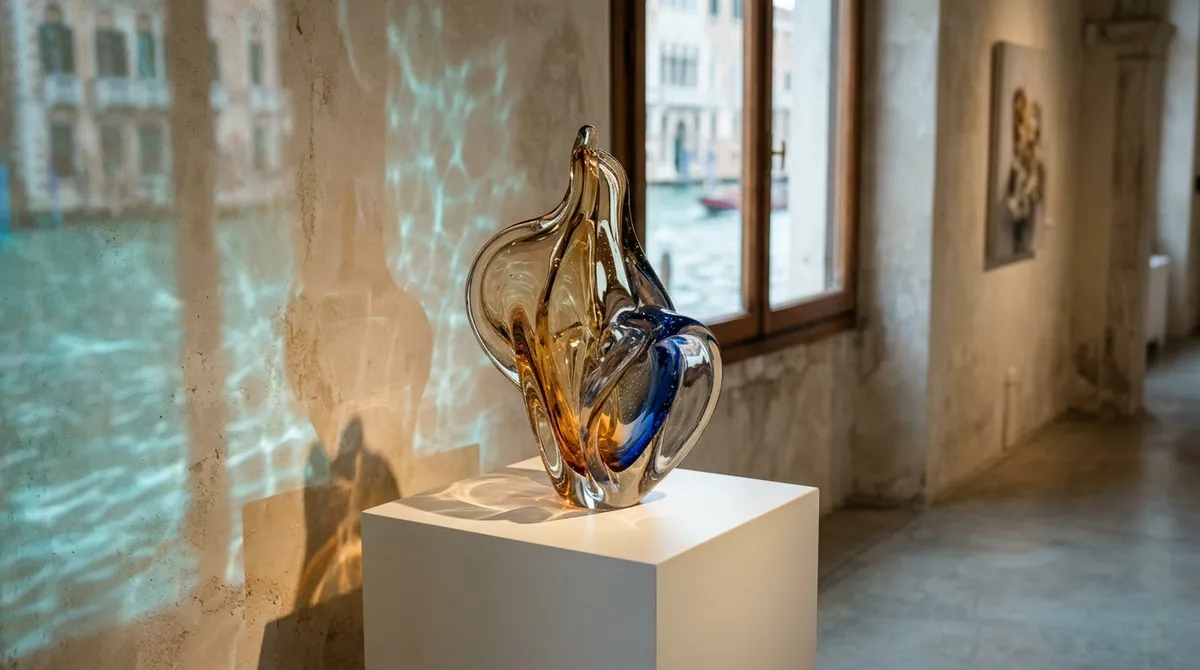
The mid-century art world was suffocated by intellectual snobbery that treated painters as philosophers and glassblowers as mere gift-shop mechanics. Canvas was celebrated as sacred territory for existential thought, while furnace glass was written off as commercial kitsch fit only for tourist trinkets. In the early 1950s, an eccentric Venetian clerk named Egidio Costantini decided to blow that hierarchy apart by dragging the giants of European modernism straight to the kilns of Murano.
Costantini had watched the centuries-old glassmaking tradition of his city slide into formulaic repetition after World War II. He saw molten Murano glass not as an applied craft, but as a severe sculptural medium capable of matching cast bronze or carved marble. When he persuaded Pablo Picasso, Max Ernst, Jean Cocteau, and Lucio Fontana to supply concepts for his furnaces, he was not looking to produce luxury souvenirs; he was demanding that the avant-garde test its ideas against raw fire.
On November 14, 2026, the Peggy Guggenheim Collection in Venice opened Fucina degli Angeli: Peggy Guggenheim and 20th-Century Artistic Glass, a survey curated by Cristina Beltrami running through March 29, 2027, at Palazzo Venier dei Leoni. The exhibition brings together over 100 glass sculptures, preparatory drawings, test pieces, and letters that document this collision of worlds.
The cultural fault line between Parisian salons and Venetian kilns
In the 1950s, the European art scene was split into two hostile camps that spoke completely different languages. In Paris, painters debating Cubism, Surrealism, and Spatialism viewed glass with deep suspicion. To artists whose reputations were built in high-minded galleries and cataloged in places like the Musée Picasso Paris, working in hot silicate seemed dangerously close to commercial decorating.
Across the lagoon on Murano, the maestri vetrai had their own reasons for skepticism. Isolated on their island since the Venetian Republic ordered all furnaces moved there in 1291, these families had guarded secret recipes for soda ash, cobalt, and potash for centuries. They knew how molten silicate flowed, chilled, and cracked under thermal shock, and they had little patience for two-dimensional drawings sent from Paris by intellectuals who had never held an iron blowpipe.
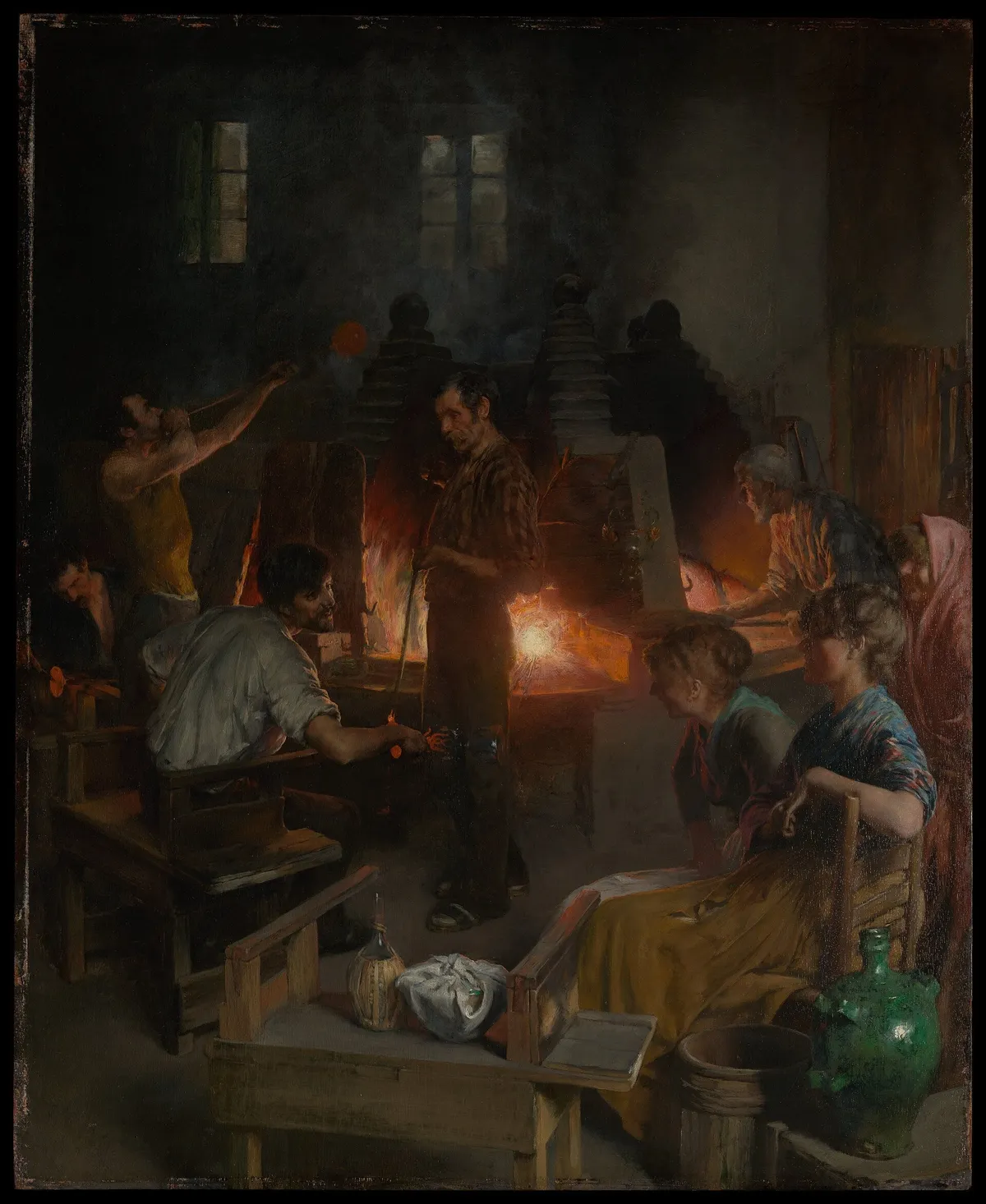
Molten silicate at 1,400 degrees: translating drawings into Murano glass
Costantini served as the indispensable cultural translator between these two stubborn factions. In 1955, French poet Jean Cocteau christened the venture Fucina degli Angeli (the Foundry of the Angels), recognizing that bridging paper and fire required something close to alchemical mediation.
The workshop floor was blistering, noisy, and unforgiving. Glass softens into workable syrup near 1,400 degrees Celsius, giving a master mere seconds to gather, roll, shear, and blow before cooling makes the piece shatter. Costantini traveled south to France, collecting ink drawings from Picasso in Vallauris and plaster maquettes from Ernst in the Touraine, then rushed back to Venice to stand beside the furnace opening, coaching glassmakers with wooden paddles and arm gestures.
Picasso provided sketches of mischievous fauns, horned satyrs, and mythological heads, testing how his graphic line held up in solid crystal. Lucio Fontana translated his spatial concepts into thick glass ellipsoids with pierced cavities and deliberate bubbles, while Max Ernst created totemic figures such as Poète, a sculpture modeled in plaster around 1960 and cast in heavy dark glass. These biomorphic shapes and glowing fields mirrored the formal questions being asked across post-war abstract art, showing how non-representational volume could live inside colored light.
Peggy Guggenheim’s Grand Canal gamble
Technical breakthroughs did not pay furnace fuel bills. By 1958, crushing production costs, broken molds, and customs disputes brought the Fucina to the edge of bankruptcy.
That was when Peggy Guggenheim stepped in. As The Art Newspaper reported in its coverage of the survey, Guggenheim provided emergency funds, became Costantini's close patron, and recognized that modern sculpture needed to escape its own somber conventions.
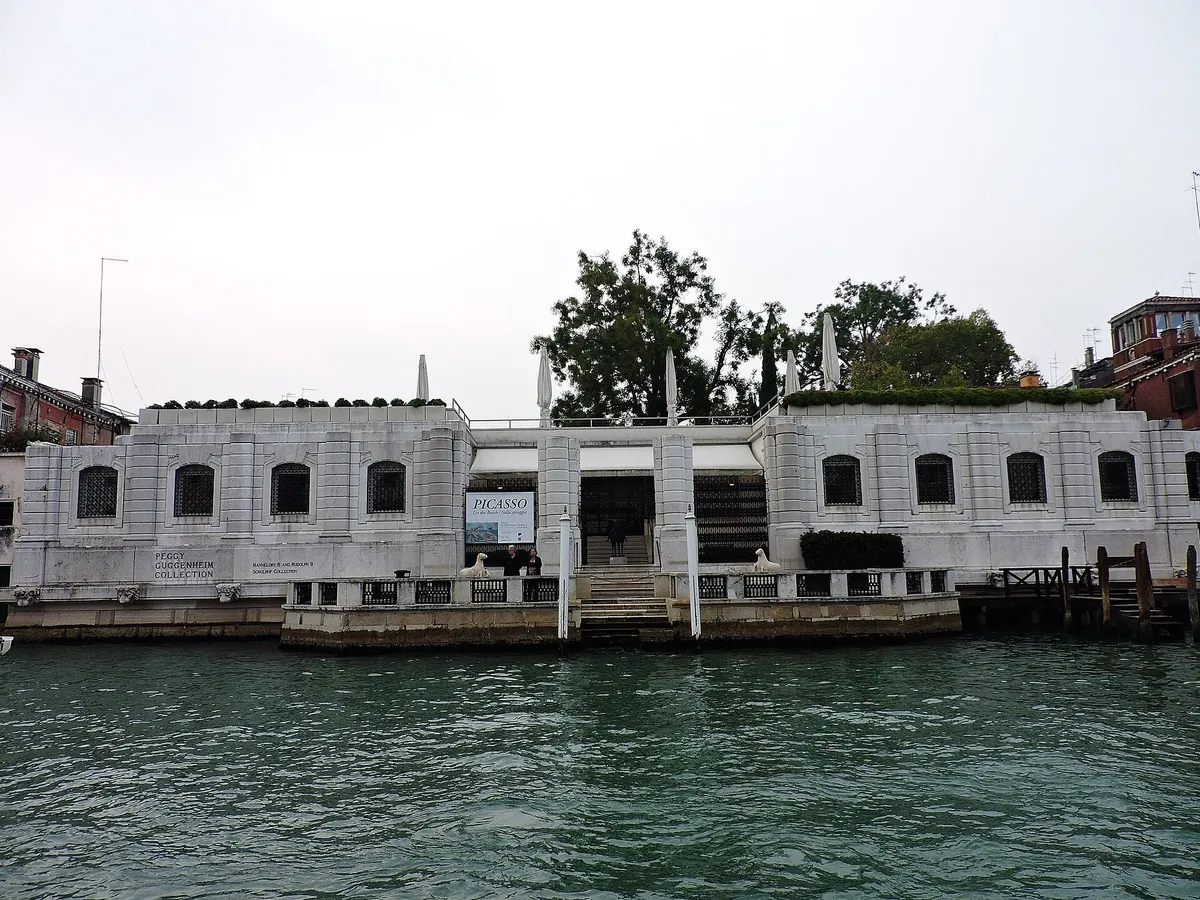
In 1960, Guggenheim mounted a dedicated exhibition of Costantini's glass inside her home, Palazzo Venier dei Leoni on the Grand Canal. She set glowing glass creatures directly on her garden terraces alongside bronzes by Alberto Giacometti and stone carvings by Constantin Brancusi. Sunlight reflecting off canal waters danced through Ernst's amber figures and Picasso's cobalt satyrs, forcing international collectors to look past the souvenir stigma.
Guggenheim took the fight abroad, tapping her network of curators and dealers to place Costantini's works in major collections. That advocacy led directly to the landmark 1965 exhibition Sculpture in Glass at the Museum of Modern Art in New York. Retrospectives preserved by institutions like Le Stanze del Vetro Venice show how that MoMA survey permanently shifted the critical perception of studio glass.
The lasting legacy at Palazzo Venier dei Leoni
Seven decades later, the 100 works assembled in Beltrami's 2026 exhibition at Palazzo Venier dei Leoni carry an unexpected, muscular presence. Picasso's fauns gaze out with animal stillness, Fontana's punctured spheres retain their cosmic tension, and Ernst's totems cast long, colored shadows across the stone floors.
The boundary between fine art and decorative craft was always a convenience for theorists rather than makers. As Jean Cocteau wrote when dedicating the Fucina degli Angeli: "You have given our dreams the solidity of crystal."