Stop treating Jean-Michel Basquiat like an art-market sacrificial lamb. For 40 years, the blue-chip gallery establishment has preferred him tragic, primitive, and dead, turning his crowned skulls into $110 million auction trophies and mall-brand hoodies. On December 11, Netflix and his surviving family are finally setting the record straight with the global streaming premiere of Jean-Michel Basquiat, the first estate-authorized Basquiat Netflix documentary.
The commercial art world loves a doomed prodigy because a silent ghost cannot dispute an auction catalogue. Freezing Basquiat as an unschooled graffiti kid rescued from cardboard boxes by Andy Warhol allows buyers to ignore the razor-sharp political critique running through every brushstroke. His surviving family is using private archives to dismantle that myth piece by piece.
The Basquiat Netflix Documentary Dismantles the Savant Myth
Co-directors Quinn Whitney Wilson and Viridiana Lieberman bypass the exhausted trope of an erratic downtown mascot. When the feature premiered at the 2026 Tribeca Festival, taking home the jury award for Best Editing in a Documentary Feature, the film proved that Basquiat's studio practice was an exercise in deliberate intellectual strategy. Wilson and Lieberman anchor their story in domestic reality rather than nightclub folklore.
The backbone of the film comes directly from his sisters, Lisane Basquiat and Jeanine Heriveaux, who co-administer The Estate of Jean-Michel Basquiat. As detailed in Essence, their leadership unlocked family holdings that outside biographers never accessed: Super-8 home reels, childhood sketchbooks, and personal correspondence. What emerges is not an isolated savant, but a multilingual Brooklyn kid raised in an ambitious middle-class home.
Basquiat spoke fluent French, Spanish, and English years before he picked up an aerosol can. His mother, Matilde, enrolled him as a junior member of the Brooklyn Museum when he was six years old, nurturing a lifelong habit of museum research. The 1980s downtown narrative painted him as an unschooled primitive largely because white collectors struggled to accept a young Black man operating with superior art-historical literacy.
An Accumulation of Deliberate Studio Genius
The documentary's most compelling sequence tracks the sheer density of Basquiat's research methods. Early notebooks show him methodically dissecting anatomical diagrams from Gray's Anatomy, a gift from his mother after a childhood car accident. Rather than doodling at random, he was studying Leonardo da Vinci’s compositional structures, transcribing bebop jazz theory, and annotating classical histories with relentless focus.
His SAMO tag with Al Diaz was not aimless vandalism: it was an ironic, highly visible conceptual campaign targeted directly at SoHo dealers. When Basquiat transitioned to raw canvas, his layered oilstick, acrylic, and paper collage baffled contemporary reviewers who lacked the cultural context to read his work. He sampled rhythmic syncopation from Charlie Parker and Dizzy Gillespie, fusing bebop cadence with Spanish proverbs and biting satire of American consumerism.
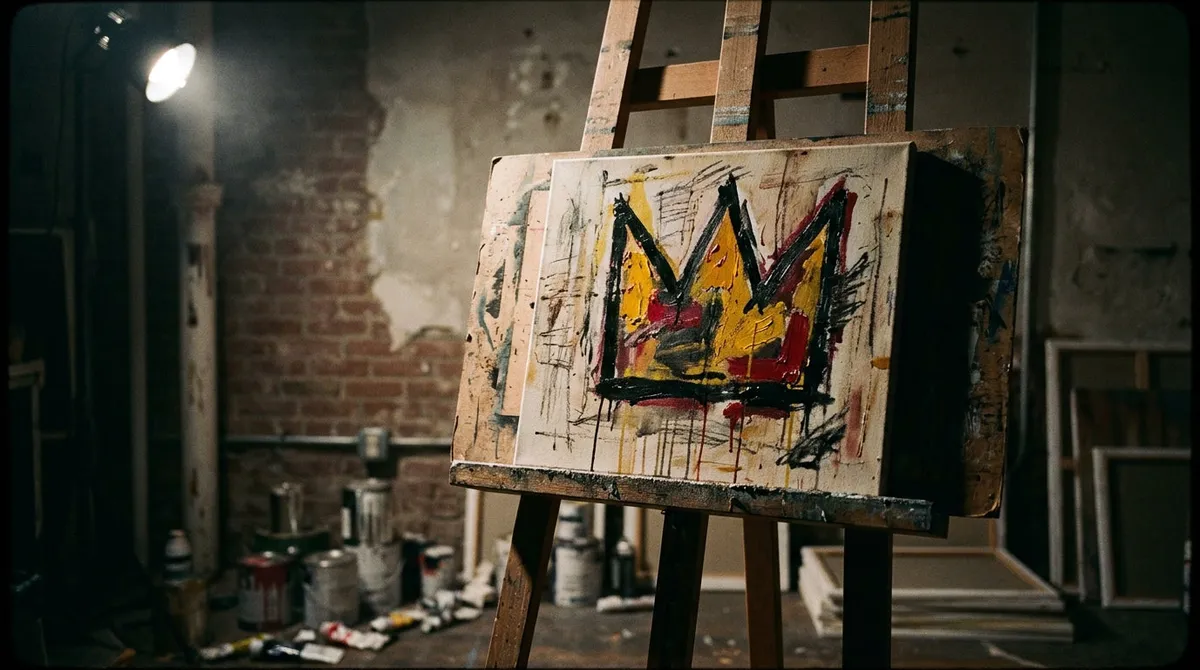
Even his trademark three-pointed crown was an act of political subversion. While dealers often treated the motif as naive shorthand, estate documents confirm it was an intentional coronation of Black excellence. Basquiat used the crown to confer royal dignity on figures like boxer Joe Louis, systematically writing Black genius into a segregated Western art canon.
His signature habit of crossing out lines served that same tactical agenda. Basquiat crossed out phrases specifically so the viewer would strain to read them, weaponizing curiosity through deliberate obstruction. That typographic bravura paved the way for generations of graphic designers and modern pop culture wall art, yet on his canvases, every crossed-out letter was calculated psychological combat.
Why an Authorized Basquiat Film Matters Now
Controlling an artist's biographical record is the only defense against endless commercial dilution. As reported by Ocula, the documentary represents the estate's largest media undertaking since their traveling King Pleasure museum exhibition. When an artist's visual vocabulary gets stamped across sneakers and luxury luggage, the original anti-capitalist critique risks evaporating into pure decor.
Traditional retrospectives and auction houses inevitably center the collector's prestige over the painter's mind. By taking this archival archive directly to hundreds of millions of living rooms on Netflix, Lisane Basquiat and Jeanine Heriveaux strip the gallery gatekeepers of their editorial monopoly. The public finally gets to view Basquiat through the eyes of the women who shared his breakfast table, not the dealers who billed him by the yard.
The Smartest Person in the Room
Forty years of mythology reduced Jean-Michel Basquiat to a downtown tragedy, but the work tells an entirely different story. He did not burn out from fragility; he confronted a predatory industry, laid bare its racial hypocrisies, and left behind an airtight visual philosophy.
He was never Warhol's sidekick or an art-world oddity. He was a ruthless visual strategist, and he was the smartest person in every room he entered.