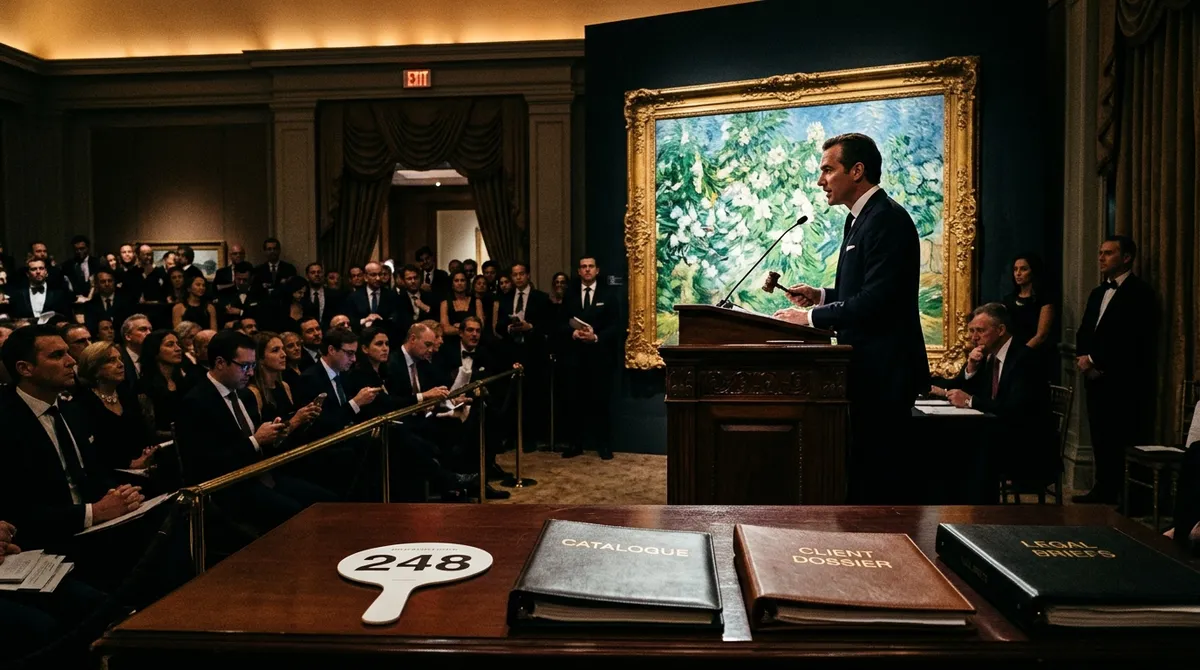
Auction catalogs on York Avenue describe Vincent van Gogh’s Châtaigniers en fleurs as a hymn to spring, celebrating floral renewal in Auvers-sur-Oise. In reality, the canvas has become the flashpoint of a ferocious legal and moral contest. Hours before the opening gavel of New York’s fall auction season, a dispute over Nazi-era extortion threatens to halt this historic Van Gogh sale.
At stake is a $180 million pre-sale valuation, the highest ever placed on a Van Gogh canvas at public auction. Billed as the crown jewel of New York's marquee evening sales, the painting now sits between an aristocratic consignment contract and an eleventh-hour demand for restitution.
The Flashpoint: A $180 Million Van Gogh Sale in the Crosshairs
Van Gogh completed Châtaigniers en fleurs (Chestnut Trees in Blossom) in May 1890, working with rapid intensity across the French countryside barely two months before his death in July. The composition depicts heavy chestnut boughs bowing under white blossoms, their petals rendered in thick impasto against an agitated blue-green sky. Archival studies from the Van Gogh Museum in Amsterdam document that this final spring in Auvers marked one of the painter's most concentrated creative periods.
The canvas dropped out of public sight in 1975, when Argentine collectors Carlos Pedro Blaquier and Nelly Arrieta acquired it for their private residence in Buenos Aires. For five decades, art historians knew the work primarily through black-and-white catalog photographs. When Sotheby’s secured the estate consignment for its November 18 sale, it backed the lot with a substantial house guarantee to win the collection.
As Artnet News noted, the lot was positioned to eclipse the existing Van Gogh auction record of $117.2 million set by Verger avec cyprès in 2022. That plan unraveled when Berlin attorney Gunnar Schnabel sent a formal demand letter on behalf of the heirs of German-Jewish publisher Samuel Fischer. The letter demanded that Sotheby's withdraw the painting from the rostrum immediately.
Camp A: The Fortress of Good-Faith Commercial Title
Sotheby’s defense rests on property law, established title statutes, and contemporaneous market records. Institutional researchers argue that the Fischer family sold Châtaigniers en fleurs in 1936 through Paul Cassirer's gallery in Amsterdam, an open commercial transaction conducted outside the borders of the German Reich four years before the Nazi invasion of the Netherlands. Archival ledgers indicate that the painting fetched fair market value for a major Post-Impressionist work at the time, rather than a distressed liquidation price.
The Blaquier-Arrieta estate maintains that it holds clean legal title backed by five decades of open ownership. The Argentine family purchased the painting in 1975 through established dealers, with no competing claims logged on international stolen art registries across fifty years. Unwinding an extraterritorial commercial sale from ninety years ago, consignor advocates argue, would destabilize legal certainty across the global art trade.
Commercial exposure further complicates any retreat for the auction house. Sotheby's contractual commitments to the consignors mean that pulling the lot without a court order risks heavy breach-of-contract penalties. In public statements, representatives for Sotheby's stated that the firm uncovered no evidence of an unlawful seizure, while confirming ongoing talks with the claimants' legal team.
Camp B: The Fischer Heirs and the Weaponized Flight Tax
The Fischer descendants view the 1936 Amsterdam transaction through the lens of systematic persecution. Samuel Fischer founded S. Fischer Verlag, the renowned publishing house that published Thomas Mann, Hermann Hesse, and Arthur Schnitzler, having purchased the Van Gogh before the First World War. After Fischer died in 1934, his son-in-law Gottfried Bermann Fischer took charge, only to face anti-Semitic boycotts, police raids, and the state-directed confiscation of publishing assets.
Reporting from The New York Times revealed that the family fled Berlin for Vienna under immediate financial coercion. The Nazi regime levied the punitive Reichsfluchtsteuer, or Reich flight tax, assessing a 25 percent capital tax on departing Jews while freezing their remaining assets in blocked accounts. To pay that extortionate levy and fund their escape, the family consigned the painting in Amsterdam; treating a refugee's survival sale as a voluntary transaction ignores the state apparatus that stripped them of their livelihood.
Under the 1998 Washington Conference Principles on Nazi-Confiscated Art, forty-four nations agreed to pursue fair and just solutions for assets sold under racial persecution, recognized as Fluchtgut or flight goods. Gunnar Schnabel challenged Sotheby’s to prove that the family would ever have sold their prized Van Gogh without the threat of Nazi terror. For restitution scholars, economic extortion by a totalitarian state cannot be legitimized by pointing to a foreign border.
The Cultural Fault Line: Where Trophy Capital Collides with History
The conflict on York Avenue reflects a broader international shift away from technical legal shields in Holocaust-era art disputes. Only days before the Van Gogh standoff, The Art Newspaper detailed how a Paris court voided all successive sales of a 1902 Camille Pissarro canvas looted from Jewish banker Salomon Flavian, ordering Sotheby’s to unmask the private buyer who bought it in London in 2024. That French ruling highlighted the growing willingness of European courts to look past intermediate market transactions to remedy wartime spoliation.
The enduring public fascination with late nineteenth-century masterworks, including the expressive legacy reflected in museum collections and Impressionism prints, ensures that trophy sales remain intensely scrutinized. When a canvas carries both a nine-figure estimate and documented flight-tax coercion, aesthetic prestige cannot insulate it from provenance ethics. High valuations raise the stakes for all parties, making private compromises both harder to negotiate and more critical to achieve.
As attorneys for Sotheby's and the Fischer heirs conduct closed-door negotiations in Manhattan ahead of the November 18 sale, the auction room awaits a resolution. A private settlement or lot withdrawal would affirm that flight-tax liquidations fall within the scope of modern restitution standards. Proceeding to the rostrum under an active claim, by contrast, tests whether market momentum can still outrun the unresolved debts of twentieth-century history.