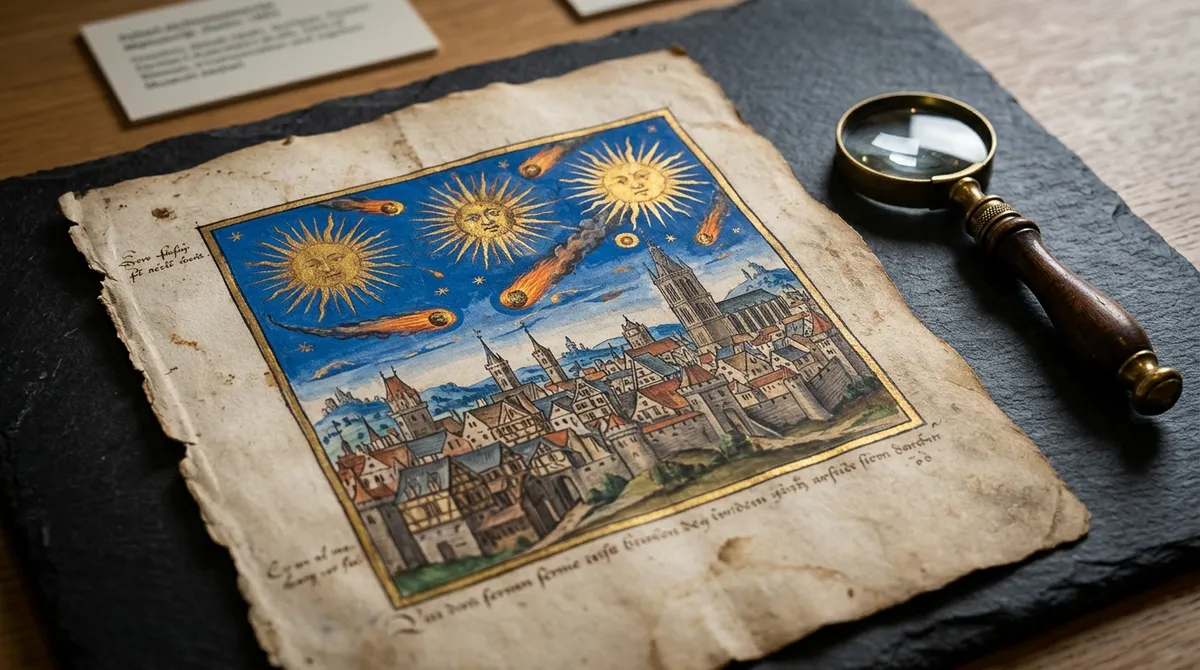
In 1552, a painter in Augsburg dipped a camel-hair brush into lapis lazuli and vermilion gouache to paint three suns blazing simultaneously over the Bohemian hills. To modern eyes, it looks like speculative fiction. To a Renaissance German watching religious wars fracture the Holy Roman Empire, it was visual proof that God was running out of patience.
The painting belongs to the Augsburger Wunderzeichenbuch, known in English as the Augsburg Book of Miracles. Created during a period of intense spiritual panic, this illuminated codex brought together ancient prodigies, Old Testament catastrophes, and contemporary weather anomalies into a single apocalyptic ledger. For nearly four and a half centuries, it sat unrecorded in a private Bavarian library.
On December 10, 2026, the original manuscript goes under the hammer at Christie's London, carrying an estimate of £700,000 to £1,000,000 ($900,000 to $1.3 million). Reporting from The Art Newspaper and ARTnews confirms it is the centerpiece of An Alchemy of Ideas: Works from the Mickey Cartin Collection, marking the first time in sixteen years that the codex has faced the open market.
The 167 Visions of the Augsburg Book of Miracles
In the 1550s, Augsburg was a banking powerhouse where strange skies were never dismissed as optical flukes. Vast commercial fortunes could not insulate the city from regional panic, and citizens parsed every comet, parhelion, or unseasonal frost as an unmistakable sign that the cosmic order was collapsing.
Scholarly research by art historians Till-Holger Borchert and Joshua P. Waterman attributes the 167 miniatures to the workshops of two prominent Augsburg masters: Hans Burgkmair the Younger (c. 1500–1562) and Heinrich Vogtherr the Younger (1513–1568). Working on heavy paper leaves measuring roughly 205 by 307 millimeters, their studio artists turned chronicled portents into panoramic disaster scenes, combining observational realism with visionary horror.
Across its surviving leaves, painters recorded skybound armadas clashing above Swiss villages, showers of iron rods and hot stones rattling onto dry fields, and blood-red moons hovering over drowning seaports. Locust swarms chewed through whole provinces until the dirt turned black, each calamity framed by careful borders and written records noting the exact day the omen fell. The sequence begins with Noah's flood and Egyptian plagues, marches through classical Roman prodigies, and culminates in the multi-headed dragon of Revelation rising out of churning seas.
The manuscript grounded its cosmic fears in startling local reality. On Folio 117, illustrating a two-headed calf born near Langweid in 1529, Hans Burgkmair the Younger added his own handwritten note: “...and I, Hans Burgkmair, painter, bought the skin for half a guilder from a parchment-maker, who had bought it for only six kreuzer.” In sixteenth-century Swabia, the end of the world was physical evidence you could buy from a leather merchant down the street.
The Castle Library and Mickey Cartin
Almost immediately after its completion around 1552, the manuscript vanished. It left no trace in regional inventories or Renaissance correspondence, sitting undisturbed for centuries in the private library of an unnamed Baroque castle in Upper Bavaria. Through the Thirty Years' War, Napoleonic marches, and modern air raids, the codex escaped damp rot, fire, and pillaging.
The silence broke in 2008, when the near-complete volume surfaced unexpectedly at a Munich auction house. In 2010, Connecticut art collector Mickey Cartin acquired the manuscript with London dealer James Faber. Cartin recognized that the book was an extraordinary survival of Northern Renaissance graphic art: a complete visual encyclopedia of sixteenth-century cosmic terror that deserved scholarly study rather than a dark safe.
The Taschen Phenomenon and the Private Vault
Rather than locking the book away, Cartin opened it to researchers. Borchert and Waterman spent three years deciphering its Early New High German captions, and in 2013, art publisher Taschen released a landmark full-color facsimile that reproduced every gouache miniature at actual size.
The publication turned a long-lost German codex into a viral phenomenon. Graphic novelists, fantasy illustrators, and printmakers latched onto its flat planes of gouache, stark silhouettes, and saturated mineral palettes: an uninhibited, cinematic branch of Renaissance art that felt closer to graphic novels than to gilded altar panels.
That public exposure was always fragile. For the past fifteen years, the Augsburg Book of Miracles belonged to the public imagination entirely because one private collector chose to share it with scholars and cameras.
On December 10, when bidding opens in Christie's London salesroom, that era of open access may quietly close. Public museums rarely have the unrestricted acquisition budgets to outbid offshore trusts or private wealth funds on seven-figure manuscripts. In a few weeks, this 500-year-old warning sign could easily disappear into another climate-controlled vault for the next four centuries. We were fortunate to have seen it at all.