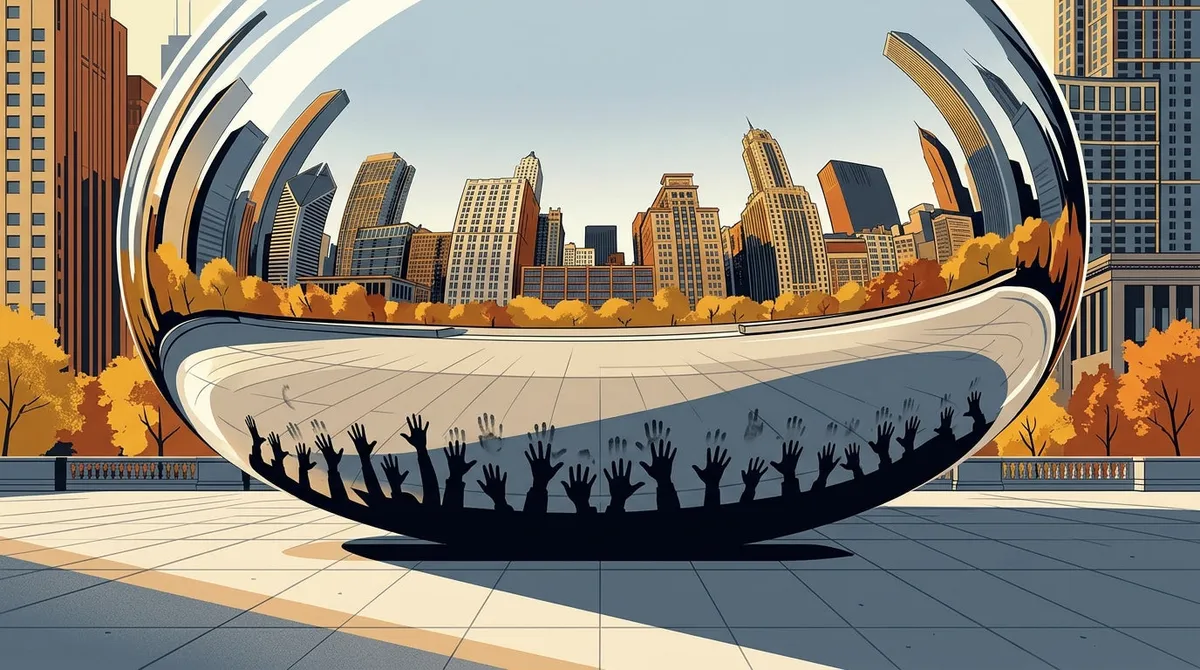
At 12:47 p.m. on Sunday, more than 250 shivering Chicagoans gathered in Millennium Park, flattened their bare palms against 110 tons of mirror-polished British stainless steel, and shoved with collective fervor. The objective was neither political protest nor municipal revolution: the crowd had assembled to heave Anish Kapoor’s Bean seven inches to the left to liberate an imaginary maintenance worker supposedly sealed inside since 2004 and slide him a dill pickle.
The stunt, coordinated through a tongue-in-cheek invite on the event platform Partiful, treated the world's most famous piece of reflective civic sculpture as an interactive playground toy. As reported by Artnet News, the gathering was entirely peaceful, wildly photographed, and completely futile. The 110-ton monolith remained anchored to its concrete footing without shifting a fraction of a millimeter.
Yet the sight of hundreds of people physically straining against the steel shell struck an exposed nerve across the art world. What began as a digital joke collided head-on with twenty years of tension between institutional sanctity and civic ownership. The crowd laid bare the central unresolved friction of municipal monuments: who actually owns a piece of public art once the ribbon is cut?
The Flashpoint: Seven Inches to the Left
The premise circulating across social media was straightforward absurdism. According to the organizers, shifting the sculpture seven inches would expose an underground release catch, letting participants pass basic provisions into the dark hull. People arrived carrying grocery jars, chanted rhythmic countdowns, and threw their full shoulder weight into the cold curvature.
Tourists visiting AT&T Plaza quickly joined the heave, creating an unscripted spectacle in the center of the Loop. As detailed by Artforum, park security monitored the perimeter without stepping in, recognizing the gathering as harmless communal humor rather than a physical threat to city property. Within hours, phone clips of the coordinated push collected millions of views across TikTok and Instagram.
The stunt succeeded because it tapped into something rare: genuine, unscripted public assembly organized entirely for the sake of a shared joke. It also exposed a sharp divide between those who view civic monuments as static altars to be observed and those who treat them as shared municipal furniture.
Camp A: Anish Kapoor’s Bean as a Proprietary Monument
The institutional argument begins with the physical and financial reality of the object itself. Officially titled Cloud Gate, the sculpture is an unprecedented engineering feat commissioned in 2004 and formally dedicated in May 2006. Fabricated by Performance Structures, Inc. in Oakland, California, under founder Ethan Silva, its exterior consists of 168 cold-rolled 316-grade stainless steel plates welded together and polished until every joint vanished.
The project was originally budgeted at $6 million, but overcoming the complex structural hurdles pushed the final bill to $23 million, paid entirely by private donors through the Millennium Park Foundation. Measuring 33 feet high, 66 feet long, and 42 feet wide, the sculpture was engineered to liquid tolerances so its surface would reflect the Chicago skyline without distortion. Like the broader tradition of reflective minimalism and metallic modern wall art, the piece relies entirely on ambient light and architecture to complete its composition. Preserving that pristine finish requires maintenance workers to hand-wipe the lower steel twice daily and wash the entire structure in a 40-gallon liquid detergent bath every spring and autumn.
From the institutional perspective, treating this delicate architectural marvel like a carnival tug-of-war threatens both the material object and the civic investment behind it. Beyond the physical upkeep, Anish Kapoor has spent decades fiercely guarding the conceptual sanctity of his work. Kapoor famously bristled when Chicagoans immediately nicknamed the piece "The Bean" in 2004, dismissing the moniker as "completely stupid" and lamenting that it reduced a meditation on infinite sky to a vegetable.
Kapoor has repeatedly backed that possessiveness with legal force. In 2018, he filed a federal copyright infringement lawsuit against the National Rifle Association after the organization used unauthorized footage of Cloud Gate in a political recruitment video, forcing them to remove the image. Coupled with his controversial exclusive monopoly over the light-swallowing pigment Vantablack S-VIS, Kapoor represents the purist belief that an artwork remains the intellectual property of the artist, no matter how public its plaza becomes.
Camp B: The Populist Reclaiming of Public Space
Street level has its own logic: once an artwork enters a city square, the public becomes its true author. Chicago never treated the piece as a distant, untouchable temple. From the week it opened, visitors stepped directly underneath its twelve-foot underbelly arch, touched the chilled metal, and laughed at their warped reflections alongside office towers.
The public re-baptized the monument "The Bean" within forty-eight hours of its unveiling, sweeping aside museum jargon. Even Kapoor eventually yielded to the city's stubborn affection, conceding in later interviews that he had begun calling it The Bean himself. Sunday's attempt to shove the structure was simply the latest chapter in that civic relationship, where affection takes the form of playful irreverence.
In a downtown core where most open areas are privatized, surveilled, or commercialized, gathering to push an immovable object offers a rare moment of spontaneous, uncommodified play. The participants were not tagging the surface or chipping the metal; they were testing its permanence with their own hands. By turning passive sightseers into co-conspirators, the crowd asserted that public art earns its keep through direct engagement.
The Cultural Fault Line: Contracts, Cleaning Crews, and Public Space
That friction exposes an unresolved question for city halls and park districts: when a municipality commissions a monument, who actually owns the experience? The City of Chicago Department of Cultural Affairs and Special Events deliberately promotes the plaza as an open civic forum, inviting millions of tourists each year to gather at the site.
Yet the legal architecture surrounding public art still leans heavily toward gallery-style control. Under the Visual Artists Rights Act of 1990, artists retain moral rights to prevent the modification or distortion of their creations, even when installed outdoors. But while federal statute shields sculptures from physical alteration, it cannot govern how the surrounding culture chooses to interpret, celebrate, or gently parody them.
Out in the open plaza, absolute control is an illusion. When an artist accepts a commission for a public park, they sign an implicit contract with the city's inhabitants. The public will fund the policing, clean away the fingerprints, photograph their families in the reflection, and occasionally gather on a freezing afternoon to test whether the whole thing might slide into Michigan Avenue.
The Unmovable Mirror
At 1:00 p.m., the crowd gave one last concerted heave, cheered, and stepped back. The sculpture remained exactly where Ethan Silva’s engineers bolted it two decades ago, undisturbed by the collective muscle of several hundred people. The fictional worker remained trapped, and the pickle jars stayed sealed in backpacks.
The crowd drifted off into the Loop for hot coffee, leaving behind only an overlapping gallery of palm prints along the lower steel belt. Park maintenance crews had the surface washed and squeegeed before evening, bringing back the crisp, unbroken reflection of Michigan Avenue. The sculpture did not move, but the city once again made its point: an artist may hold the copyright, but the public holds the soul of the plaza.