Almost everything popular culture tells you about Vincent van Gogh and Paul Gauguin in the Yellow House belongs to cheap melodrama. The story has been reduced to a lurid loop: shouting matches over absinthe, a severed earlobe wrapped in newspaper, and a panicked midnight train from Provence. That caricature forgets the intellectual shock that took place just days before the crisis, during a freezing day trip to Montpellier in mid-December 1888.
Van Gogh and Gauguin boarded an early train to flee the waterlogged chill of Arles. They traveled forty miles west to the Musée Fabre, drawn by the radical private collection of art patron Alfred Bruyas. Standing before Gustave Courbet's 1854 manifesto, The Meeting (derisively known as Bonjour, Monsieur Courbet), the two painters collided with the central dilemma of modern art: whether a canvas should report the physical truth of the eye or construct an independent world of the mind.
Their freezing day trip did not calm the psychological storm in Arles. Within a week, the Yellow House was abandoned in blood, while Courbet's painting directly seeded Gauguin's sardonic 1889 response, Bonjour Monsieur Gauguin. Now, that sharp confrontation anchors a major Bonjour Monsieur Gauguin retrospective running from October 30, 2026 to February 28, 2027 at Budapest's Museum of Fine Arts (Szépművészeti Múzeum). Curated by art historian Judit Geskó, the exhibition brings together 150 works to reopen the files on the most consequential, volatile partnership in nineteenth-century painting.
The Pressure Cooker in Arles
When Gauguin stepped off the train in Arles on October 23, 1888, Vincent believed his communal sanctuary had finally begun. Vincent had spent the late summer decorating the rented rooms on Place Lamartine with radiant sunflower canvases and sturdy provincial chairs. He envisioned an egalitarian brotherhood of painters living simply, pooling resources, and working outside the greedy orbit of Parisian art dealers.
The economic reality behind the arrangement was far more transactional. Gauguin had not traveled south out of affection. He was broke, recovering from dysentery contracted in Martinique, and deeply in debt. He came because Vincent's brother, Parisian art dealer Theo van Gogh, agreed to pay him a monthly stipend of 250 francs and cover his travel expenses in exchange for regular shipments of paintings.
From the first week, domestic life inside the house was volatile. Vincent was thirty-five, erratic, and careless with money, living on bread, coffee, and cheap tobacco while working himself into a fever over wet canvases. Gauguin, six years older, was a pragmatic former sailor and stockbroker who took immediate control of the household finances, locking their money in a tin box on the mantelpiece and dividing it strictly into rent, groceries, and nocturnal outings.
By late November, the golden light of Provence had vanished under weeks of driving rain and punishing blasts of the Mistral. Trapped indoors with wet laundry and charcoal smoke, their working methods clashed violently. Vincent set up his easel directly before his subject, attacking the canvas with rapid, furious brushwork. He squeezed paint straight from lead tubes, building up sculptural ridges of chrome yellow and Prussian blue that recorded every tremor of his hands.
Gauguin looked at Vincent's churning surfaces with undisguised irritation. In Brittany, working alongside Émile Bernard, Gauguin had pioneered Synthetism: an approach that rejected the photographic copying of nature in favor of memory and decorative rhythm. Gauguin painted on dry burlap and coarse linen, applying thin, matte washes of color bordered by dark contours like medieval stained glass.
"Do not copy nature too much," Gauguin warned Vincent during their long studio sessions. "Art is an abstraction; extract it from nature while dreaming before it."
Gauguin pressed Vincent to put away his live models and paint from imagination. Vincent tried, producing works like his Memory of the Garden at Etten, but the exercise left him anxious, disoriented, and frustrated. When Gauguin painted a portrait of Vincent at his easel (The Painter of Sunflowers), Vincent stared at the canvas in horror. "It is certainly I," Vincent muttered, "but it is I gone mad."
The Train to Montpellier
By the second week of December, the atmosphere inside the studio had curdled into open hostility. Gauguin was drafting quiet letters to his friend Émile Schuffenecker in Paris, complaining that Vincent's temperament was unbearable and that he planned to leave Provence the moment his finances allowed.
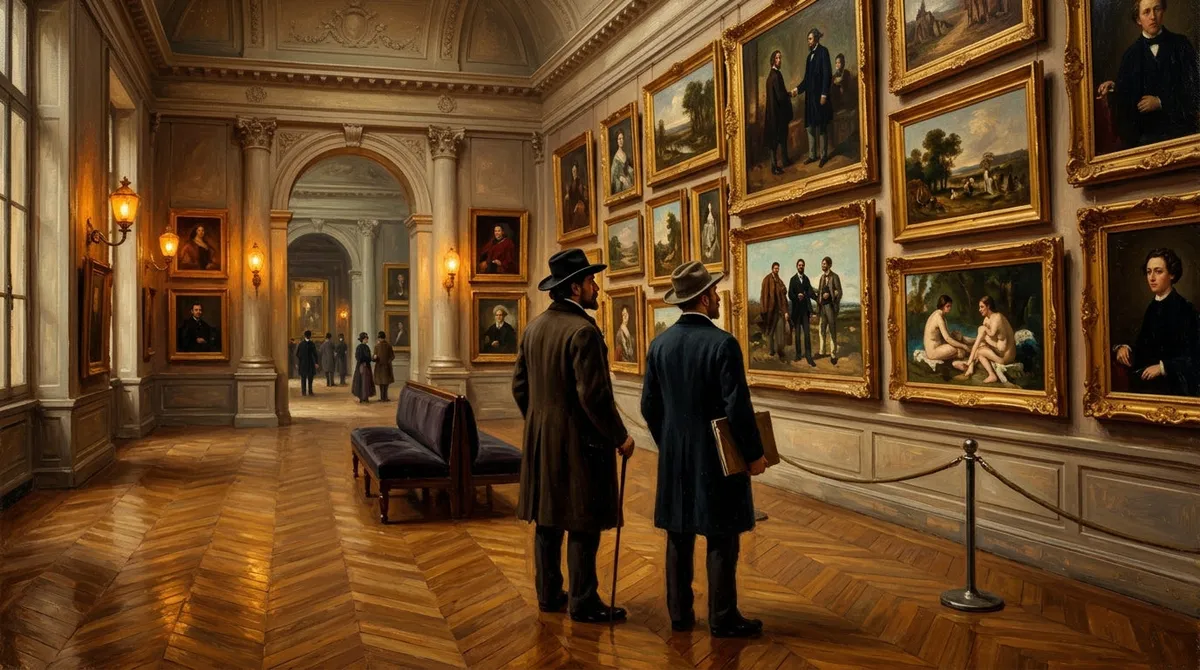
To break the suffocating routine, Gauguin proposed an excursion on Sunday, December 16. The two men boarded an early morning train for a sixty-kilometer journey across the Rhône delta to Montpellier. They were heading for the Musée Fabre, where the personal collection of François-Zénon Alfred Bruyas was on public display.
Bruyas was a legendary figure in nineteenth-century French collecting. The sickly son of a wealthy Montpellier banker, Bruyas used his inheritance to bankroll painters whom the official Paris Salon condemned as vulgar or dangerous. Between 1868 and his death in 1877, Bruyas gifted his entire holdings to Montpellier, creating a provincial sanctuary for the avant-garde.
In the Bruyas gallery, the centerpiece was Courbet's enormous 1854 canvas, The Meeting. The painting depicted a real incident from May 1854, when Bruyas met Courbet on the sun-baked dirt road to Sète. Courbet portrayed himself in profile, walking stick in hand and painter's pack on his back, his dark beard tilted upward with supreme self-confidence. Facing him was Bruyas, accompanied by his servant Calas and a hunting dog, tipping his hat in respectful greeting.
When shown in Paris at the 1855 Exposition Universelle, the public ridiculed the composition, christening it Bonjour, Monsieur Courbet to mock the artist's perceived arrogance. Traditional portraiture expected an artisan to bow to the gentleman paying the bill. Courbet turned the social hierarchy upside down: the wealthy patron was paying homage to the sovereign creator.
For Gauguin, Courbet's haughty defiance was pure fuel for his own ego. He saw himself as Courbet's true heir, an unbending wanderer who owed nothing to the bourgeois public. But for Vincent, the room held a far more haunting, intimate power.
Vincent lingered before Eugène Delacroix's 1853 portrait of Alfred Bruyas. Staring at the collector's frail posture, reddish beard, and melancholy blue eyes, Vincent saw a mirror image of himself and his brother Theo. To Vincent, Bruyas was not merely an art buyer; he was an exhausted saint of art who had broken his own health to keep great painters alive. Vincent realized with terrifying clarity that Theo was playing the exact same sacrificial role in Paris, destroying himself financially to keep the Yellow House afloat.
The visit settled none of their artistic arguments. On the train ride back across the marshes to Arles, their debate over Courbet, Delacroix, and the meaning of realism flared into an intellectual tempest. As Vincent wrote to Theo in Letter 726 after returning to the studio, their conversations were "terribly electric." Vincent noted that they ended their discussions with their minds drained of power, like electric batteries that had completely run down.
The Aftermath and the Canvas
The electric battery never had a chance to recharge. Just one week after returning from Montpellier, on the evening of December 23, 1888, the Yellow House imploded.
After dinner, following another screaming argument about artistic independence, Gauguin walked out into the cold night air of Place Lamartine. Gauguin claimed in his memoirs that Vincent stalked him through the dark with an open straight razor, stopping only when Gauguin turned and commanded him to go home. Whether that confrontation happened as Gauguin told it, Vincent returned to his room in a delirium, severed his left earlobe with a razor, wrapped it in newspaper, and delivered it to a woman named Rachel at a nearby brothel.
Gauguin spent that night in a hotel. The next morning, discovering the house surrounded by police and Vincent lying unconscious in a pool of blood, Gauguin sent a telegram to Theo, packed his bags, and caught the morning train to Paris. The two men never saw each other in person again.
Yet the memory of Courbet's sunlit meeting in Montpellier haunted Gauguin for months. In the autumn of 1889, marooned in the windswept Breton fishing village of Le Pouldu, Gauguin decided to settle his score with Courbet. Working inside Marie Henry's coastal inn alongside Dutch painter Meijer de Haan, Gauguin painted his biting masterpiece: Bonjour Monsieur Gauguin.
The canvas is a brilliant, caustic inversion of Courbet's open road. Where Courbet stood tall on a Mediterranean highway under brilliant sunlight, Gauguin shows himself shivering on a muddy Breton path under a leaden northern sky. Where Courbet greeted his patron face-to-face, Gauguin is barricaded behind a rough timber fence gate.
Gauguin depicts himself bundled in a heavy greenish-blue overcoat, hands jammed deep in his pockets, with a dark beret pulled low over his brow. Approaching him on the road is not a wealthy, deferential gentleman like Bruyas, but a local peasant woman in a black cloak and white coif, clutching an umbrella and eyeing him with suspicion.
Even the dog is stripped of nobility. Courbet's sleek hunting hound is replaced by a miserable stray slinking through the mud behind the fence. Courbet had celebrated the triumphant arrival of the artist into society. Gauguin documented the cold reality of the modern painter: an alien figure, bankrupt and distrusted by the very peasants he sought to immortalize.
Today, that primary Breton canvas hangs in the National Gallery in Prague. It stands as a landmark document of post-impressionist revolt, proving that the modern canvas was no longer interested in flattering the viewer or copying a sunny afternoon. It had become a psychological weapon.
Inside the Budapest Retrospective
That explosive trajectory from Arles to Brittany now forms the curatorial backbone of a landmark retrospective in Hungary. Running from October 30, 2026 to February 28, 2027, the Szépművészeti Múzeum in Budapest is presenting Bonjour Monsieur Gauguin: The Circles of the Post-Impressionists and Symbolists.
Curated by art historian Judit Geskó, the exhibition brings together approximately 150 works, including roughly 80 pieces by Gauguin spanning paintings, drawings, and ceramic sculptures. To pull off a project of this scale, Geskó secured loans from nearly 40 international museums, including the Musée d'Orsay, the Metropolitan Museum of Art, MoMA, the Van Gogh Museum, and the National Gallery in Prague.
As reported by The Art Newspaper, Geskó avoids the easy cliché of presenting Gauguin as a solitary, exotic wanderer. Instead, the retrospective maps his career as a series of intense intellectual collisions with contemporaries like Camille Pissarro, Paul Cézanne, Claude Monet, and Vincent van Gogh.
The exhibition follows a clear chronological path through the physical spaces that shaped Gauguin's visual language. Visitors move from his early Parisian Impressionism through the remote Breton colonies of Pont-Aven and Le Pouldu, past his brief, vivid 1887 sojourn in Martinique, and straight into the pressure cooker of Arles in 1888. The final rooms explore his controversial, myth-making years in Tahiti and the Marquesas Islands.
What makes the Budapest installation remarkable is the way it stages the ideological debate between Courbet's realism and Gauguin's emerging Symbolism. In one of the central galleries, Gauguin's flat, decorative Breton landscapes hang directly opposite the swirling impasto of Van Gogh's portraits from Arles.
That fundamental tension between physical observation and symbolic distortion is what gives a curated post-impressionism collection its raw friction. Modern art did not emerge from peaceful contemplation in quiet gardens. It was hammered out through shouting matches, financial panic, and the freezing train ride to Montpellier.
What Remained in the Dust
When Vincent van Gogh died in Auvers-sur-Oise in July 1890, twenty months after the Yellow House collapsed, Gauguin was already preparing to leave France for Tahiti. He packed his brushes, his woodcutting tools, and a handful of small photographic reproductions of the paintings he loved.
Among those prints was Courbet's The Meeting. Even on the other side of the globe, stranded in the tropical heat of Mataiea, Gauguin never stopped measuring himself against that dusty road in Montpellier. He continued to write about Courbet in his notebooks, remembering the painting that had provoked so much fury in Arles.
The Yellow House was bombed to rubble during the Second World War, leaving behind an empty street corner on Place Lamartine. But the argument that destroyed it remains completely intact. Whenever you stand before a modern painting and wonder whether it is showing you the world outside or the world inside the painter's skull, you are standing in the drafty galleries of the Musée Fabre, watching two stubborn men argue in front of a Courbet.