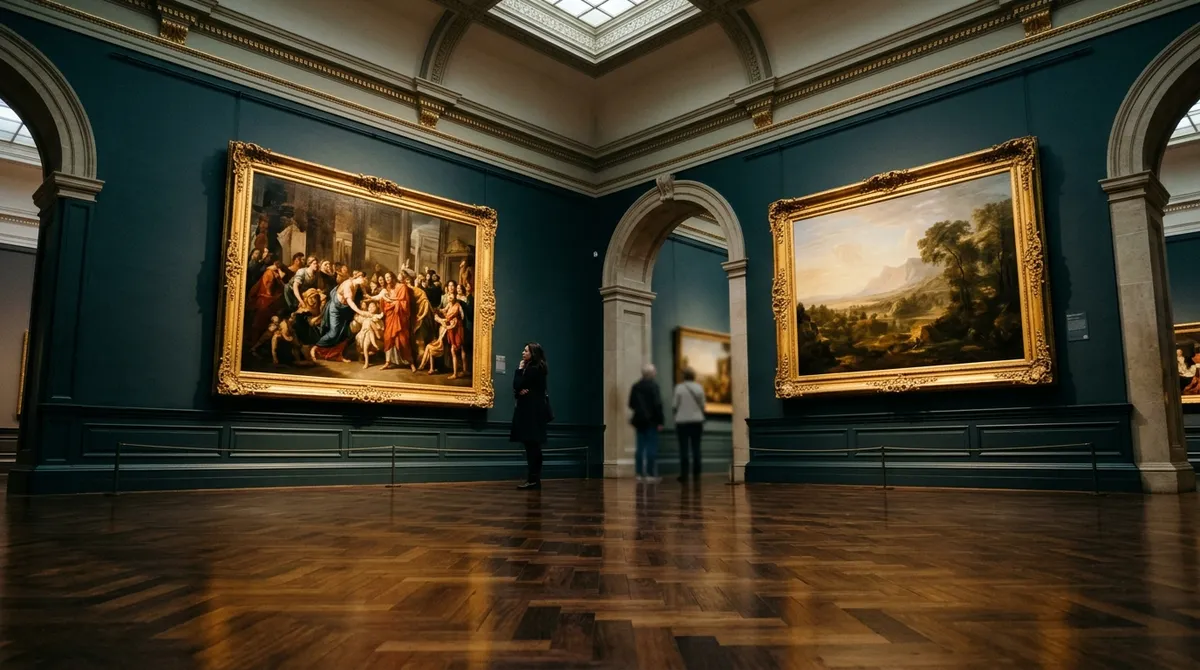
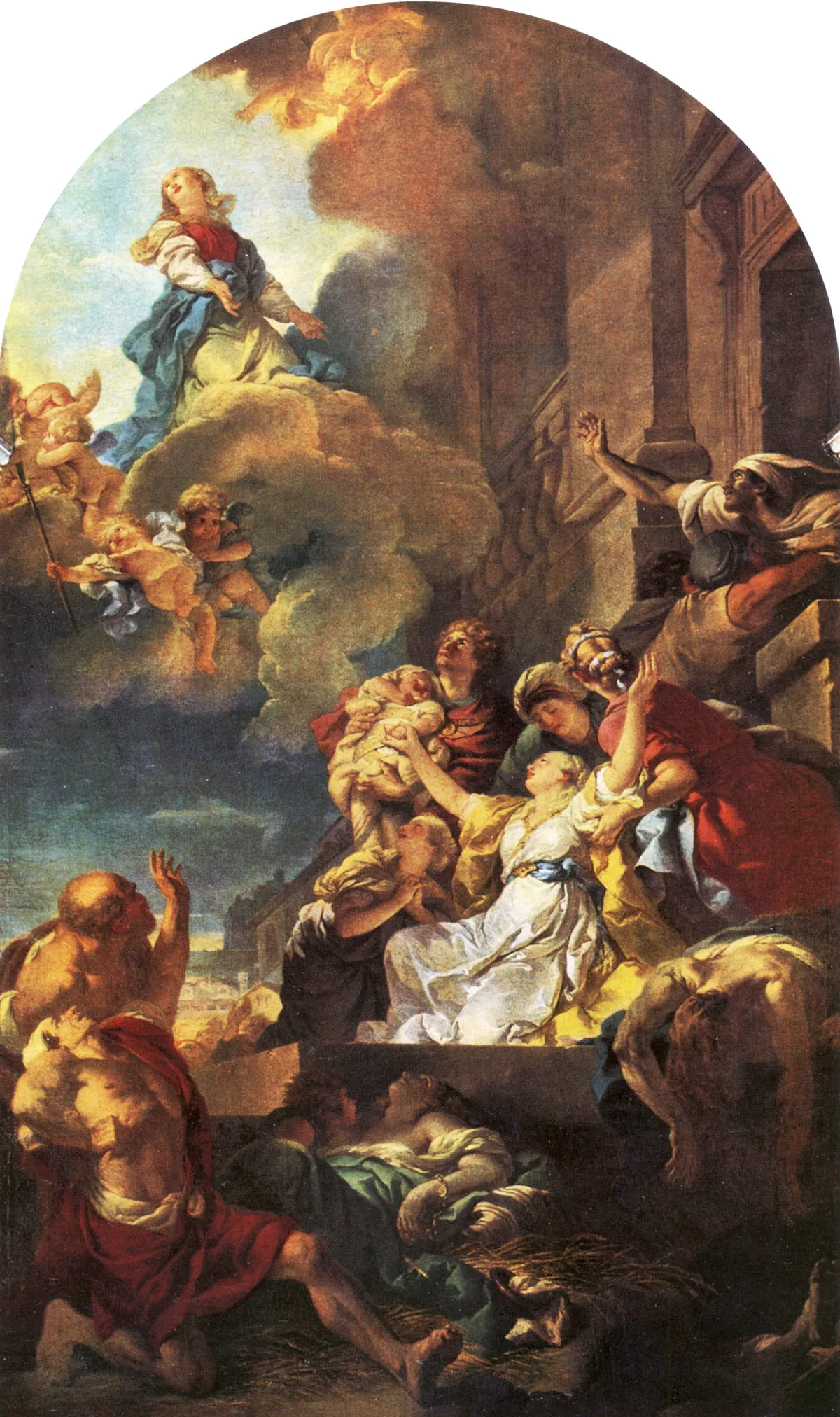
On 2 October 1767, the French playwright and songwriter Charles Collé returned to Paris and paid a visit to the history painter Gabriel-François Doyen. Doyen was the man of the hour in French art: at the official Salon of August and September 1767, his monumental altarpiece Le Miracle des ardents had drawn crowds to admire its harrowing, Rubensian depiction of Saint Genevieve halting a plague of ergot poisoning in medieval Paris. The canvas, commissioned for the Church of Saint-Roch, was heavy with dying mothers, writhing victims, and divine tragedy; art historians would later view its visceral terror as a direct ancestor to Théodore Géricault. Diderot and the salon establishment hailed Doyen as a serious custodian of academic art and moral grand manner painting.
Yet as Doyen explained to Collé, that solemn reputation had just produced the most insulting commission of his life. A gentleman of the royal court had summoned Doyen to his petite maison, a suburban pleasure villa kept for discreet liaisons outside Paris. The courtier received the painter with his young mistress on his arm, and outlined precisely what he wished to see on canvas.
He demanded that Doyen place Madame on an escarpolette suspended from the garden boughs; that a consecrated Catholic bishop be painted standing in the shadows behind her, physically hauling on the ropes to propel the swing through the air; and that the nobleman himself be depicted reclining in the undergrowth directly beneath the arcing seat, positioned to look straight up between her petticoats.
Collé copied Doyen’s exact account into his journal: "‘I should like,’ he said, ‘to have you paint Madame on a swing that a bishop would push. You will place me in such a way that I would be able to see the legs of this lovely girl, and better still, if you want to enliven your picture a little more…’"
To an academic history painter who had spent years rendering plague victims vomiting blood for a parish altar, the idea of painting a Catholic prelate servicing a courtier’s voyeurism was not merely frivolous; it verged on blasphemy. "I confess," Doyen told Collé, "that this proposition, which I could never have expected, given the nature of the painting that the gentleman suggested, confounded and petrified me at first."
Once he recovered his composure, Doyen refused the commission flatly. But rather than throwing the patron out the door, he redirected him to a colleague whose growing impatience with the royal academy was already open gossip in Parisian studios: Jean-Honoré Fragonard.
The Defection to Private Pleasure
Fragonard was thirty-five years old and stood at a decisive career fork. Two years earlier, in 1765, he had presented Coresus and Callirhoe to the Académie Royale de Peinture et de Sculpture, earning universal praise and an official purchase by King Louis XV for the Gobelins royal manufactory. He had won the prestigious Prix de Rome in 1752, studied antique sculpture in Italy, and seemed destined for the comfortable honors of a Premier Peintre du Roi. But royal commissions arrived with crippling caveats: the Crown paid agonizingly late, the academic hierarchy dictated themes of stoic civic virtue, and history painters frequently went broke waiting for royal treasurers to disburse promised pensions.
Private collectors, by contrast, paid prompt gold for cabinet canvases that celebrated the senses. In accepting the courtier’s bizarre commission, Fragonard was abandoning the Academy’s demand for monumental history art in favor of the lucrative, freewheeling Parisian market for private pleasure. Yet Fragonard possessed far too much political instinct to paint the scene exactly as dictated. Showing an active Catholic bishop assisting in an adulterous assignation invited police confiscation, censorship from the Sorbonne, and possible royal punishment. Fragonard agreed to paint the picture, but he quietly edited the prelate out of the script.
Reading the Libertine Codes
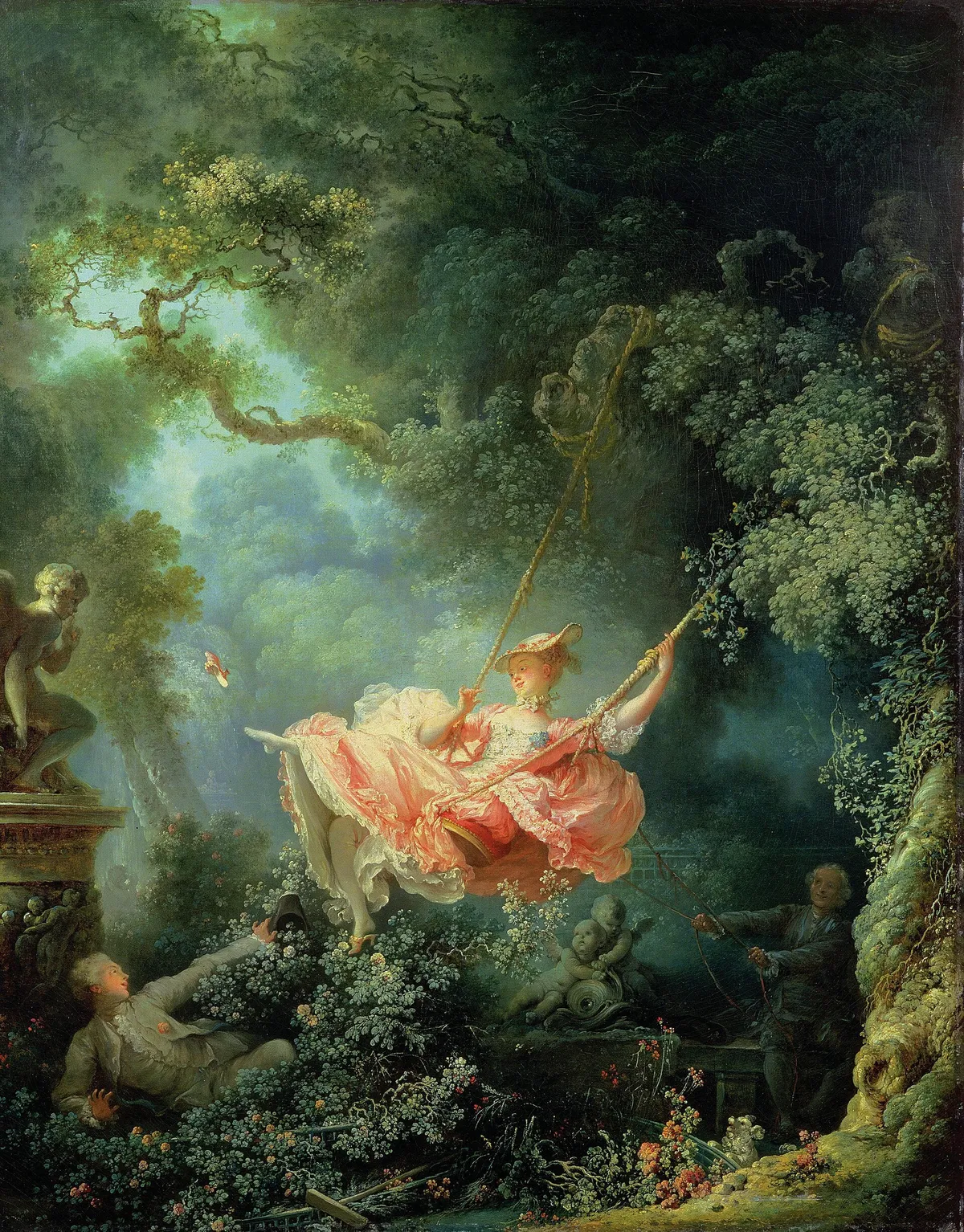
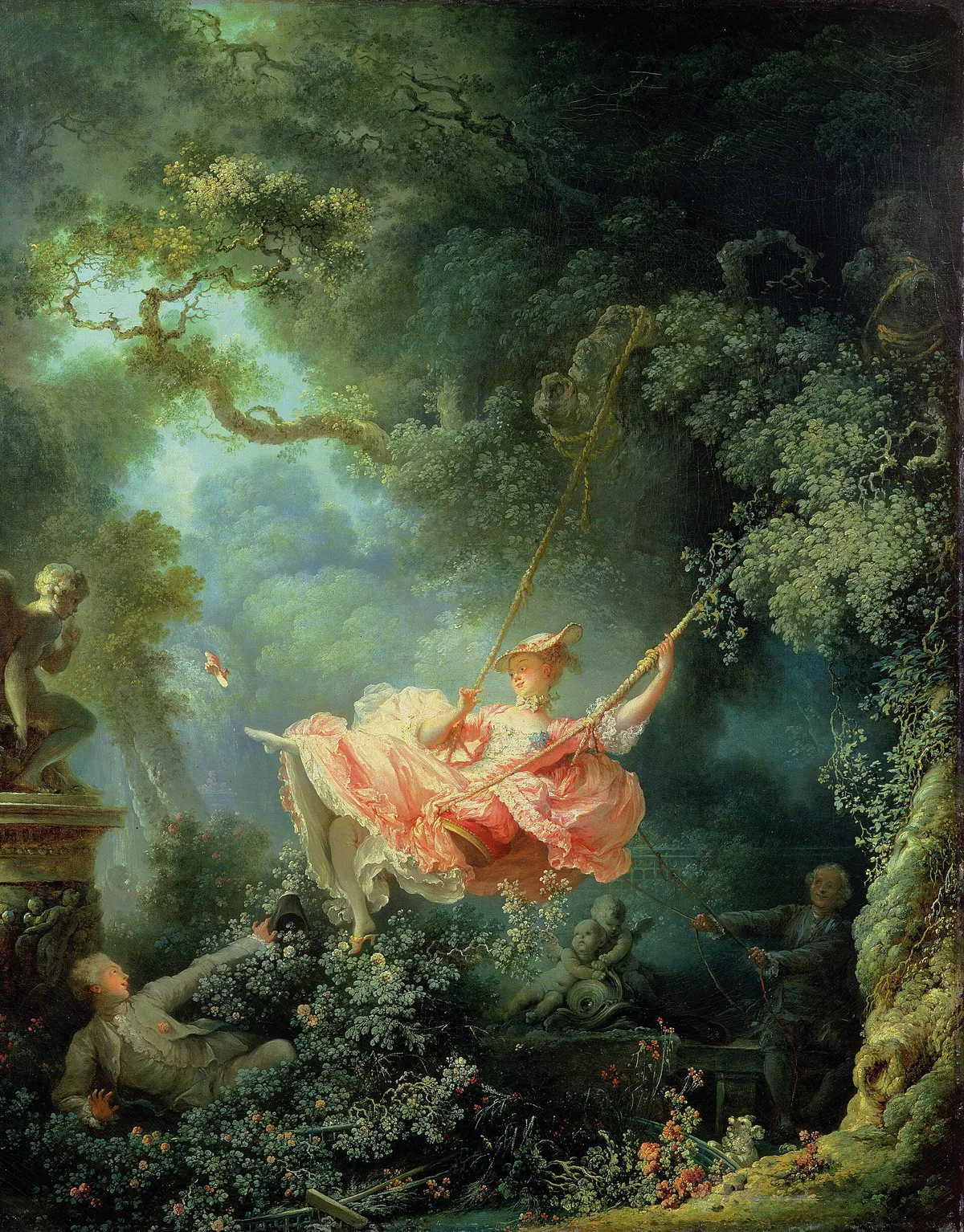
The finished picture, measuring 81 by 64.2 centimetres, transforms the courtier’s crude peep-show request into a dense web of Enlightenment erotic signs. In place of the bishop, Fragonard installed an elderly layman half-hidden in the foliage on the right, smiling benignly as he works two guide ropes to send the woman soaring over the rose garden. In the foreground shadows beneath him sits a tiny white lapdog, barking frantically at the hidden suitor. In European portraiture and figurative art, the dog had symbolized marital fidelity since Jan van Eyck; here, the miniature hound sounds an alarm that neither the elderly pusher nor the soaring lady has any interest in hearing.
At the lower left, parted by thorny briars and blooming pink roses, the young suitor reclines on his back. He holds his tricorn hat aloft, aiming it directly upward toward the cascade of silk petticoats. In the libertine iconography of eighteenth-century France, offering an upturned hat was an explicit gesture of masculine tribute and invitation. Suspended above him, the young woman wears an apricot-pink silk dress, kicking out her left leg so violently that her pointed-toe pink slipper flies through the air.
The flying shoe was a recognized pictorial shorthand across French printmaking for the loss of female virtue or the sudden surrender to passion. The slipper arcs directly toward a marble sculpture standing above the young lover: Étienne-Maurice Falconet’s L’Amour menaçant ("Menacing Cupid"), an iconic work exhibited at the Salon of 1757 after being commissioned by Louis XV’s official mistress, Madame de Pompadour. Falconet’s winged putto presses his right index finger firmly against his lips, enjoining the garden to silence.
Even the landscape departs deliberately from French courtly tradition. This is not the geometric, obedient terrace garden engineered by André Le Nôtre at Versailles, with manicured hedges and straight avenues of gravel. Fragonard set his lovers in an overgrown, encroaching thicket modeled on the fashionable English-style park, where twisting boughs, moss-laden trunks, and invasive foliage create a private sanctuary completely closed off from civic duty. Decades before the philosophical clash of rococo vs romanticism would redefine European landscape aesthetics, nature here was no longer a decorative backdrop, but an accomplice in emotional and physical abandon.
The 2021 Discoveries and the Identity Puzzle
For two centuries, popular retellings assumed the elderly figure pulling the ropes was either a cuckolded husband or a disguised cleric dressed in sombre black. Between August and November 2021, the Wallace Collection undertook the painting’s first conservation treatment in over a century, funded by the Bank of America Art Conservation Project. Conservator Martin Wyld removed a century of discolored, yellowed natural resin varnish and degraded surface retouches that had flattened Fragonard’s palette into a murky bronze.
The cleaning altered the physical reading of the scene. The older man in the shadows was revealed to be wearing a shimmering coat of rich civilian blue, confirming that Fragonard had stripped away every lingering trace of clerical vestments to leave an aristocratic companion. Scientific analysis, including X-radiography, revealed that Fragonard executed the oil painting with almost no preparatory underdrawing. Instead, he mapped out the composition directly in paint, making immediate adjustments on the canvas: conservators detected visible pentimenti where Fragonard altered the outline of the woman’s left knee and billowing petticoat, as well as the contour of the suitor’s right shoulder, to heighten the kinetic rush of the swing.
The identity of the courtier who commissioned the canvas remains unresolved. Nineteenth-century tradition identified him as Marie-François-David Bollioud de Saint-Julien (1713–1788), the Baron d’Argental and Receiver General of the French Clergy, whose administrative post collecting taxes for the church might explain his satirical desire to put a bishop on swing duty. But as the art historian Catherine Baradel-Vallet has pointed out, Saint-Julien was fifty-four years old in the autumn of 1767, while the young gallant lounging in the roses is barely out of his teens. Baradel-Vallet suggests the client was more likely Saint-Julien’s eighteen-year-old son, Jean-Victor-François-Auguste, whose youthful bravado explains why he made the absurd error of asking a solemn painter of dying plague victims to record his afternoon tryst.
The painting’s first confirmed legal owner was Marie-François Ménage de Pressigny, a royal tax farmer who owned it until the French Revolution. On 8 May 1794, during the height of the Terror, Pressigny was sent to the guillotine alongside twenty-seven other tax farmers, including the chemist Antoine Lavoisier. Revolutionary authorities seized the canvas as property of the state. It passed through the collection of the Duc de Morny, half-brother to Napoleon III, and on 1 June 1865 was sold at auction in Paris to Richard Seymour-Conway, 4th Marquess of Hertford, for 30,200 francs. Lord Hertford shipped it to Manchester Square in London, where it remains today in the Wallace Collection: an 81-centimetre private joke that survived the fall of the monarchy that bred it.