In an undisclosed industrial storage facility in Norfolk, more than 120 miles away from the North Sea port where it was created, sits a 22-foot slab of severed steel and asphalt bearing one of the most famous street murals in modern British history.
It has been locked in private commercial custody for seven years. The artwork, stenciled in monochrome aerosol by the anonymous artist Banksy in January 2018, once belonged to a derelict river crossing in East Yorkshire. Today, insured for an estimated £1.2 million, it rests on timber skids in an agricultural county across the Wash, guarded by municipal non-disclosure agreements and racking storage fees.
The piece has survived physical vandalism, emergency solvent washes, marine cutting torches, and endless council hearings. Yet for the public who watched it appear overnight, the Hull Banksy mural has spent far more time as an invisible line item on a spreadsheet than as accessible public art.
The municipal wall of secrecy
For years, local residents and elected representatives who inquired about the mural's whereabouts met an impenetrable bureaucratic wall. When members of Hull City Council's Economy and Environment Overview and Scrutiny Committee pressed for details about where the salvaged bridge deck had been taken, senior council leadership deflected the questions.
Angela Blake, the council's assistant director of major projects, culture, and place, offered a blunt three-word answer: "It's a secret."
When pressed further by committee members asking whether the artwork was even kept within Yorkshire borders, executive director for regeneration Chris Jackson admitted the institutional silence: "I'm not sure we're allowed to say."
That opacity sparked outrage among local ward representatives who had long campaigned to see the artwork returned to the community that protected it. Orchard Park councillor Rosie Nicola voiced the growing frustration inside the council chamber: "Nobody will tell us where this painting is and when it's going to be put on display. It's wrong."
The silence finally broke when a BBC News investigation tracked public procurement filings, followed by wider reporting from ARTnews, confirming the artwork had been quietly hauled across three county borders to rural Norfolk.
The night on Scott Street Bridge
The road to that private depot began on the damp morning of January 26, 2018. Banksy posted a photo to his Instagram account, claiming authorship of an unannounced stencil that had materialized on the Scott Street Bridge over the River Hull.
The stencil depicted a small boy wearing an upturned kitchen colander as a helmet and a homemade cape, brandishing a wooden toy sword with an HB pencil bound to its tip. Beside him, stenciled in bold white capital letters, ran a rallying cry: "DRAW THE RAISED BRIDGE!"
The location was loaded with local resonance. Built in 1902, the Grade II listed bascule bridge had been stuck in a permanently raised position since 1994, its dual roadway leaves pointing hopelessly toward the sky after mechanical failure and severe corrosion forced its closure. According to maritime historical records from Open Bridges Hull, the rusting span had stood as a monument to industrial abandonment for nearly a quarter of a century.
The slogan was a layered political provocation: a literal plea to lower a frozen drawbridge, an ode to the pencil outlasting the sword, and a sharp jab at post-referendum Britain. Hull had just completed its turn as the UK City of Culture 2017, yet 68 percent of its electorate voted to leave the European Union in 2016. On Scott Street, the upright bridge stood as both a navigation hazard and an emblem of a country pulling up its own borders.
The window cleaner vs. the vandals
The artwork almost did not survive its first weekend. On the evening of Sunday, January 28, just two days after Banksy verified the piece, vandals climbed the perimeter fence and coated the entire stencil in thick white gloss paint.
Word of the defacement spread rapidly across local social media. Rather than waiting for municipal working hours or heritage conservators, Jason Fanthorpe, a local window cleaner, loaded ladders, pure water containers, and white spirit into his work van and drove straight to the bridge deck under freezing rain.
Joined by a handful of volunteer residents around 10 PM, Fanthorpe worked under floodlights to save the stencil before the oil-based gloss cured against the cold asphalt. He tested a tiny corner with purified water, discovered the top coat was still tacky, and carefully applied diluted white spirit with microfiber cloths.
By midnight, the volunteer crew had lifted the white paint, exposing the boy and his colander helmet beneath. While the solvent left the aerosol slightly softened, Fanthorpe's prompt intervention preserved the piece from total loss. Municipal contractors arrived the following week, not with solvents, but with a protective sheet of clear Perspex bolted over the bridge timbers.
The £900,000 extraction of the Hull Banksy mural
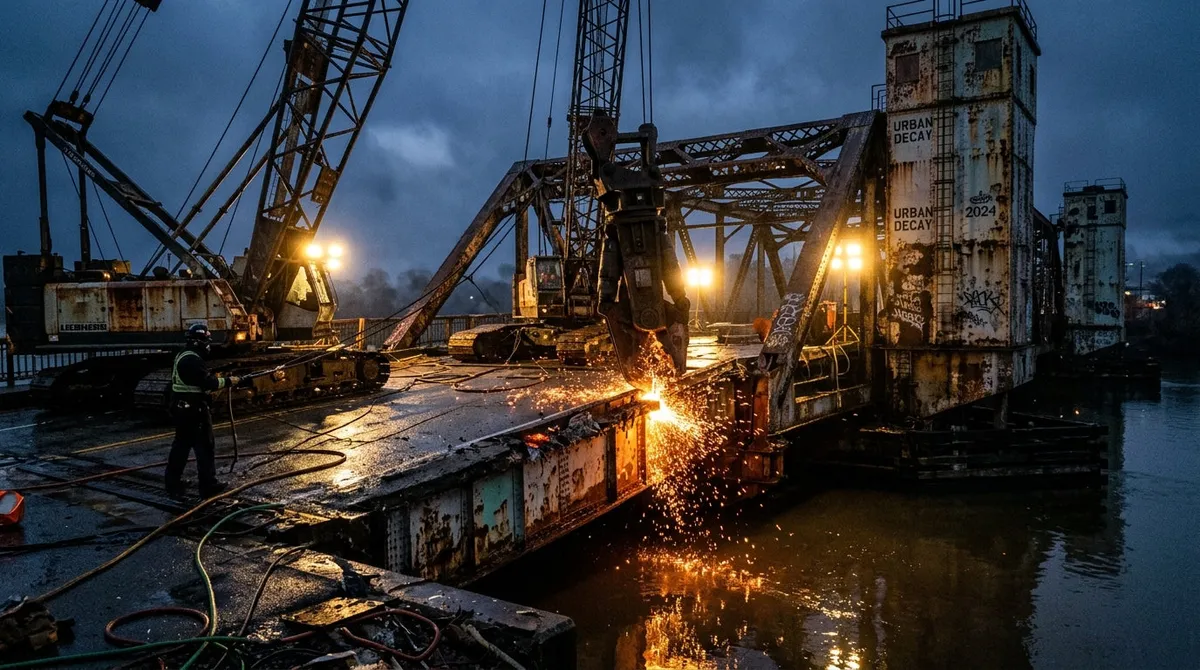
Civilian heroics could not fix the bridge beneath the boy's feet. Marine surveys commissioned by Hull City Council warned that the 117-year-old steel structure was rotting rapidly from river spray and represented an immediate hazard to navigation along the River Hull.
In 2019, the council approved a £900,000 engineering contract awarded to Alan Wood and Partners to dismantle the bridge. Preserving the mural meant undertaking a surgical engineering feat: cutting through structural steel, asphalt road surface, and timber backing to extract a 22-foot by 6-foot section weighing over one tonne without shattering the painted tarmac.
Once crane crews hoisted the multi-tonne section away from the riverbed, the mural disappeared from the city. The council cited security liabilities, insurance requirements, and conservation needs, but declined to name the storage provider.
The paper trail remained buried until late 2026, when official tender notices appeared on public procurement portals. The council published a £60,000 contract titled "The Supply and Installation of a Storage and Display Casing for the Banksy artwork 'Draw the Raised Bridge'". Within the specification documents, the truth emerged: the contractor would be required to collect the 22-foot slab from its long-term specialist holding facility in Norfolk and transport it back to Hull for permanent installation inside Trinity Market.
When outlaw street art becomes a ward of the state
The Scott Street saga exposes the unresolved paradox of street art in modern Britain. Stenciled illicitly on decaying civic infrastructure, it celebrated the temporary and the unsanctioned; yet once authenticated, the market valued it like an Old Master, leaving local government with the expensive burden of playing museum guard.
Hull City Council spent nearly £1 million dismantling a hazardous bridge and storing its painted deck, only to face public backlash over why a piece created for the street was hidden behind locked doors. For an authority managing tight municipal budgets and public services, spending tens of thousands on climate-controlled freight and bespoke display cases is difficult to defend. Letting a world-famous cultural artifact deteriorate into the river would have been equally unforgivable.
That tension explains why public fascination with graffiti wall art and unsanctioned murals never quite cools down: the work draws its vitality from defying institutional control. The moment an authority tries to tame it, the contradictions multiply.
For now, the severed bridge deck remains locked in its crate, awaiting the bespoke enclosure that will finally bring it home to Trinity Market. The last word belongs to the people who fought to keep it.
As Councillor Rosie Nicola stated when demanding an end to the secrecy: "As a resident, somebody born and bred in Hull, I was thrilled to bits that Banksy came to our city, left his mark, but now nobody can see it. It's been so long since it's been stashed away. I just want to know when is it going to be on public display again."