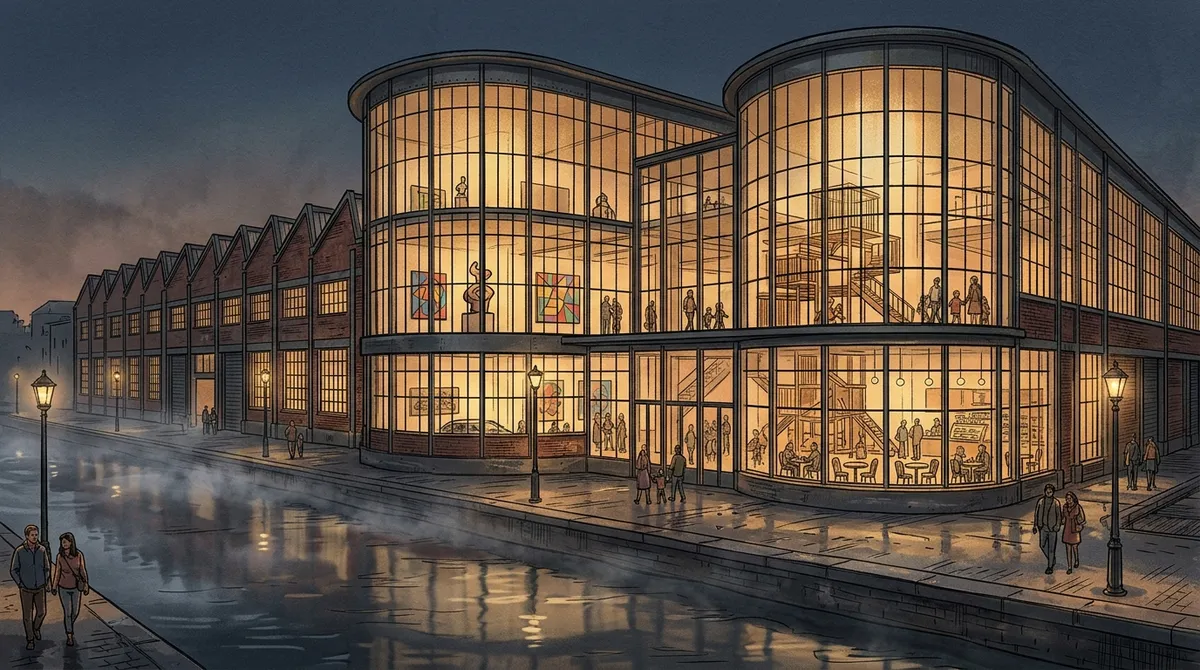
On Saturday morning, November 28, 2026, the smell of baking sourdough greeted visitors inside a 1934 Brussels car showroom before any ticket barrier appeared. Behind curved steel-framed glass along the Charleroi-Brussels Canal, pastry chef Alice Jaroszuk's team kneads dough where mechanics once shuttled Citroëns between repair bays.
Above them, bouquets of gold letter-shaped helium balloons drift beneath a 21-metre ceiling. Half of the 40,000-square-metre complex stays open without a ticket Wednesday through Sunday, 8 a.m. to midnight, while exhibitions inside cost €18.
The free half: coal piles, books, and no QR codes
Brussels had never built a dedicated museum of modern and contemporary art before KANAL-Centre Pompidou opened this weekend. Now it has one larger than the original Tate Modern, housed inside Citroën's former Belgian "cathedral for cars."
Instead of gutting the plant, the winning architects (Atelier Kanal, uniting EM2N, noAarchitecten, and Sergison Bates) moved their office onto the factory floor. Sergison Bates co-founder Stephen Bates called the approach "invisible mending" in The Guardian.
They slotted 470 metres of new glass straight into the original, slightly wonky 1930s steel frames. Concrete floors received three differently colored coats of paint meant to wear away under footsteps, while three ribbed-glass "houses" dropped through the industrial roof.
The free public zones behave less like a lobby than a covered street:
- Assemble's playground: A 700-square-metre first-floor playscape built with Molenbeek schoolchildren, using dark rubber mounds shaped like old canal coal barges alongside ropes and miniature wheelbarrows.
- The quiet reading room: Floor-to-ceiling books and modular desks with a strict ban on screens or QR codes, ordered by director-general Yves Goldstein so teenagers can spend the day offline.
- The Salon and print shop: A live poster press printing daily announcements beside power sockets in the floor and a concrete stage-table built for public debates.
Inside KANAL-Centre Pompidou's lone Paris show
Upstairs in the five-storey gallery box, the French name over the door goes curiously quiet. Brussels pays Paris's Centre Pompidou roughly €2 million a year through 2031 while the Parisian flagship closes for renovations until 2030. Yet only one of KANAL's ten opening shows uses Pompidou loans, prompting Flemish lawmaker Benjamin Dalle to ask The Art Newspaper why Brussels didn't just take the 90-minute Eurostar.
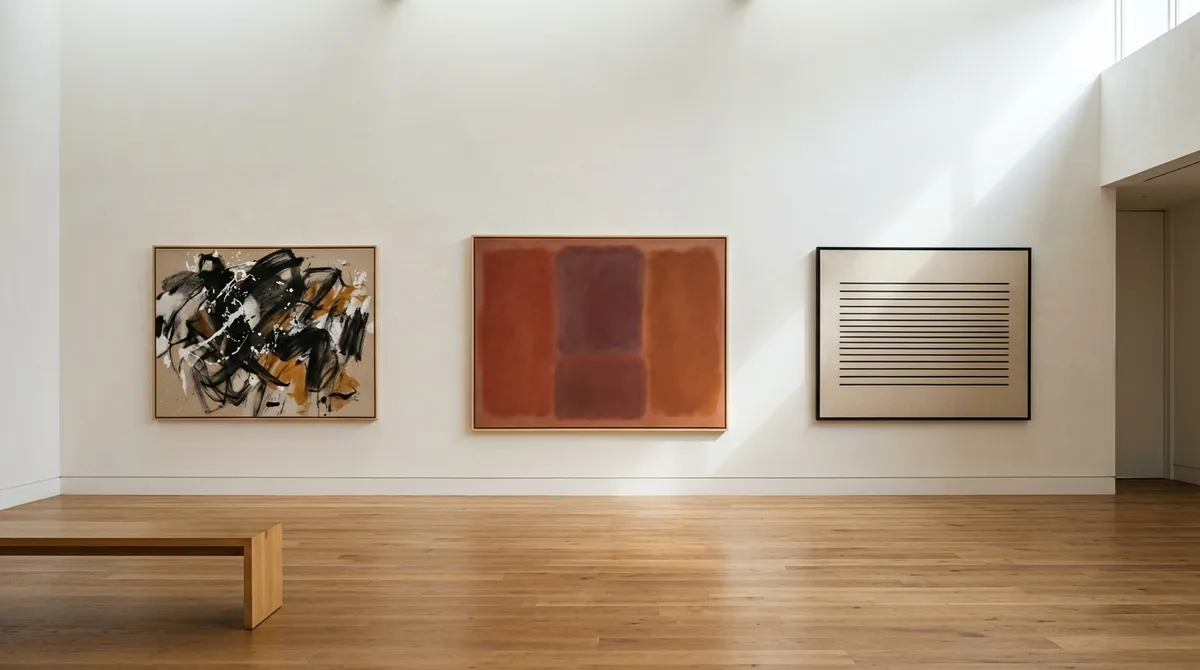
That show, A Truly Immense Journey (running through January 9, 2028), gathers over 350 works around migration and the canal outside. Curators mixed European modernism by Piet Mondrian and Marcel Duchamp's suitcase-sized museum right beside Kader Attia's couscous model of an Algerian town, refusing to isolate Paris loans in a separate room.
Local artists carry the rest of the building. In Hall 2, Otobong Nkanga sets up wooden looms where visitors weave beside trained artisans, and nearly 200 pupils from four neighboring schools helped write the gallery wall labels.
Two days after opening, the director leaves
On Monday, November 30, two days after Saturday's opening, director-general Yves Goldstein steps down after a decade leading the project. Brussels minister-president Boris Dilliès's cabinet cited a "difference of opinion regarding the future of Kanal."
Construction jumped from an initial €150 million budget to €230 million, forcing a €60 million regional loan in May just to open on time. Meanwhile, public operating support falls from €28 million this year to €10 million by 2029, leaving private donors expected to step in from 2028.
Regional officials project 550,000 annual visitors by 2030 and want KANAL to "become financially self-sustaining," a government spokesperson told The Art Newspaper. London's Tate Modern offers a cautionary parallel: its £260 million Blavatnik extension opened in 2016 and now sits partly closed off to the public.