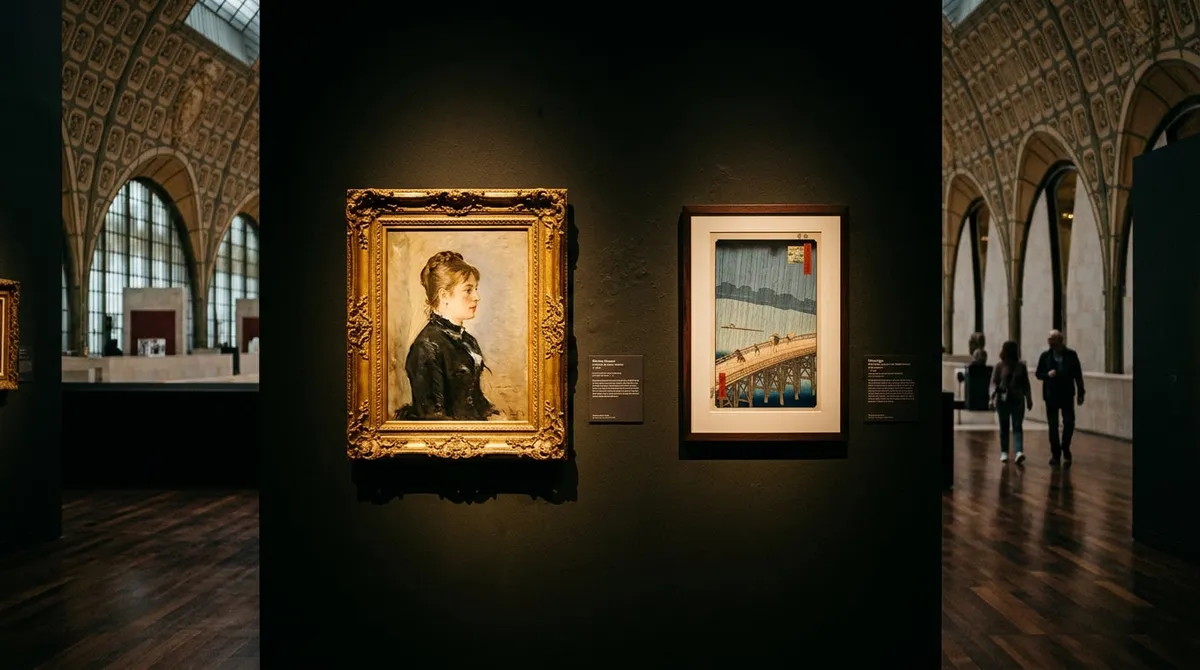
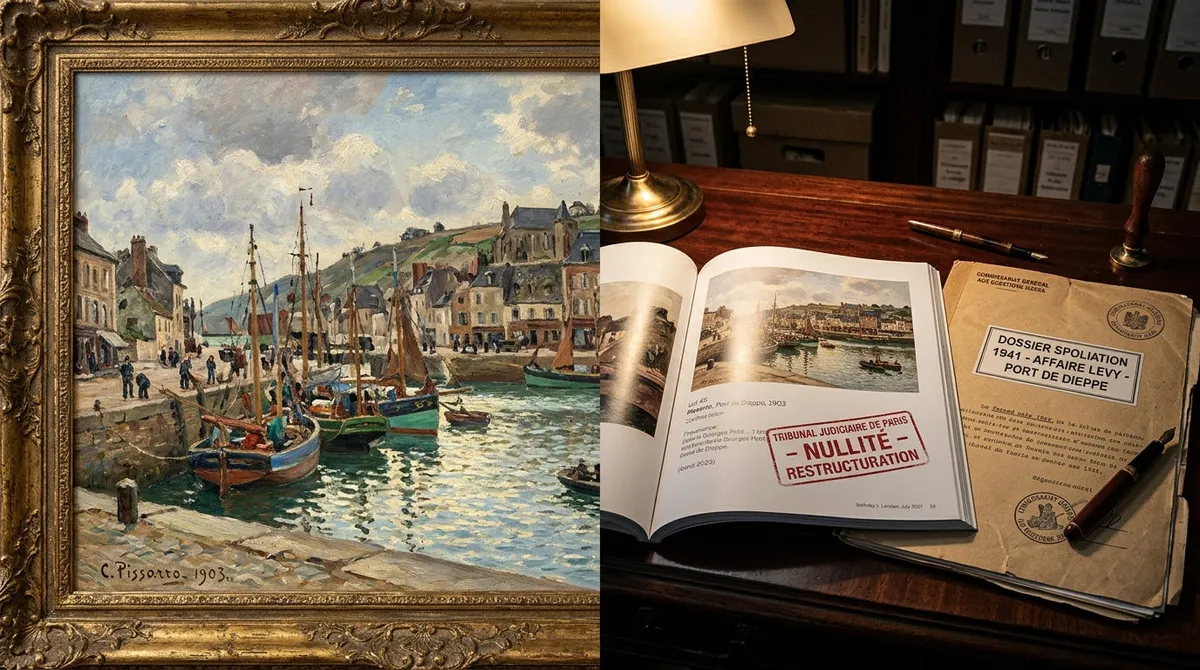
How did a 1902 Impressionist masterpiece end up in the crosshairs of French justice?
What happens when an international auction house sells a Nazi-looted Impressionist painting for £1.2 million with a signed settlement, only for a judge to rule the entire transaction was illegal?
On November 5, 2026, the Tribunal Judiciaire de Paris answered by tearing up the receipt. In a landmark decision where the Paris Court orders Sotheby's to return Nazi-looted Pissarro property to the descendants of Parisian banker Salomon Flavian, the judges invalidated eighty-five years of private sales and gave the auction house sixty days to name its anonymous buyer or face mounting daily fines.
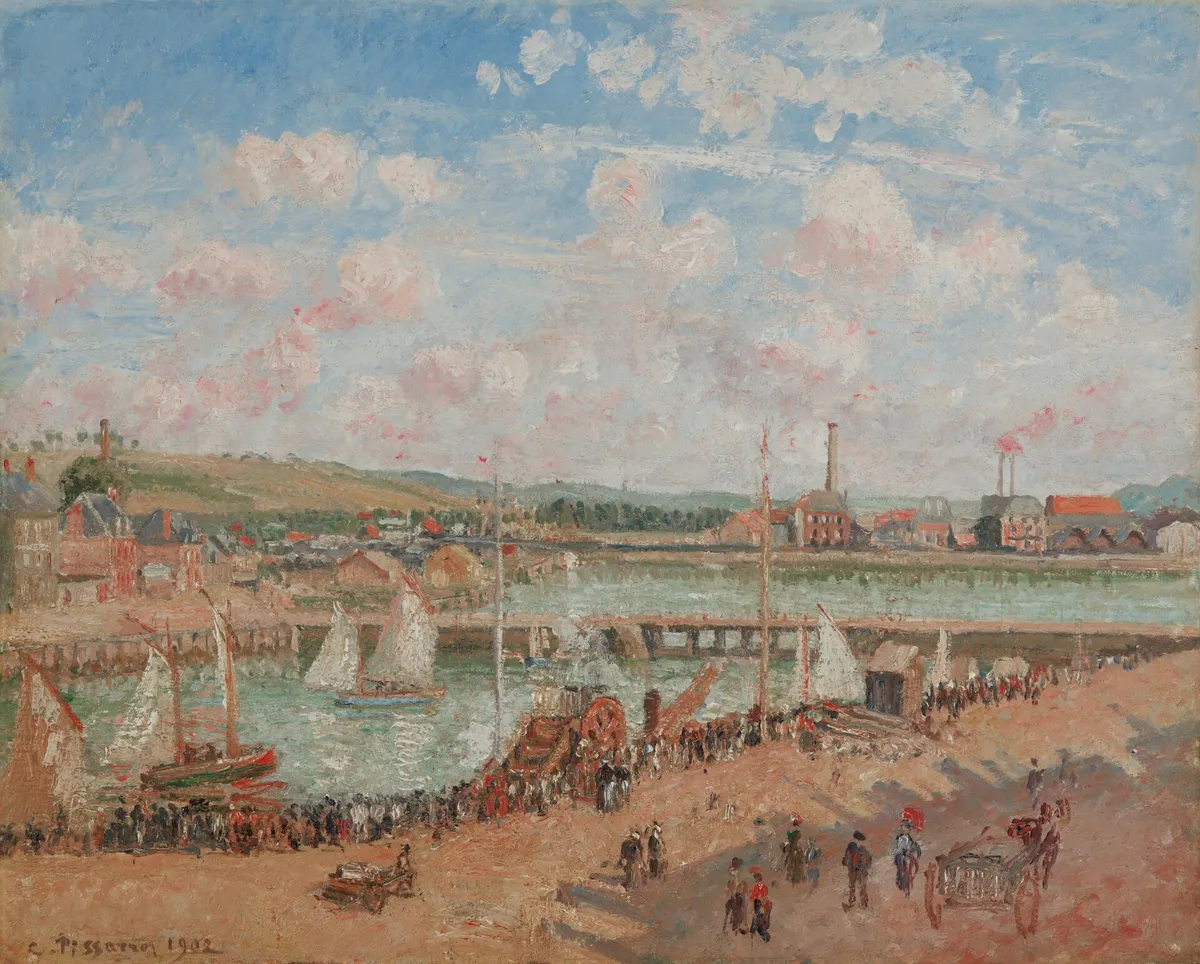
The disputed canvas is Darse de pêche et bassin Duquesne, Dieppe, après-midi ensoleillée (1902), an oil-on-canvas harbor view by Camille Pissarro measuring 54 by 65 centimeters. Painted during the artist's stay in Normandy, the work captures the tidal basin of Dieppe under radiant coastal light, with working fishing boats moored against stone docks. While Pissarro's harbor series remains central to the visual legacy of Impressionist art, this particular canvas spent decades cycling through private hands away from public scrutiny.
In 1935, Salomon Flavian, a Jewish-Romanian banker and private collector living in Paris, acquired the painting. In 1941, during the Nazi occupation of Paris, German forces and collaborationist authorities seized his private collection.
After the Liberation, the French state officially logged the missing work in the postwar Répertoire des biens spoliés (RBS). That registration designated the canvas as looted Jewish cultural property, establishing an active claim recognized by restitution authorities including the CIVS commission.
Why did Sotheby's believe it had the right to sell the painting in 2024?
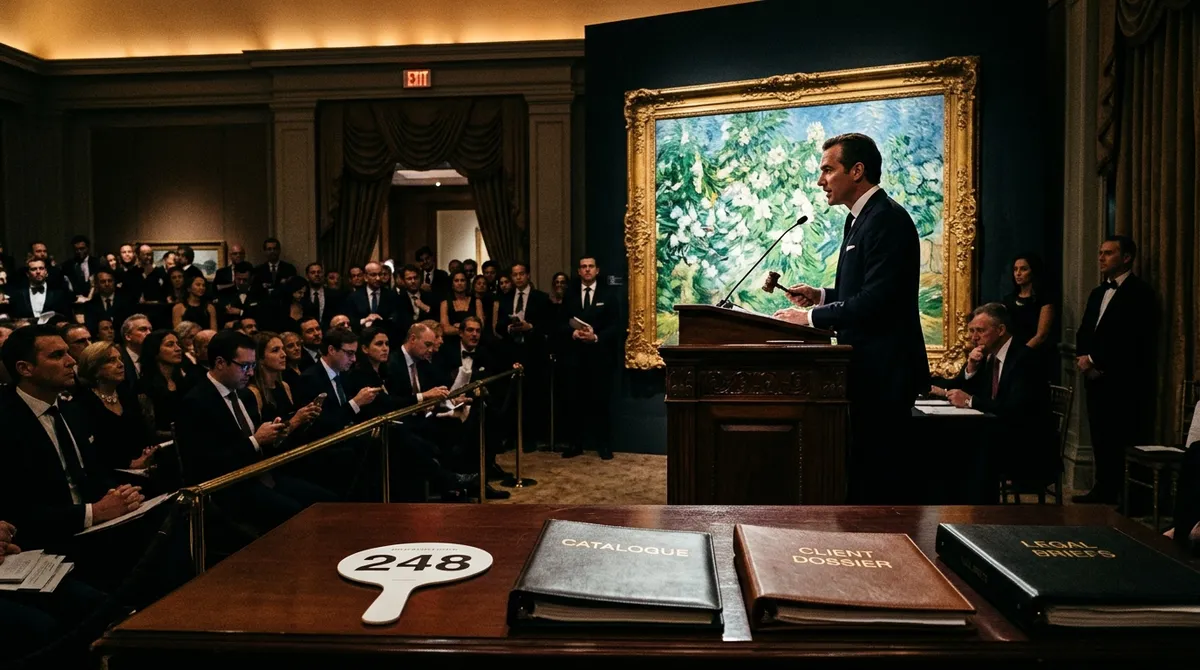
On June 25, 2024, the painting went up for bidding at Sotheby's Modern & Contemporary Evening Auction in London. The hammer fell at £1.2 million, or approximately $1.5 million.
Bidders had every reason to assume the provenance was resolved. The official auction catalog printed a specific reassurance: the lot was being offered "pursuant to a settlement agreement between the current owner and heirs of Salomon Flavian."
That settlement had been arranged by Mondex Corporation, a Toronto-based commercial asset-recovery firm that traces Holocaust-spoliated art. Mondex located the canvas with a European possessor and negotiated a quiet deal with two Flavian family descendants, Gilles and Nicolas Flavian.
The two signatories agreed to waive all future ownership and restitution claims against the possessor and the auction house in exchange for a portion of the net auction proceeds. Armed with that contract, Sotheby's cataloged the work, conducted the sale, and handed the painting over to an undisclosed telephone bidder.
What constitutes the "second dispossession" alleged by the excluded heirs?
The Flavian bloodline did not belong to Gilles and Nicolas alone. Seven other direct descendants of Salomon Flavian were alive, traceable, and entirely unaware that their family's looted Impressionist canvas was on an auction block in London.
Under French succession law, claims on ancestral property belong strictly to the collective estate under a status known as indivision; consequently, two relatives acting privately possess no legal authority to forfeit or liquidate the rights of co-heirs who were never notified, never consulted, and never signed a waiver.
Months after the London hammer fell, the seven excluded relatives received a formal letter from Mondex offering them an 8 percent share of the remaining net funds. The documents revealed that Mondex and the two signing relatives had already secured substantial fees and commissions from the £1.2 million sale.
The excluded heirs retained Corinne Hershkovitch, one of Europe's foremost art restitution attorneys, and filed a lawsuit in the Tribunal Judiciaire de Paris. As reported by The Jewish Chronicle, Hershkovitch argued that orchestrating backroom settlements with isolated family members while freezing out the majority reduces Holocaust recovery to an opportunistic transaction, inflicting what the family termed a "second dispossession."
Why did a Paris court claim authority over a London auction?
Sotheby's mounted a jurisdictional defense. The auction house argued that because the transaction took place in London under English commercial law, French courts had no territorial jurisdiction over the contract or the buyer.
The auction house also raised evidentiary doubts, questioning whether the 1941 wartime loss met the evidentiary threshold of a forced Nazi confiscation.
The Tribunal Judiciaire de Paris rejected both arguments without hesitation. The judges ruled that the underlying crime, the spoliation of Salomon Flavian's private collection, occurred in occupied Paris in 1941 against a French resident.
Under French civil doctrine, the wartime pillaging of Jewish households violates international public order (*ordre public international*). Because the initial theft occurred on French soil under anti-Semitic persecution, French courts maintain jurisdiction to judge the validity of every subsequent transfer, regardless of how many international borders the canvas crossed over the intervening decades.
What did the court actually order: why is Sotheby's in a corner?
The November 5 decision directly upends standard auction house operating procedures. The court issued two binding directives.
First, the judges pronounced every transfer, sale, and waiver involving the Pissarro since 1941 null and void (*nullité de plein droit*). By invalidating the chain of title at its origin, the court wiped out the legal basis of the 2024 London auction, ruled that Salomon Flavian's heirs remain the rightful owners, and ordered the physical return of the artwork wherever it is found.
Second, the court struck at the auction market's traditional shield: buyer anonymity. The judges ordered Sotheby's to provide the Flavian family with the full identity, residential address, and contact details of the private collector who purchased the painting in London.
The court set a strict sixty-day countdown. If Sotheby's fails to disclose the buyer within two months, the auction house will incur an *astreinte*, a court-imposed financial penalty of €1,000 for every single day of delay.
What does this verdict signal for the global art market?
The Paris verdict closes a loophole long exploited in the art trade: the practice of settling with a willing fraction of a family to clean up tainted provenance. Commercial firms and auction houses can no longer cut side deals with select relatives while ignoring the rest of an unliquidated estate.
The ruling also punctures the idea that international sales offer a legal haven from restitution claims. Consigning a looted artwork in London or New York no longer protects a seller or an auction house from European courts enforcing public-order anti-spoliation statutes.
For high-end buyers, the warning is stark. Printed assurances in an auction catalog provide zero legal immunity when the underlying title traces back to wartime theft. If an auction house negotiates a defective settlement, judges can nullify your invoice, order the return of the canvas, and compel the auctioneer to hand over your name.