In November 2016, Juan Francisco León Catena, an electrician in the southern Spanish town of Úbeda, purchased a neglected three-story townhouse at Calle Cava No. 10. Exactly ten years later, in November 2026, state valuation courts confirmed that the Spanish government owes him more than €1,000,000 in cash. The payout was not won through real estate speculation: it was triggered because his pickaxe struck an 11-meter-tall Renaissance church facade concealed behind modern interior partition walls.
León Catena bought the building intending to complete a straightforward family renovation on a modest budget. Armed with masonry chisels and an ordinary municipal building permit, he and his father climbed to the upper floors to strip away cracked plasterboard and water-damaged drywall. They expected to expose common terracotta brick or hollow cinder block.
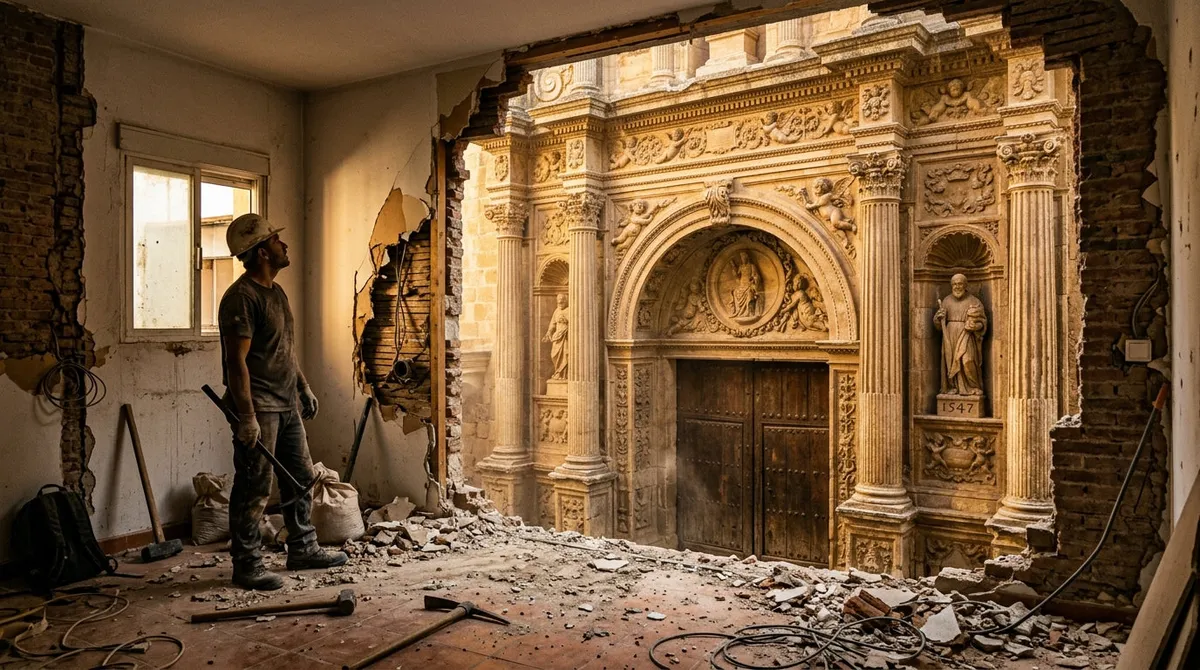
Instead, the chisel sparked against solid rock. Working late into the evening beneath hanging halogen work lights, the two men cleared away a patch of plaster, only to uncover finely dressed, golden ashlar limestone. As larger sheets of gypsum fell away, an astonishing scene emerged: classical fluted pilasters, crisply carved capitals, and monumental architraves spanning 15 meters across the interior of the house.
The masonry did not merely frame a single corner. It ran straight through the building, cutting across floor joists and rising eleven meters through the upper stories to meet the roof beams.
The Renaissance Church Facade Behind the Plaster
León Catena immediately dropped his tools and halted construction. Municipal architects and heritage inspectors arrived within hours, stepping across plaster rubble to peer into the narrow gaps between the bedroom partitions and the monumental stone. What they documented shook the regional cultural administration.
The stonework belonged to the lost church of the Hospital de San Jorge, also recorded in regional archives as the Hospital del Santísimo Sacramento or Pero Almíndez. Founded in 1347 by local nobleman Pedro Almíndez Chirino to care for the poor, the complex received a monumental mid-sixteenth-century upgrade under master architect Andrés de Vandelvira (1509–1575) and stonemason Gonzalo Martínez de Alarcos. Vandelvira was the undisputed master of Spanish Renaissance stereotomy: the demanding mathematical science of cutting curved, interlocking ashlar blocks with flawless structural geometry.
His landmark monuments, including the Sacra Capilla del Salvador and the Hospital de Santiago, helped secure Úbeda and neighboring Baeza their joint inscription on the UNESCO World Heritage Directory in 2003. When the hospital ceased operating, centuries of domestic expansion steadily swallowed the sanctuary: neighboring landlords threw up shared party walls, private owners ran timber ceiling joists directly into Vandelvira's carved reliefs, and ordinary families layered lath, lime wash, and gypsum over the ashlar until an entire sacred portal became an anonymous interior hallway. Úbeda's streets remain a living showcase of that Golden Age masonry, where the monumental stone facades celebrated in art history and framed architecture wall art still stand shoulder-to-shoulder with modern apartments.
León Catena followed the law to the letter. Under Article 44 of the Spanish Historical Heritage Law (Ley 16/1985 del Patrimonio Histórico Español), any citizen who makes a casual discovery of protected cultural property is entitled to a cash reward equal to half of its appraised economic value. The finder and the landowner split the prize, and since León Catena held both titles, the full 50 percent belonged to him.
The State's Semantic Defense
Regional cultural officials celebrated the monumental discovery in public announcements, quickly designating the stone facade a protected asset of cultural interest. But when León Catena formally requested the statutory reward to offset the loss of his home, the administration refused to pay. On February 15, 2018, the Junta de Andalucía formally rejected his claim.
State attorneys argued that because León Catena held an active renovation permit, knocking down walls was a deliberate structural intervention rather than an accidental find. The regional government insisted that Article 44 was written for farmers plowing up Roman coins in a muddy furrow, not homeowners taking a hammer to their own attic partitions. If you buy a house in a historic district, the state claimed, any antiquity inside is merely part of the parcel you purchased.
León Catena refused to accept that semantic dodge. Represented by heritage litigation specialists Serrano Alberca & Conde, he took the Andalusian government to court. As detailed by El País, the lawsuit turned into a landmark referendum on whether regional administrations could seize private architectural discoveries without honoring statutory rewards.
The High Court of Justice of Andalusia (TSJA) in Granada ruled firmly in his favor. The judges determined that buying a townhouse to build a home does not constitute archaeological exploration, meaning the initial chisel strike was completely accidental under the law. When the Junta de Andalucía appealed the verdict to the Spanish Supreme Court, the high tribunal dismissed the state's petition with prejudice, confirming the decision as final in a ruling analyzed by Iberian Lawyer.
Following that judicial defeat, the state valuation commission concluded its formal appraisal, officially establishing the finder's fee at over seven figures. As reported internationally by ARTnews, the decision settled an exhausting dispute over who pays when heritage appears where it was never expected. Yet the court's financial vindication brought an unforeseen second crisis.
The Domestic Hostage
On paper, Juan Francisco León Catena had prevailed against the state. In reality, he is the caretaker of an uninhabitable domestic ruin.
A court-ordered reward does not move sixteenth-century limestone. Under Spanish heritage protection laws, the Vandelvira facade cannot be dismantled, transported, or altered by even a single millimeter. León Catena cannot drill into the masonry, cannot run plumbing lines for a bathroom, and cannot hang electrical conduits through a protected national monument.
The townhouse he bought to raise his family remains suspended in an architectural deadlock. He cannot divide the space into bedrooms, cannot install a kitchen against an ancient church portal, and cannot sell the building on the open market without triggering state preemption rights. Ten years after his tools first struck stone, the greatest Renaissance discovery of Andalusia sits locked behind an ordinary front door, waiting for a government that rewarded its finder but cannot figure out how to give him back his home.