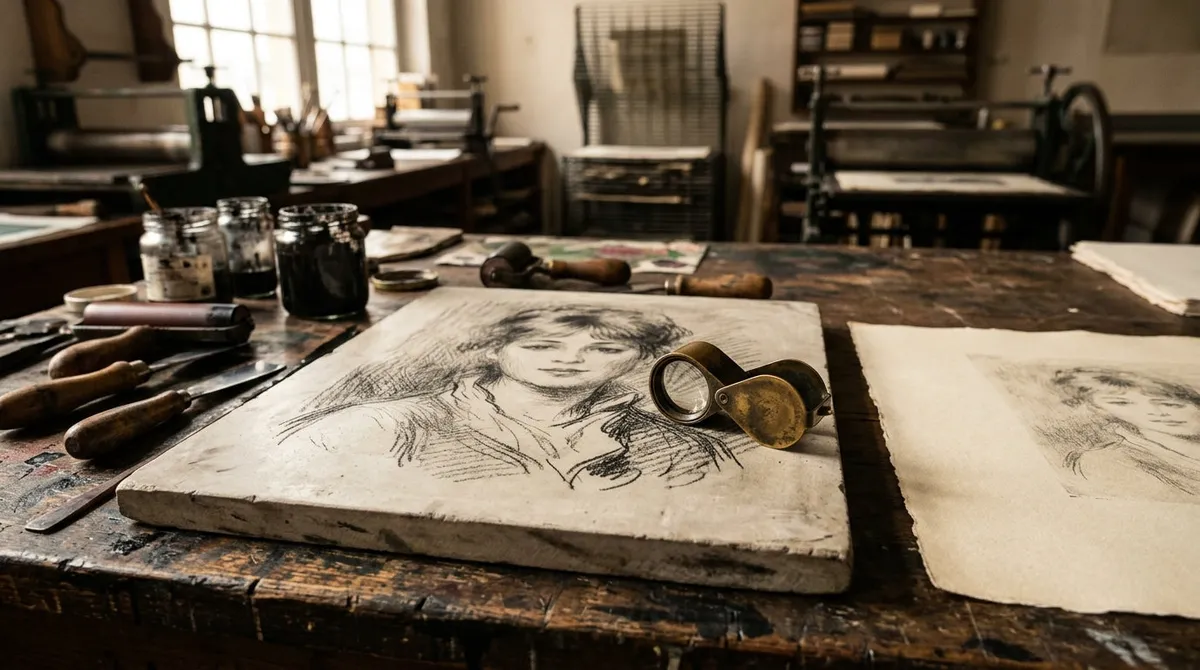
Private collectors do not surrender family heirlooms to university archives unless hope has run out. In 2023, an elderly German owner handed an unframed sheet over to Heidelberg University’s study collection of counterfeits, resigned to the belief that its quiet portrait was an amateur forgery. For fifty years, commercial appraisers had dismissed the piece as a clumsy pencil sketch imitating Pierre-Auguste Renoir. Forensic examination under a student microscope just flipped the script.
In November 2026, art historian Henry Keazor and researchers at the Heidelberg University Institute for European Art History announced that the disputed portrait is an authentic, uncatalogued Renoir lithograph. Pulled in Paris in 1899 and hand-signed by the Impressionist master in black grease crayon, the work was never a drawing at all. As reported in the ARTnews reattribution coverage, the rediscovery rescues a masterwork from a half-century in the shadows.
Titled Jeune femme en buste, the portrait captures Parisian actress Amélie Diéterle in three-quarter profile. Its journey from a private estate to a cabinet of student curiosities exposes how easily standard market connoisseurship falters when visual appraisal substitutes for physical material science.
How does an authentic masterwork end up in a cabinet of fakes?
The provenance trail began in the 1970s when the German collector acquired the unframed print from the estate of a deceased gallery owner. The family treasured the portrait for decades, convinced that its fluid contours reflected Renoir's genuine hand. Seeking formal verification, they eventually brought the sheet to an established commercial gallery in New York.
Appraisers in Manhattan dismissed the work out of hand. They classified the portrait as a modern imitation, telling the family that an unknown copyist had drawn a weak pencil sketch to cash in on the Impressionist market. Unable to insure or sell the piece, the frustrated owner kept it tucked away in a drawer.
That exile ended in 2023 during an estate dissolution. The owner decided to donate the condemned sheet to the Heidelberger Fälschungs-Studiensammlung (HeFäStuS), founded in 2021 by Henry Keazor at Heidelberg University. Keazor established the teaching archive specifically to train art history students in spotting forged signatures, fraudulent provenance papers, and deceptive surface distressing. The donor expected the Renoir to sit in a flat file as a textbook warning against wishful thinking.
Who was the woman in the portrait, and why did Renoir draw her?
The sitter was Amélie Diéterle (1871-1941), a prominent soprano and comedic actress at the Théâtre des Variétés on Boulevard Montmartre. Diéterle stood at the center of Parisian cultural life during the Belle Époque, celebrated as much for her expressive stage presence as for her personal art collection. Renoir frequently attended her performances and became captivated by her delicate profile.
By 1899, rheumatoid arthritis was stiffening Renoir's fingers, turning extended easel sessions into physical torment. Graphic media offered an essential creative outlet: lithographic crayons allowed him to work quickly without gripping heavy brushes or waiting for oil glazes to dry. In Diéterle's portrait, he captured her soft jawline and swept-back hair through rapid, feathered contour lines that relied on paper contrast rather than heavy shading.
The resulting profile study captured an immediacy that Renoir's formal salon portraits rarely pursued. Stripped of costume flourishes, the composition functioned as a pure celebration of linear grace, setting the stage for his involvement in one of the decade's most ambitious publishing projects.
How did a microscope expose a New York gallery’s fifty-year blunder?
When Keazor unpacked the donation in his Heidelberg seminar room, the drawing did not look like graphite. Together with his graduate students, he placed the sheet under high-magnification stereomicroscopes and adjusted raking light across the paper fibers. The physical evidence overturned the Manhattan appraisal within minutes.
Pencil graphite and charcoal leave jagged crystalline fragments that sit perched on paper ridges, indenting the surface under the mechanical pressure of the artist's hand. This portrait showed perfectly flat, continuous black ink that saturated the cellulose fibers uniformly without compressing the sheet. The lines had not been drawn onto the paper; they had been pressed into it on a printing press.
Magnification revealed the distinctive porous reticulation created when greasy tusche releases from Bavarian limestone, the standard planar matrix of nineteenth-century lithography. As documented by Monopol Magazin's investigation and the Informationsdienst Wissenschaft announcement, the New York gallery had committed an elementary blunder: mistaking planar ink absorption for clumsy pencil shading.
What was the Germinal portfolio, and why was this sheet missing half its ink?
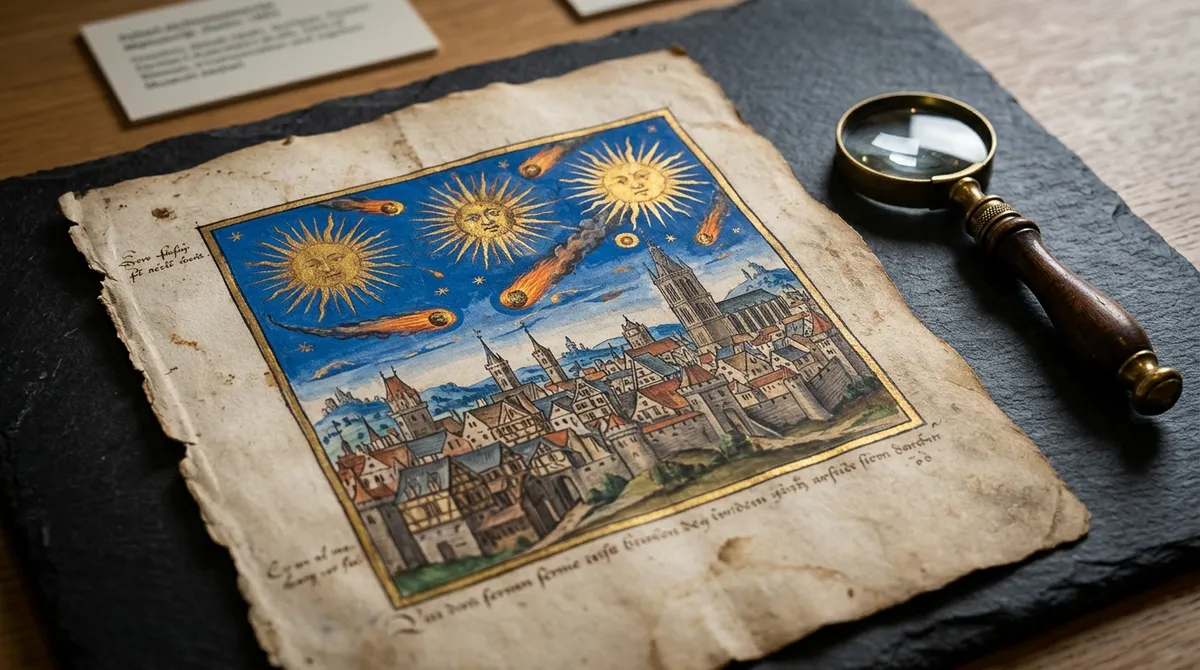
Recognizing the sheet as a lithograph connected the work directly to late nineteenth-century publishing records. The motif matched Renoir's contribution to Germinal, an 1899 portfolio of twenty original prints commissioned by the German critic and gallerist Julius Meier-Graefe through his Parisian firm, Éditions de La Maison Moderne.
Meier-Graefe championed printmaking as an autonomous fine art, enlisting painters like Pierre Bonnard, Édouard Vuillard, and Edgar Degas to produce original graphic work. For the published edition of one hundred numbered portfolios, master printers produced Renoir's Diéterle portrait using two separate limestone slabs.
The primary stone carried the black structural drawing of Diéterle's face and hair. A second tone stone laid down an ochre tint wash across the background and printed Renoir's stone signature in the lower margin. The Heidelberg sheet contained only the black structural pass; the second tone stone had never been run across the paper.
Why does black grease chalk make this Renoir lithograph rarer than the finished edition?
Because the second tone stone never touched the paper, the standard printed signature was absent. Instead, Keazor and his students discovered an original inscription in the lower margin executed in deep, matte black material. Laboratory testing confirmed the signature was applied by hand with a stick of black grease chalk (lithographic crayon).
In late nineteenth-century print shops, printers pulled preliminary trial impressions (known as Probedrucke or épreuves d'essai) from the first stone so the artist could inspect ink density, line clarity, and paper bite before committing to multi-stone runs. Renoir reviewed this solitary trial pull in the Parisian workshop, picked up the grease chalk from his worktable, and signed the margin by hand to certify his approval.
While commercial collectors frequently compete for numbered impressions from the final published edition of one hundred, a working printer's trial bearing the artist's spontaneous hand signature represents a unique historical moment: a solitary sheet held, inspected, and validated by Pierre-Auguste Renoir inside the bustling printshop before the second stone ever met the paper. That autographed grease mark turned an incomplete workshop proof into an exceedingly rare original.
What happens next to a "forgery" that turns out to be priceless?
The reattribution removes the sheet from the HeFäStuS counterfeit drawers for good. From November 26, 2026, to March 21, 2027, the print will be unveiled to the public in a dedicated exhibition titled Rätsel um Renoir at the Kurpfälzisches Museum Heidelberg. Curators will display the authenticated trial proof directly beside an actual Renoir forgery from the university's collection, offering visitors a rare side-by-side study in the material difference between fraudulent imitation and authentic masterly line.
The rediscovery highlights the enduring appeal of nineteenth-century graphic techniques, where the direct pressure of ink on paper captured an immediacy that oil paint often obscured. For modern collectors exploring Impressionist wall art, that tactile history remains central to the medium's appeal: the grain of Bavarian stone and the raw gesture of the artist's hand survive long after the original debates fade.
At Heidelberg, a sheet once written off as worthless now serves as a reminder of what careful scholarship can accomplish: a piece condemned by market consensus has reclaimed its rightful name through the simple discipline of looking through a lens.